

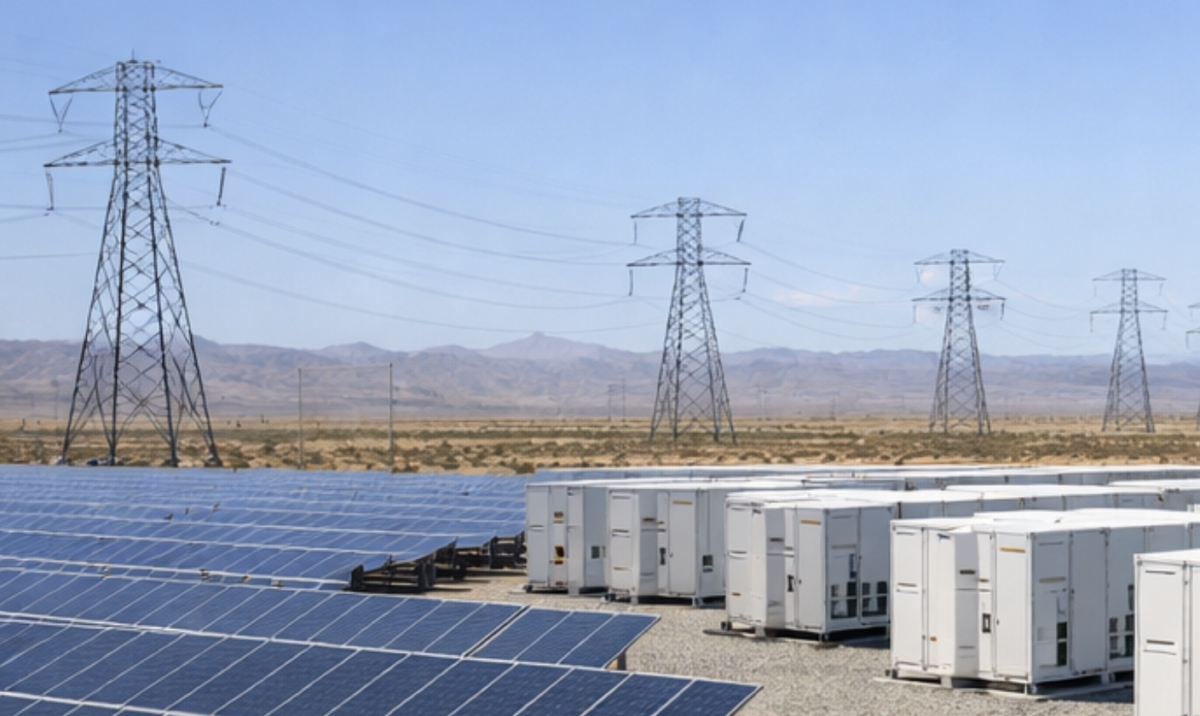
A new report from the International Renewable Energy Agency (IRENA) shows that 24-hour solar and wind energy, combined with battery storage, provide power at a lower cost than new fossil fuel generation in regions with high-quality resources.
Firmly leveled electricity costs for solar plus storage range from $54/MWh to $82/MWh in high irradiation areas, IRENA says in its new report: “24/7 renewable energy sources: the economics of solar and wind energy.” That compares to $70/MWh to $85/MWh for new coal in China and more than $100/MWh for new gas globally.
Since 2010, total installed costs have fallen by 87% for solar and 55% for onshore wind, while battery storage costs have fallen by 93%. IRENA’s analysis shows that fixed costs for solar plus storage have fallen from more than $100/MWh in 2020 to $54/MWh to $82/MWh in 2025 at high-quality locations. The agency expects further reductions of roughly 30% by 2030 and about 40% by 2035, bringing operating costs at the best-performing sites below $50/MWh.
Fixed costs for wind-plus-storage in 2025 ranged from about $59/MWh in Inner Mongolia to $88/MWh to $94/MWh in Brazil, Germany and Australia, with costs expected to fall to about $49/MWh to $75/MWh in those markets by 2030. IRENA says costs will fall further when wind energy is combined with solar, reducing storage requirements and overall system costs decrease.
The Al Dhafra complex in the United Arab Emirates, which combines PV with battery storage, delivers a solid 1 GW of clean electricity for around $70/MWh, according to IRENA.
“24/7 renewable energy is now cost-competitive with fossil fuels,” says IRENA Director General Francesco La Camera. “The long-standing argument that renewables are not reliable no longer holds true. Today, renewables can provide reliable, 24-hour power. As oil and gas markets remain exposed to geopolitical shocks, including ongoing disruptions in the Strait of Hormuz, we must insulate our economies with resilient renewable systems. The economics of the entire energy system have changed: the battery revolution has driven down costs while accelerating advances in storage. The benefit of renewables is not only economic but also strategic, strengthening resilience, stability and energy in times of crisis.”
IRENA said 24/7 renewable systems optimize the use of limited grid connections, shift electricity production to higher value hours and reduce exposure to price volatility. The company says hybrid solutions are well positioned to serve high-demand users, including artificial intelligence and data centers that require uninterrupted supply, and that robust renewables can enable clean fuel production for hard-to-reduce sectors where economic viability depends on high utilization rates.
Construction timelines are also shortening, with projects typically built within one to two years of obtaining permits and connecting to the grid. The report provides a framework for evaluating and comparing the costs of 24-hour renewable energy in hybrid solar, wind and storage systems, analyzing cost drivers and regional differences.
The IRENA report enters a period of historically low solar and storage costs, even as the pace of decline has slowed in many markets. IRENA’s own data sets the the global average solar-levelled electricity costs at $0.043/kWh by 2024, while a separate analysis shows that falling capital costs for batteries have already resulted in dispatchable “anytime” solar energy electricity is commercially viable in regions with high PV potential.
This content is copyrighted and may not be reused. If you would like to collaborate with us and reuse some of our content, please contact: editors@pv-magazine.com.
