

Research from Poland shows that the development of the country’s solar industry is likely to result in stable economic stimulation over the next fifteen years, supporting between 20,000 and 40,000 direct full-time contracts until 2040, depending on the level of investment, operation and maintenance of the PV installations.
The development of PolandAccording to new research, the solar energy market will help maintain consistent employment levels in the country over the next fifteen years.
A research team from the AGH University of Krakow used data from the Central Statistical Office of Poland and the Energy Transition Observatory to analyze the development of the Polish PV industry between 2026 and 2040. The findings are available in the research paper On the economic and environmental consequences of expanding the deployment of PV systems in Polandavailable in the magazine Scientific reports.
Corresponding author Łukasz Lach related pv magazine that the article is the first attempt to quantitatively assess the size and development potential of the photovoltaic market in Poland under different installation capacities and market scenarios.
“Poland’s official strategic plans in the energy sector, including the National Energy and Climate Plan (NECP), lack data on the socio-economic impacts of new energy-related investments. In the absence of such national indicators, some measures from studies on other countries in the NECP are used as a starting point for discussion on the socio-economic impacts of the energy transition in Poland,” Lach said. “However, it is clear that relying on estimates based on foreign economies is more like guessing than conducting meaningful analysis, and leads to a situation where it is virtually impossible to paint a complete picture of the energy transition in Poland based on the country’s official NEKP. The aim of the article is to present a general method to solve this problem.”
The research paper discusses three possible market scenarios for the next fifteen years. The first, a base case, assumes further development of the Polish solar industry based on currently existing legal and market conditions. A second scenario, called PEP2040, is based on the legal and market conditions outlined in Poland’s energy policy until 2040, while a third, called the Optimal Scenario for Industry (OPT), assumes that further development will take place at a pace optimally aligned with the strategic considerations and growth of solar industry actors.
The findings in the paper show that the total number of jobs will remain stable, but at different levels depending on the scenario. “It could increase to around 20,000 for the base variant, to around 25,000 for PEP2040, and to between 35,000 and 40,000 for the OPT scenario,” the research report said. “This justifies pursuing the OPT scenario for the sector.”
Image: Lach et al
Lach explained that there will likely be more jobs related to prosumer installations in the early years of this period, but that the importance of large installations will increase over time. “At the same time, the number of permanent jobs related to the maintenance of deployed infrastructure will increase, which will offset the likely decline in construction-related jobs,” he said.
The research paper adds that employment projects often include jobs related to induced impacts, but this analysis does not include them because such impacts were not directly traceable given the current state of economic data on Poland. “It is worth noting that the literature estimates that the number of jobs created could account for 33% to even 100% of the jobs associated with direct and indirect impacts,” Lach explains. “In other words, induced impacts associated with PV infrastructure development can contribute significantly to the direct impacts discussed above.”
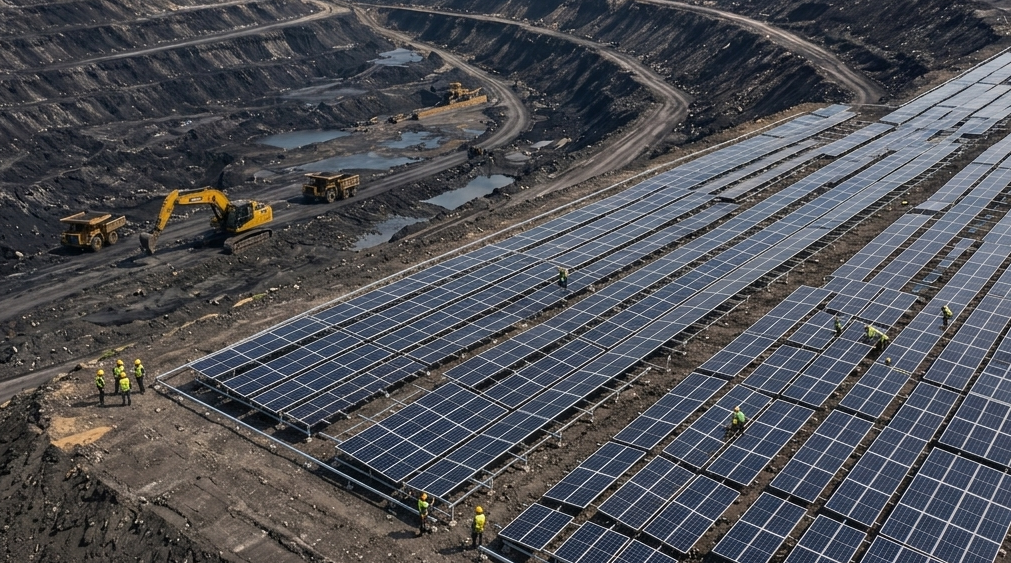
Lach also noted that despite the ongoing energy transition in Poland, the number of coal-related jobs remains high, as coal remains the largest source of electricity in the country. “The development of the PV industry in Poland offers clear opportunities for laid-off coal workers,” he added.
At the request of pv magazine Assessing the prospects for solar energy in Poland, Lach said the long-term potential remains high due to high energy prices, robust industrial demand for power purchase agreements and the need to reduce dependence on coal.
But he warned that significant action is needed to address key barriers such as rebates, negative prices and insufficient returns on investment, adding that the most pressing challenge is the overloaded electricity grid, which is causing delays and denials for new project connections.
“Significant investments in transmission and distribution infrastructure will also be essential to support the further integration of renewable energy,” Lach explains. “Simply installing additional solar panels will no longer be enough; instead, the market must shift to an integrated model that combines solar energy generation with energy storage, flexibility solutions and efficient local consumption to relieve pressure on the electricity grid.”
Poland’s cumulative solar capacity has been reached 24.8 GW late last year, after the country added about 3.6 GW by 2025.
This content is copyrighted and may not be reused. If you would like to collaborate with us and reuse some of our content, please contact: editors@pv-magazine.com.
Popular content

