

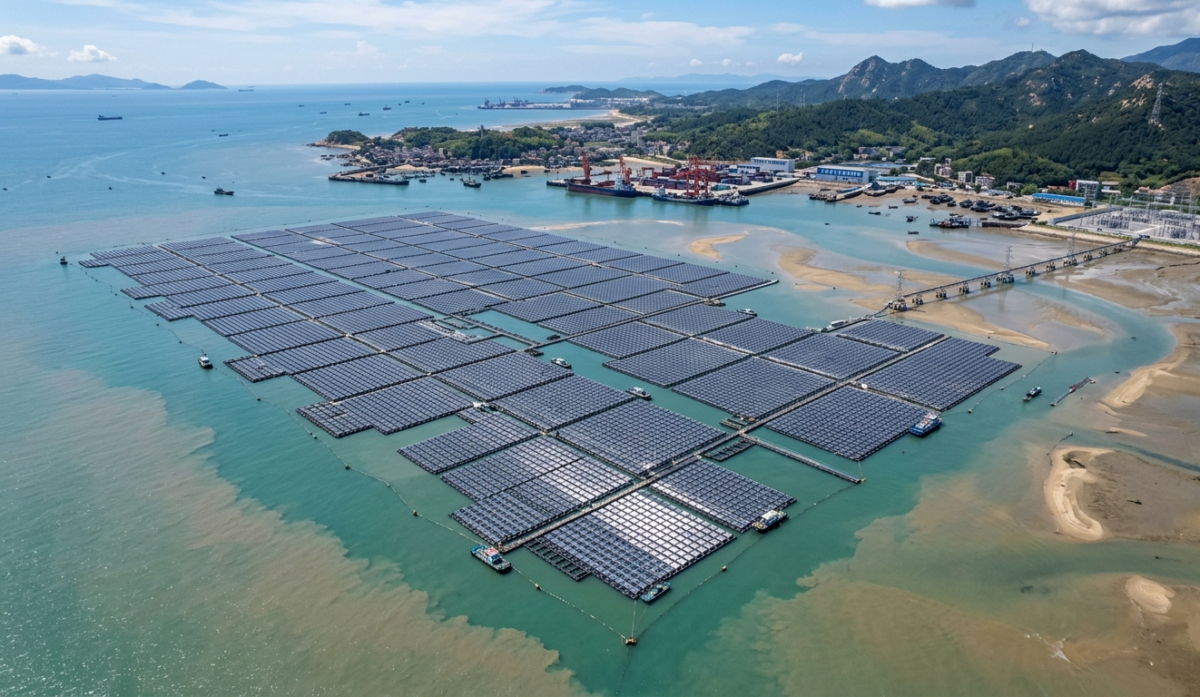
Taiwanese researchers compared a 100 MW solar power plant with a 181 MW floating PV system at sea and found that the offshore setup produced about 12% more electricity over its lifetime. They attribute the gains to cooling and intertidal effects, suggesting that floating solar at sea is technically feasible, although it is currently around 30% more expensive and still faces sustainability and hydraulic engineering challenges.
Researchers from Taiwan National Taipei Technical University have conducted a techno-economic analysis comparing large-scale floating offshore PV installations with conventional ground-mounted solar facilities and found that offshore installations can achieve 12% higher power generation than land-based counterparts.
The scientists compared a 100 MW ground-mounted facility in Taiwan’s Changbin Industrial Park with a 181 MW offshore floating PV project, using the larger offshore capacity to normalize performance comparisons between systems of different configurations. “This normalization approach enabled direct comparison of performance data – including energy yield, efficiency and environmental impacts – under equivalent system capabilities, while eliminating biases related to differences in project size,” says lead author Ching-Feng Chen told pv magazine.
In his opinion the 12% higher energy production achieved by offshore photovoltaic solar energy does provide a meaningful basis for economic viability. “This is particularly relevant as PV modules represent a large proportion of system costs, while their operational life is typically around 25 years. Therefore, even a modest increase in energy yield can significantly improve the overall long-term return on investment,” he added. “With us However, I did not conduct a levelized cost of electricity (LCOE) analysis during this study. The primary focus of the article was on energy payback period (EPBT) and return on investment (EROI).
Based on preliminary discussions with industry stakeholders, the scientists estimate that the installation costs of floating offshore systems are currently estimated to be approximately 30% higher per kW than that of ground-mounted solar power plants. “This is especially true for the 181 MW offshore project discussed in the article, which is located in an intertidal zone,” Chen added. “In these types of projects, the floating structures are assembled close to shore and then towed in batches by ships to the offshore location. Some of these installation and marine logistics costs may be comparable to the foundation and civil engineering costs associated with land-based PV systems.”
“At the same time, however, offshore systems require corrosion-resistant structures, including high-density polyethylene (HDPE) floating platforms and anti-corrosion mounting components for PV modules, which are indeed relatively expensive and deserve further research,” Chen added.
In terms of technical feasibility, the researchers believe that offshore PV is currently technically feasible if an appropriate technical solution is adopted, especially with regard to the system layout, design of the mooring systems, structural strengthening and environmental adaptation.
“Based on the commercial operation status of the 181 MW project in Taiwan discussed in this article, the concept has already demonstrated practical feasibility at the utility scale,” they stated. “Certainly, installing offshore systems in the Taiwan Strait poses significant challenges, including heavy mechanical loads, strong seasonal winds, saltwater corrosion, wave loads and extreme weather events such as typhoons. However, these challenges are not insurmountable. With appropriate engineering design, optimized layout configurations, robust floating structures and long-term sustainability considerations, offshore PV is suitable for coastal environments.”
In the study “Using an integrated approach for a comparative analysis of the carbon footprint in onshore and offshore photovoltaic systems”, published in the Journal for Renewable and Sustainable Energythe research team explained that its analysis relied on the use of life cycle energy assessment based on the Product Carbon Footprint – Product Category Rules (CFP-PCR) framework, that is a standardized, international system used to calculate and communicate the greenhouse gas (GHG) emissions of a specific product over its life cycle.
To ensure consistency, both systems were evaluated against the same assumptions, including module type, 25-year service life, degradation rate, and normalized capacity. The offshore system was found to generate approximately 2,047 GWh over its lifetime, compared to 1,828 GWh for the onshore installation, representing a 12% increase in production. It was estimated that the offshore project would also avoid 1.013 million tons of CO2 emissions, compared to 0.905 million tons for the ground-mounted plant.
The researchers attributed the higher performance to intertidal environmental conditions, including cooling effects and periodic exposure to water. “From a broader perspective, our work shows that floating marine solar power is not just a technical alternative, but a strategic solution for other countries with limited land resources that can help expand their renewable energy capacity while meeting environmental and land use constraints,” Chen said.
This content is copyrighted and may not be reused. If you would like to collaborate with us and reuse some of our content, please contact: editors@pv-magazine.com.
