

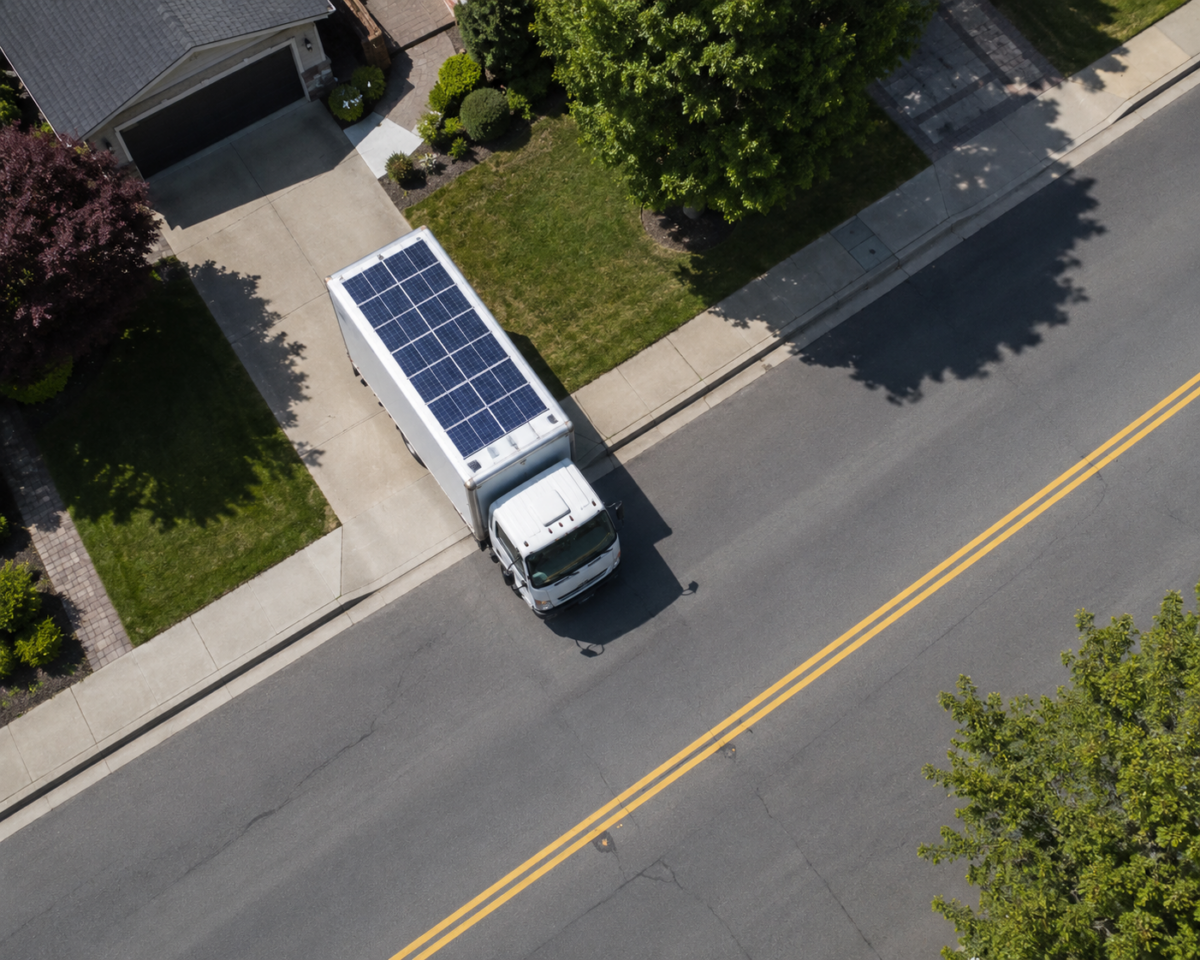
Japanese researchers conducted a large-scale field study on 200 commercial trucks to evaluate the performance and fuel-saving potential of vehicle-integrated solar photovoltaics (VIPV) in practice. Their results show that VIPV systems can reduce alternator load and fuel consumption by approximately 5.5-7%, with approximately 70% of horizontal solar radiation effectively reaching the vehicle surface and approximately 85% of PV output directly offsetting alternator demand under real operating conditions.
Researchers from Miyazaki University have investigated the real-world performance and fuel-saving potential of vehicle-integrated solar photovoltaics (VIPV) on heavy-duty vehicles through an extensive field study in Japan, finding that shading is a crucial factor affecting photovoltaic energy generation and overall system efficiency.
The project involved 200 diesel commercial trucks equipped with 300–500 W copper, indium, gallium and selenide (CIGS) PV modules, collecting data on photovoltaic power generation, alternator performance, battery power flow and vehicle operation. The solar panels are only used to power auxiliary systems and charge the main battery, not to directly propel the vehicle.
“We assessed how effectively PV power was used by simultaneously monitoring the output of both the PV system and the alternator,” said the corresponding author Kenji Araki told pv magazine. “This allowed us to determine to what extent solar energy reduced the load on the alternator.”
The scientists explained that the probability of shading in VIPV is influenced by object geometry and sweep angles, and can be statistically approximated using aperture matrix averaging, a computational technique used to evaluate dynamic, non-uniform shading and solar radiation on curved or complex PV systems by integrating directional light contributions over discretized surface elements within a local coordinate framework. According to the researchers, it enables consistent and practical calculation of solar radiation on vehicle surfaces.
The research team monitored the energy flow between the photovoltaic system and the alternator in truck-based VIPV setups, focusing on energy consumption within isolated vehicle systems rather than the efficiency of PV modules. Pyranometers were not used due to installation limitations, and PV output was assumed to correspond to local solar radiation.
Customized control boxes with charge controllers and data loggers were developed, using current sensors to monitor PV yield, vehicle energy generation and battery charge-discharge behavior. The system was reinforced with stable wiring and fuses and was subjected to vibration and weather resistance tests to ensure reliability under real operating conditions.
The PV system was treated as a complete module with integrated charge controller functions including MPPT, DC-DC conversion and backflow prevention, rather than just a solar panel. The alternator similarly includes rectification and voltage regulation via DC-DC conversion, and operates independently without synchronization with the PV system, prioritizing the higher voltage source.
Over 17,901 vehicle days, the academics recorded total driving distance, operating hours, energy consumption, PV generation and alternator suppression, while noting data synchronization limits in the measurement system. The PV systems were found to provide measurable energy offsets during operation, in addition to a significant reduction in alternator load under real driving conditions.
Overall, the results showed measurable fuel and energy benefits, but also highlighted the need to evaluate VIPV performance using detailed, state-dependent models rather than simple averages.
“In addition, the evaluation of the measured data set showed that the solar radiation received by vehicle-mounted surfaces corresponds to approximately 70% of that on a horizontal plane,” Araki said. “This reduction is attributed to factors such as ambient shade, road conditions and changes in vehicle orientation, and serves as an important parameter for estimating the annual energy yield of VIPV systems.”
Furthermore, simultaneous PV and alternator measurements revealed that approximately 85% of the PV output directly offsets the alternator load, improving energy consumption under real driving conditions. A fuel consumption reduction of approximately 5.5 to 7%, meanwhile, has been confirmed through multiple validation methods, although the benefits vary by vehicle type and driving behavior.
Their findings are available in the study “PV on heavy duty vehicles (HDVs): monitoring 200 trucks with PVs”, published in Energy conversion and management: X.
“The findings of this study will provide an essential basis for the international standardization of VIPV (IEC PT600) and will facilitate the development of subsequent energy assessment methodologies. Furthermore, providing a practical tool that allows logistics operators to easily assess the impact of energy generation reduction and fuel efficiency using their own operational data will promote the widespread adoption of VIPV,” the researchers concluded.
Last year, another research group at Miyazaki University unveiled a non-destructive method to investigate solar cell vibrations independently of module components. The study included potential design features for resonance-resistant, vehicle-integrated PV modules that would increase the natural resonant frequency above 2,000 Hz.
This content is copyrighted and may not be reused. If you would like to collaborate with us and reuse some of our content, please contact: editors@pv-magazine.com.
