

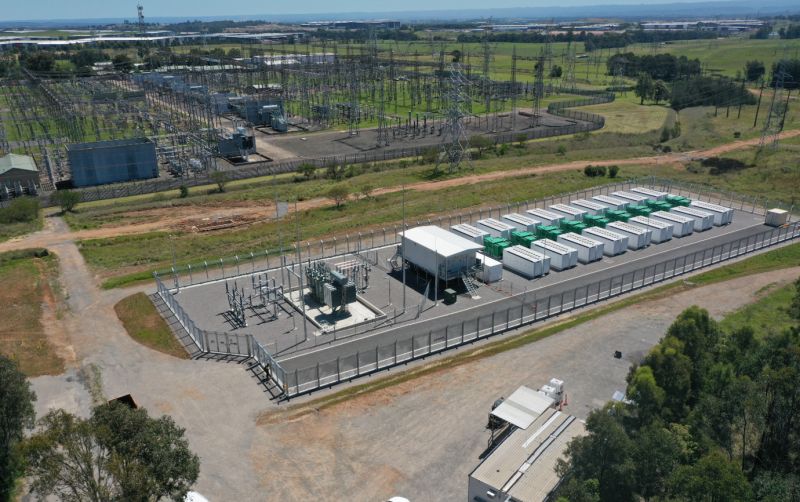
Transgrid, the New South Wales (NSW) transmission network operator, plans to add more grid-forming batteries to its portfolio to provide vital system strength services to the state’s electricity grid as aging coal-fired power stations continue to leave the transmission network.
Transgrid, as system strength service provider for NSW, had previously called for contracting of up to 5 GW of grid-forming batteriesalong with ten synchronous condensers, to replicate the critical system services traditionally provided by coal, gas and hydropower, but the grid operator said it has now reassessed its plan.
In the revised portfolio, Transgrid reaffirms the need for synchronous condensers, but reduces the number from 10 to eight and allows for a greater role for grid-forming batteries.
Transgrid Executive General Manager of Network Jason Krstanoski said the shift in technologies is in response to “rapidly changing market conditions”, including the rising costs and delayed availability of synchronous condensers, and updates to expected timelines for NSW coal retirement.
“The energy system is becoming increasingly complex at an accelerating pace, with changing demand patterns, evolving technologies and multiple possible future pathways,” he said.
“In this environment, maintaining flexibility in how system strength is delivered is critical to ensuring the lowest costs for consumers.”
Transgrid’s original plan relied heavily on batteries, but only for a grid stabilizing role to allow new solar and wind generators to connect and operate safely, known as the ‘efficient’ level of system strength.
The grid operator said it is now looking at using grid-forming batteries to also help meet the ‘minimum’ level of system strength required to keep the energy system safe, with coal retirement delays providing additional time to prove the technology’s capabilities.
“We are creating a path for grid-forming batteries to become part of the minimum level portfolio in a measured way, with their role dependent on the confirmation of their technical credibility, which we hope to see in the coming years,” Krstanoski said.
“This includes confirming that battery systems can reliably deliver the required system strength characteristics and performance required for the safe operation of security systems, before we rely on them to deliver this in practice.”
Transgrid’s update calls for 900MW of grid-forming batteries, ideally located in the Sydney West region, by the early 2030s to provide ‘minimum’ level system strength. This would be in addition to the 5 GW of capacity identified in the initial portfolio.
The network administrator has already done that has shortlisted nine battery projects with a combined capacity of 2 GW to meet system strength needs as they arise.
Krstanoski said the updated portfolio also includes fallback options such as hydro and gas support, ensuring that minimum system strength levels can still be provided if battery capacity is delayed or insufficiently supplied.
“By combining proven infrastructure with emerging technologies, we maintain system security while increasing flexibility and reducing costs for consumers,” he said.
