

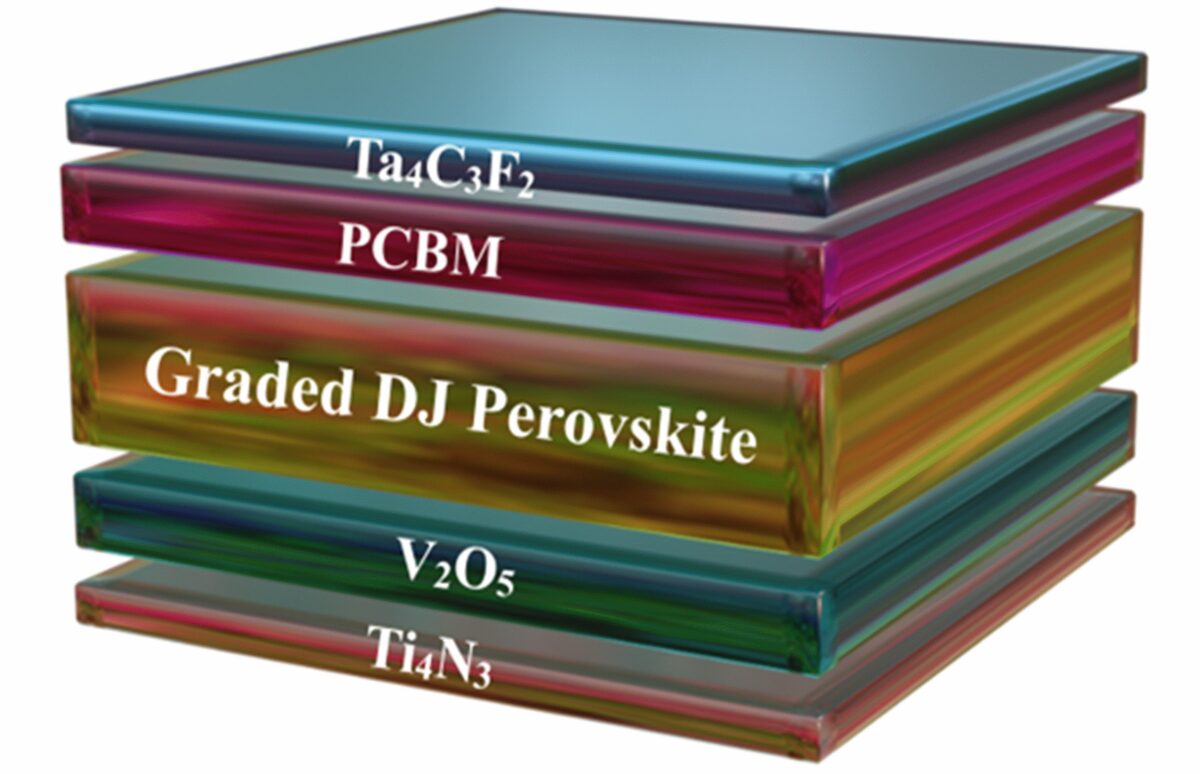
Scientists in India have combined 2D perovskite solar cell technology with MXenes materials to build a PV device with remarkable efficiency and open-circuit voltage. They argue that the new cell architecture is the key to allowing charge carriers to move smoothly through the cell layers and reduce recombination losses.
Two-dimensional (2D) Dion-Jacobson (DJ) phase perovskites have attracted interest in the scientific community due to their stability against harsh environmental conditions and their competitive performance in optoelectronic applications. However, solar cells based on DJ perovskites have shown relatively poor performance compared to their 3D counterparts.
Researchers from Chitkara University in India recently developed a two-dimensional perovskite solar cell by implementing bandgap grading techniques and using contacts based on a functionalized two-dimensional titanium carbide, known as MXeen.
MXenes compounds take their name from their graphene-like morphology and are made via selective etching of certain atomic layers from a bulk crystal known as MAX. Recently, MXenes materials have shown promise for use in PV technology due to their unique optoelectronic properties, such as their high charge carrier mobility, excellent metal conductivity, high optical transmission, and tunable work function (WF).
“In our work, we have conducted an extensive theoretical investigation using MXene contacts in combination with the 2D DJ perovskite (DJ-P), merging the unique properties of both materials,” said the corresponding author of the research, Rahul Pandey. pv magazine. “A key innovation of this research lies in the manipulation of the bandgap of the DJ-P layer through compositional adjustments.
The scientists explained that the selection of an appropriate electron transport layer (ETL) and hole transport layer (HTL) is key to achieving a compatible energy level tuning with the DJ perovskite layer and helping charge carriers to move smoothly through the layers and reduce recombination losses.
By using bandgap grading to make the perovskite material more efficient at absorbing a wider range of wavelengths and using MXenes to improve cell stability.
The academics built the cell with an ETL made from phenyl-C61-butyric acid methyl ester (PCBM) and an HTL dependent on vanadium(V) oxide (V2O5). They then used two MXene materials, known as Ta4c3F2 and T14N3 for the cell contacts and found that the optimal thickness of the perovskite absorber was 800 nm.
“We also varied the number of inorganic layers within the (PeDA)(MA).n-1PbNI3n+1 perovskite structure,” Pandey further explained. “We then used linear, parabolic, beta and power law gradation profiles to optimize the composition of the DJ perovskite layer.”
Popular content
Tested under standard lighting conditions, the device achieved an energy conversion efficiency of 17.47%, an open-circuit voltage of 1.05 V and a short-circuit current density of 19.6 mA cm.−2and a fill factor of 84.25%. “The results demonstrate the potential of this new approach to revolutionize 2D perovskite solar cell technology,” Pandey added, noting that the highest efficiency was obtained with the power law profile.
The tests also showed that the linear profile achieved an efficiency of 16.62%, while the parabolic profile and beta profile achieved 16.62% and 17.30% respectively.
The new cell concept was described in the study “Tailored sorting profiles for improved performance in Dion-Jacobson perovskite solar cells with MXene contacts”, which was recently published in Physics B: condensed matter. Looking ahead, the academics said they want to analyze the potential applications for these diverse rating profiles in 2D DJ perovskite-based technologies.
This content is copyrighted and may not be reused. If you would like to collaborate with us and reuse some of our content, please contact: editors@pv-magazine.com.
