

Entropy increases efficiency in promising new solar material
Solar energy is crucial for a sustainable future. Silicon, commonly used in solar panels and electronic devices, has limitations such as high cost and difficulty mounting on curved surfaces.
Researchers are exploring alternative materials to address these issues. One promising option is “organic” carbon-based semiconductors, which are abundant, cost-effective and environmentally friendly.
“They can potentially reduce production costs for solar panels because these materials can be coated onto arbitrary surfaces using solution-oriented methods – just like we paint a wall,” says Wai-Lun Chan, associate professor of physics and astronomy at the university. of Kansas. “These organic materials can be tuned to absorb light at selected wavelengths, which can be used to create transparent solar panels or panels of different colors. These characteristics make organic solar panels particularly suitable for use in next-generation green and sustainable buildings.”
Although organic semiconductors are already used in display panels for electronics such as mobile phones and TVs, they are not yet widely used in commercial solar panels due to their lower efficiency, around 12% compared to 25% for silicon cells.
Chan explained that electrons in organic semiconductors typically bind to positive counterparts called “holes,” creating electrically neutral quasiparticles known as “excitons” when light is absorbed.
However, a new class of organic semiconductors called non-fullerene acceptors (NFAs) has changed this. Organic solar cells with NFAs can achieve an efficiency of almost 20%.
Despite this progress, the reason for the NFAs’ superior performance remained unclear. In a study published in Advanced Materials, Chan and his team, including graduate students Kushal Rijal (lead author), Neno Fuller and Fatimah Rudayni, along with chemistry professor Cindy Berrie, identified a microscopic mechanism that contributes to the high efficiency of NFAs.
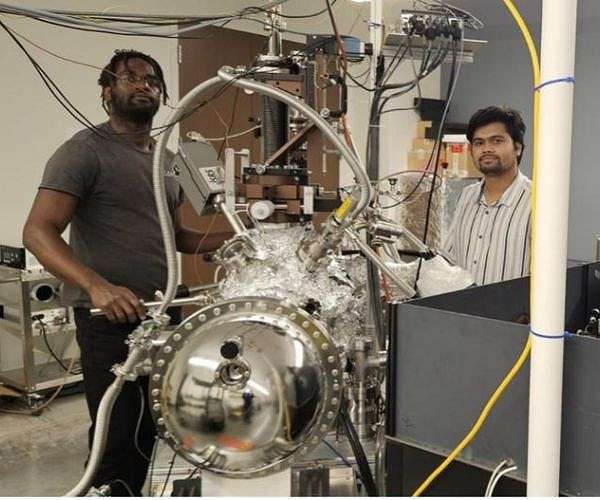
Lead author Rijal used an experimental technique called “time-resolved two photon photoemission spectroscopy” (TR-TPPE) to measure the energy of excited electrons with sub-picosecond resolution (less than a trillionth of a second).
“On these readings, Kushal [Rijal] observed that some of the optically excited electrons in the NFA can gain energy from the environment instead of losing energy to the environment,” Chan said. This observation is counterintuitive because excited electrons typically lose their energy to the environment like a cup of hot coffee loses its heat to the environment.”
Supported by the Department of Energy’s Office of Basic Energy Sciences, the team believes this process occurs due to the quantum behavior of electrons, which allows an excited electron to exist on multiple molecules simultaneously. This phenomenon, coupled with the Second Law of Thermodynamics, which dictates that physical processes increase total entropy, leads to the observed energy gain.
“In most cases, a hot object transfers heat to its cold surroundings because the heat transfer leads to an increase in total entropy,” Rijal said. “But we found that for organic molecules arranged in a specific nanoscale structure, the typical direction of heat flow is reversed, so that the total entropy increases. This reverse heat flow allows neutral excitons to take heat from the environment and dissociate into a pair of positive and negative charges. These free charges can in turn produce electric current.”
The team suggests that this entropy-driven charge separation mechanism is key to the improved efficiency of NFA-based organic solar cells.
“Understanding the underlying charge separation mechanism will allow researchers to design new nanostructures to take advantage of entropy to flow heat or energy at the nanoscale,” Rijal said. “Despite entropy being a well-known concept in physics and chemistry, it is rarely actively used to improve the performance of energy conversion devices.”
Additionally, the KU team believes their findings could help design more efficient photocatalysts for solar fuel production, which convert carbon dioxide into organic fuels using sunlight.
Research report:Endothermic charge separation occurs spontaneously in non-fullerene acceptor/polymer bulk heterojunction
