
Close Menu
  • News
  • Industry
  • Solar Panels
  • Commercial
  • Residential
  • Finance
  • Technology
  • Carbon Credit
  • More
    • Policy
    • Energy Storage
    • Utility
    • Cummunity
What's Hot

A deep learning model tracks the status of the EV battery with high precision

March 6, 2026

Mitsubishi Electric Trane announces new heat pump line for hydronic heating – SPE

March 6, 2026

Origis is developing a 413 MW solar portfolio in West Texas

March 6, 2026
Facebook X (Twitter) Instagram
Solar Energy News
Friday, March 6
  • News
  • Industry
  • Solar Panels
  • Commercial
  • Residential
  • Finance
  • Technology
  • Carbon Credit
  • More
    • Policy
    • Energy Storage
    • Utility
    • Cummunity
Solar Energy News
Home - Technology - New model to identify the optimal power size ratio for solar inverters – SPE
Technology

New model to identify the optimal power size ratio for solar inverters – SPE

solarenergyBy solarenergyJuly 24, 2024No Comments3 Mins Read
Facebook Twitter Pinterest LinkedIn Tumblr Email
Share
Facebook Twitter LinkedIn Pinterest Email

Researchers in Malaysia have proposed a new approach to identify the optimal power size ratio to balance PV energy capture with inverter cost. The calibrated model is said to accurately reflect the relationship between inverter efficiency and real-world system behavior.

July 24, 2024 Emiliano Bellini

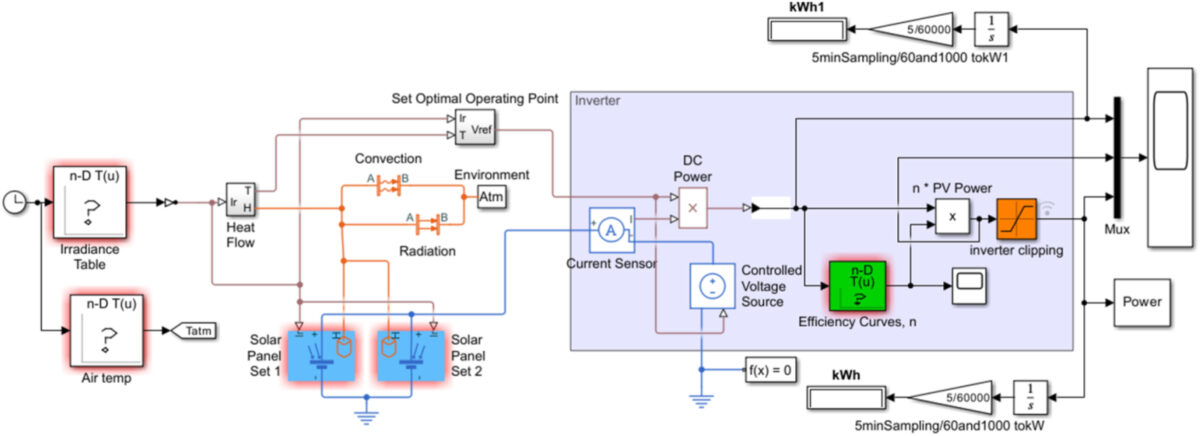
Researchers from Universiti Teknikal Malaysia Melaka have outlined a techno-economic optimization approach to define the appropriate power sizing ratio (PSR) for inverters used in grid-connected PV systems.

The PSR is the ratio between the rated power of the inverter and the total rated power of the connected PV modules and is crucial for maximizing energy yield and income. “An inverter that is too small limits the system’s ability to convert all generated direct current into alternating current, leading to potential energy losses,” the scientists explained. “Conversely, an oversized inverter has higher initial costs without a commensurate increase in energy production.”

The proposed methodology uses a pattern search algorithm (PSA), an optimization technique often used for problems involving complex relationships and potentially noisy data, to ensure an accurate representation of the inverter’s behavior in the real world.

The model takes into account radiation, thermal representations of convection and real-world weather data. Data from the inverters’ datasheets is also taken into account to evaluate the efficiency curve of the devices. Key points are then extracted from this curve to identify the efficiency values ​​between the chosen data points.

“The model undergoes a calibration phase in which the efficiency curve points are iteratively adjusted by the PSA until the estimated/modeled values ​​closely match the actual measurements obtained from the real system over a predefined period,” the group explains. “This calibration step ensures that the model accurately reflects the real-world performance of the system.”

See also  Are there consumers who want to buy 'agrivoltaic' apples? – SPE

According to the scientists, the model can estimate the annual energy output of a solar panel through different DC/AC power ratios for each iteration step, helping PV system owners find the optimized ratio that maximizes energy production.

They also cautioned that the appropriate selection of the optimal PSR must be supplemented with economic considerations regarding inverter costs, operation and maintenance, inverter complexity and monitoring systems. “It is important to note that the cost function does not directly represent monetary value, but rather a relative measure of economic performance,” they emphasized. “The actual economic feasibility would depend on specific system costs and electricity prices.”

The new methodology was presented in the study “Techno-economic optimization of the power ratio of photovoltaic (PV) inverters for grid-connected PV systems,” published in Results in technology.

“Future research directions include investigating the integration of additional factors into the model,” the research team concluded. “These factors could include advanced weather forecasting capabilities, dynamic pricing controls and potential application to different types of PV systems or even broader renewable energy systems.”

This content is copyrighted and may not be reused. If you would like to collaborate with us and reuse some of our content, please contact: editors@pv-magazine.com.

Popular content

Source link

identify Inverters model Optimal power ratio size solar SPE
Share. Facebook Twitter Pinterest LinkedIn Tumblr Email
solarenergy
  • Website

Related Posts

A deep learning model tracks the status of the EV battery with high precision

March 6, 2026

Mitsubishi Electric Trane announces new heat pump line for hydronic heating – SPE

March 6, 2026

Origis is developing a 413 MW solar portfolio in West Texas

March 6, 2026
Leave A Reply Cancel Reply

Don't Miss
Finance

SolarEdge posts $1.21 billion net loss in third quarter – SPE

By solarenergyNovember 9, 20240

SolarEdge reported $260.9 million in revenue for the third quarter of 2024, compared to $725.3…

Copeland releases heat pumps for sanitary water – SPE

January 19, 2026

The US government cancels $ 7.6 billion in energy prices in Staten-PV Magazine International guided by Democrats

October 7, 2025

Thermoelectric subcooling can improve the coefficient of performance of propane heat pumps by 12% – SPE

September 17, 2024
Stay In Touch
  • Facebook
  • Twitter
  • Pinterest
  • Instagram
  • YouTube
  • Vimeo
Our Picks

A deep learning model tracks the status of the EV battery with high precision

March 6, 2026

Mitsubishi Electric Trane announces new heat pump line for hydronic heating – SPE

March 6, 2026

Origis is developing a 413 MW solar portfolio in West Texas

March 6, 2026

New Jersey expands state community solar program by 3 GW

March 6, 2026
Our Picks

A deep learning model tracks the status of the EV battery with high precision

March 6, 2026

Mitsubishi Electric Trane announces new heat pump line for hydronic heating – SPE

March 6, 2026

Origis is developing a 413 MW solar portfolio in West Texas

March 6, 2026
About
About

Stay updated with the latest in solar energy. Discover innovations, trends, policies, and market insights driving the future of sustainable power worldwide.

Subscribe to Updates

Get the latest creative news and updates about Solar industry directly in your inbox!

Facebook X (Twitter) Instagram Pinterest
  • Contact
  • Privacy Policy
  • Terms & Conditions
© 2026 Tsolarenergynews.co - All rights reserved.

Type above and press Enter to search. Press Esc to cancel.