

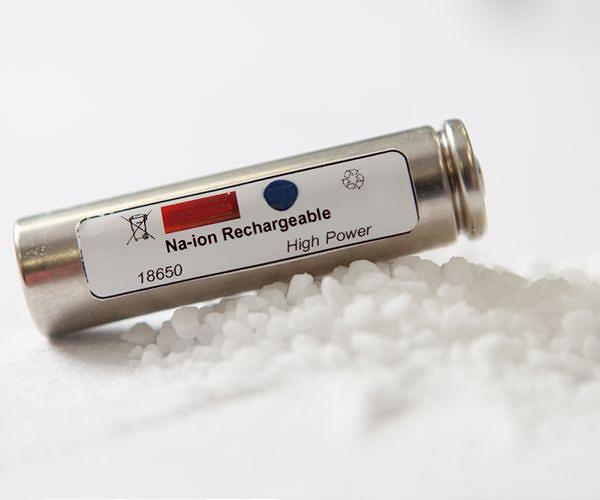
A water-enhanced sodium-ion battery could store energy and desalinate seawater
Scientists from the University of Surrey have discovered a simple but transformative way to improve the performance of sodium-ion batteries – by keeping water in the key electrode material rather than removing it. The finding not only improves battery efficiency but could also enable electrochemical desalination, which turns seawater into drinkable water.
Sodium-ion batteries are considered one of the most promising sustainable alternatives to lithium-ion technology, which relies on expensive and environmentally harmful materials. Sodium is plentiful and cheap, but achieving comparable performance has long been a challenge.
In their new study, published in the Journal of Materials Chemistry A, the Surrey team found that a common sodium-based compound – sodium vanadium oxide – performs much better when its natural water content is retained. The resulting material, called nanostructured sodium vanadate hydrate (NVOH), retained nearly twice the charge of typical sodium ion materials, charged faster and maintained stability over 400 charging cycles.
“Our results were completely unexpected,” said Dr. Daniel Commandeur, Research Fellow at the University of Surrey School of Chemistry and Chemical Engineering and lead author of the study. “Sodium vanadium oxide has been around for years and people usually heat treat it to remove the water because it is thought to cause problems. We decided to challenge that assumption and the result was much better than we expected. The material showed much stronger performance and stability than expected and could even create exciting new possibilities for how these batteries are used in the future.”
The researchers also showed that NVOH can work efficiently in salt water, where it removes sodium ions while a graphite electrode simultaneously extracts chloride ions – a process known as electrochemical desalination.
“Being able to use sodium vanadate hydrate in salt water is a very exciting discovery,” added Dr. Commander to it. “It shows that sodium ion batteries can do more than just store energy – they can also help remove salt from water. In the long term, this means we could potentially design systems that use seawater as a completely safe, free and plentiful electrolyte, while also producing fresh water as part of the process.”
These advances could help move sodium-ion batteries toward large-scale, low-cost deployment, supporting the transition to greener energy storage systems. By simplifying production and eliminating dependence on lithium, the approach provides a sustainable path for applications ranging from sustainable grid storage to electric vehicles.
Research report:Nanostructured sodium vanadate hydrate as a versatile sodium ion cathode material for use in organic media and for aqueous desalination
