

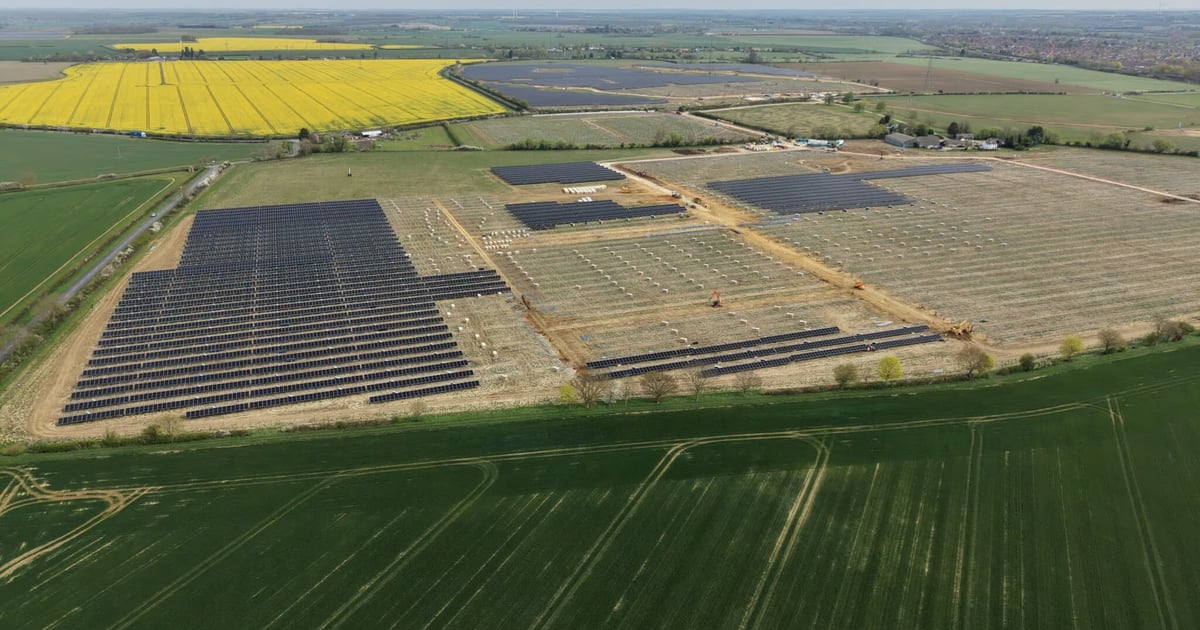
Renewable infrastructure company AGR Renewables has completed financing for a portfolio of 310MW/250MWh of UK solar-plus-storage projects.
The five projects in the group are located in Lincolnshire, Hertfordshire and Cambridgeshire and are all under construction and expected to be operational in 2026/27. The senior debt financing for the projects was led by German infrastructure investment bank BayernLB.
AGR said the 310MW of solar projects were all contracted under the government’s Contracts for Difference (CfD) programme, as well as under “high-profile” corporate power purchase agreements (PPA). Last month, AGR signed four CfD-backed PPAs with business-focused utility SmartestEnergy on four PV projects totaling 192 MW in Lincolnshire, Hertfordshire and Cambridgeshire.
The company has a total of six solar plus storage facilities in the three provinces, all of which are currently under construction. It also bought 70MWp/50MW of solar energy and energy storage capacity from Cambridge Power last year.
“By combining large-scale solar energy generation with battery storage, we are not only supporting the UK’s transition to a secure, low-carbon energy system, but also ensuring grid stability,” said Oliver Breidt, founder of AGR.
“We are on track to deliver 1 GW of renewable assets by the end of 2027. Our secured pipeline of more than 1.5 GW positions us perfectly to meet the growing energy needs of data centers and industrial users, fueling the next phase of our strategic growth.”
AGR Renewables is backed by RailPen, the £34 billion pension fund for the UK rail sector. Railpen investment manager Cristiana Dochioiu said AGR’s financing “supports the delivery of its construction pipeline while laying the foundation for continued expansion of large-scale, co-located solar and storage infrastructure, which will play an increasingly important role in improving energy security and system flexibility in the UK.”
Allocation Round 7 (AR7) of the government’s CfD programme, which saw AGR win contracts, awarded CfDs to more developers than in any previous round. The average size of successful projects also decreased, largely due to the lack of nationally significant infrastructure projects (NSIP) included in the round. Our market analysts published a review of AR7 in February.
