

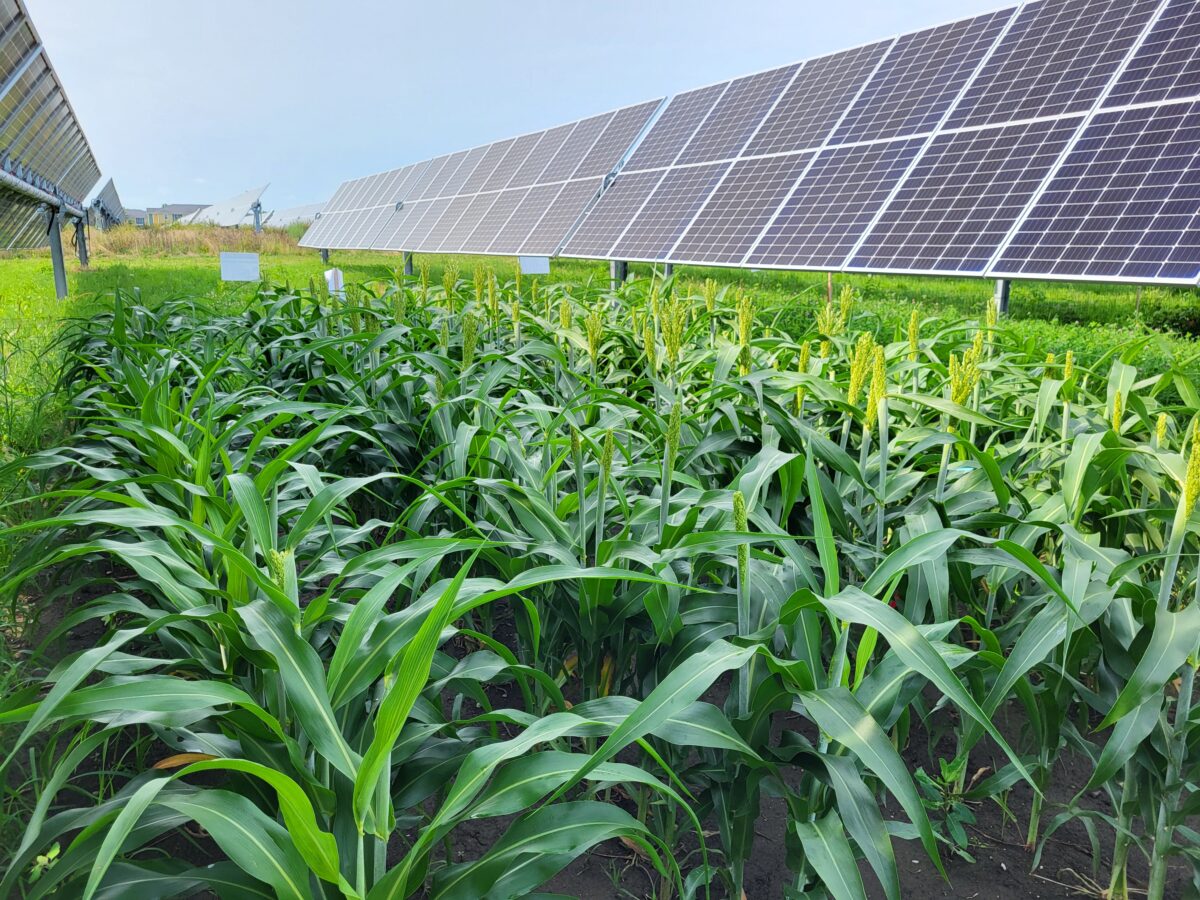
Researchers in the United States found that shading from agrivoltaic systems reduces grain numbers in both sorghum and soybeans, but sorghum can partially compensate by increasing grain weight, while soybeans cannot. The study shows that sorghum and soybeans respond differently due to their physiology, and provides guidance for crop selection and management to minimize yield damage in the agricultural voltaic sector.
A research team from the University of Illinois Urbana-Champaign in the United States experimentally investigated how shade in agricultural voltaic systems affects sorghum and soybean yields, focusing on source-sink dynamics, the processes by which plants produce and allocate assimilates such as sugars during growth.
“To our knowledge, no previous studies have performed source-sink manipulations within solar panels to investigate the physiological mechanisms that determine grain weight during grain filling,” said corresponding author DoKyoung Lee. pv magazine. “If shading from PV panels results in a yield reduction, it is essential to understand not only the overall yield reduction, but also which specific yield components are affected. In this study, we investigated both yield and yield components, such as grain number and grain weight, in sorghum. Furthermore, we elucidated the different physiological mechanisms underlying grain weight by assessing changes in source and sink strength.”
The research took place during the 2023 and 2024 growing seasons at Solar Farm 2.0 in Champaign, Illinois, USA, a project that generates approximately 20,000 MWh/year for the university. Individual PV panels were 1 m wide and 2 m long, mounted on 1.5 m brackets, with a distance of 5.5 m between rows. Panels are installed on a north-south axis with single-axis tracking, allowing them to rotate from east to west. Eight plots – four sorghum and four soybeans – were planted in the PV plant, while the other eight served as controls under full sun conditions. Each plot had dimensions of 4 m wide and 6 m long, with five rows spaced 0.75 m apart: two rows on the east side, two rows on the west side and one in the middle.
Source manipulation was performed on both sorghum and soybeans 7 days before anthesis, while sink manipulation was performed on both 14 days after anthesis. In the case of sorghum, the source was manipulated by removing alternate leaves below the flag leaf, and the sink was manipulated by vertically removing half of the panicle. As for soybean, the source was manipulated by removing two lateral leaflets from each trifoliate leaflet, while the sink was manipulated by removing all pods from all branches, leaving the pods only on the main stem.
Image: University of Illinois Urbana-Champaign
“Soybeans showed a yield penalty regardless of the intensity of shading (across different rows) between PV panels. In contrast, sorghum showed a smaller yield penalty than soybeans, and this penalty decreased as the shade in the middle row decreased, resulting in no yield penalty,” Lee said of the test results. “Grain formation in sorghum was also sensitive to resource availability, but sorghum was able to compensate for this because grain size increased when resources were sufficient.”
According to Lee, the contrasting physiological mechanisms between sorghum and soybeans “represent one of the most compelling findings of this study.” Soybeans use C3 photosynthesis, the basic photosynthetic pathway, while sorghum uses C4 photosynthesis, an enhanced photosynthetic system that concentrates CO₂. According to the researchers, the team expected C4 plants to take the bigger hit from PV shading, but found the opposite.
According to the results, both crops integrated with PV electricity generation increased the land equivalent ratio (LER), by 1.54 for sorghum and 1.23 for soybeans. Lee further explained that the main factor contributing to yield penalties in both sorghum and soybeans was reduced grain counts under shade conditions. “While grain weight in sorghum responded strongly to changes in resource availability, soybeans showed sensitivity only under resource constraints, and not under conditions of surplus,” he said.
“These findings provide guidance for optimizing cultivar selection and management practices in agri-PV systems,” the researcher said.
The team also found that to reduce yield penalties, management should first focus on the critical period before anthesis, when grain counts are established. Increasing pit size in both sorghum and soybeans, along with crop-specific practices during this phase, will be critical. However, after flowering, the two crops require different approaches. For sorghum, increasing resource availability during grain filling can offset yield losses by increasing grain weight. For soybeans, the focus should be on avoiding resource limitations as additional resources have only a limited effect on grain weight.
The research work was presented in “The influence of shade on sorghum and soybean yields in agricultural voltaic systems: source strength in response to shade”, published in Smart agricultural technology.
This content is copyrighted and may not be reused. If you would like to collaborate with us and reuse some of our content, please contact: editors@pv-magazine.com.
Popular content

