

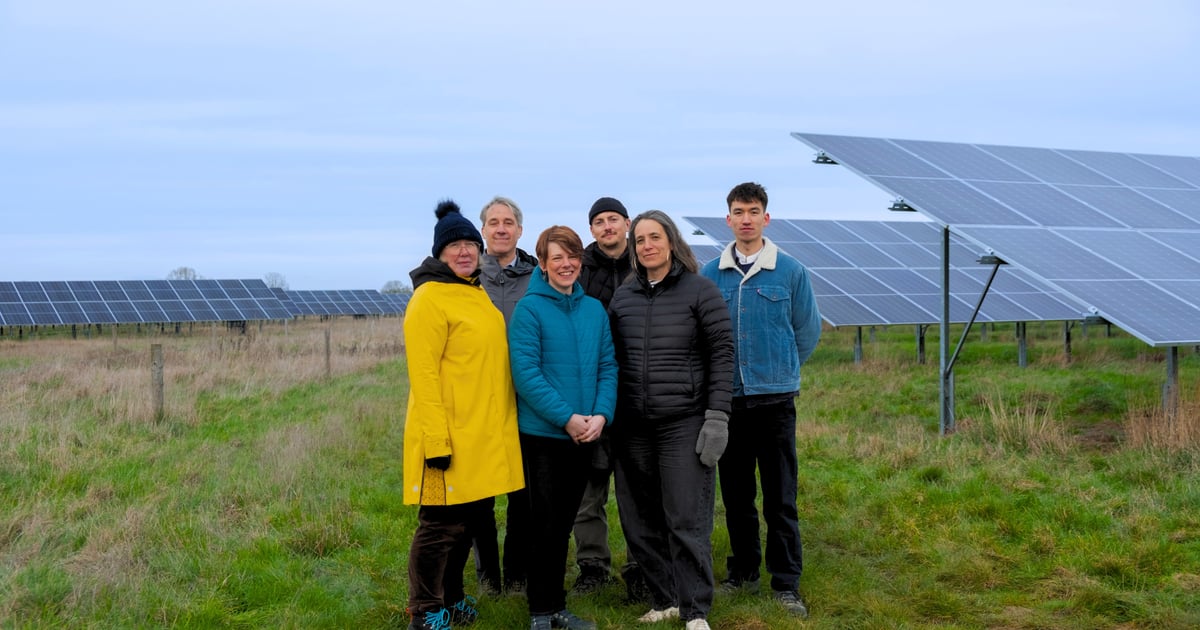
Oxford community renewable energy organization Low Carbon Hub says its battery energy storage system (BESS) share offering is now 80% funded.
Since the The share offering opened in March200 investors paid £440,000 to install the BESS at Ray Valley Solar, the 19MW community-owned solar power plant operated by Low Carbon Hub.
The 3MW/12MWh BESS is the first in the UK to be community owned, according to the group, a Community Benefit Society.
Members of the public and organizations can purchase shares in the Community Energy Fund through direct impact investment platform Ethex. Investments start at €100, with a maximum of €100,000. The capital raised will fund the installation of the BESS facility at the site, which Low Carbon Hub estimates at a total cost of £1.8 million.
Dr. Barbara Hammond, CEO of Low Carbon Hub, said: “If this momentum continues and we overdo it, an even greater share of the project will be owned by the community and we will reduce our reliance on loans, leaving a greater share of the project in the hands of the community.
“That means that an even greater share of profits through Low Carbon Hub’s work flows back to other community projects.”
The project has also received a philanthropic loan from the We Have The POWER project.
The Low Carbon Hub model offers investors returns from the profits it makes by feeding the electricity generated at community-owned sites back into the grid, which it also uses to fund energy upgrades for local properties such as schools.
In a recent interview with Hammond, she explained the The focus of the organization is on education. It uses profits from renewable generation to fund local involvement.
It is widely accepted that community energy initiatives increase public support for a project, with community involvement being central to planning decisions in many cases.
The interest in Low Carbon Hub’s latest share offering shows that there is demand for renewable energy in the UK, while there is a demonstrable return on investment for consumers, something also reflected in a revival of interest in domestic solar energy following the Iran war.
The recent local elections saw a surge in support for Reform UK, a political party that runs on a platform that includes anti-renewable energy rhetoric. Party leaders have pledged to resume oil and gas drilling in the North Sea and annul all renewable Contracts for Difference (CfDs) if the party is elected.
While it appears that the British public is not voting for Reform UK based on its climate position, there is a danger that other political parties will adopt his pro-fossil fuel rhetoric in an attempt to capture the voting base; the The Conservative Party has already withdrawn its own position on sustainable energy with current party leader Kemi Badenoch recently promising to ‘get Britain drilling’.
This creates an atmosphere of uncertainty for developers, with one calling political uncertainty in Britain ‘the biggest challenge’ to achieving the energy transition, last week during an event in London.
At the end of June, Solar Media will host the Clean Power 2030 Summit, which will bring together all the elements needed to achieve the current government’s goal: an energy system that runs almost 100% on renewable energy sources.
The political consensus will be a topic of intense discussion, with government representatives including Chris Stark, head of clean energy in the Clean Power 2030 Unit at the Department for Energy Security & Net Zero, speaking at the event.
The full agenda is available on the event website. Book now and use our discount code SPP20 20% discount on your ticket.
