

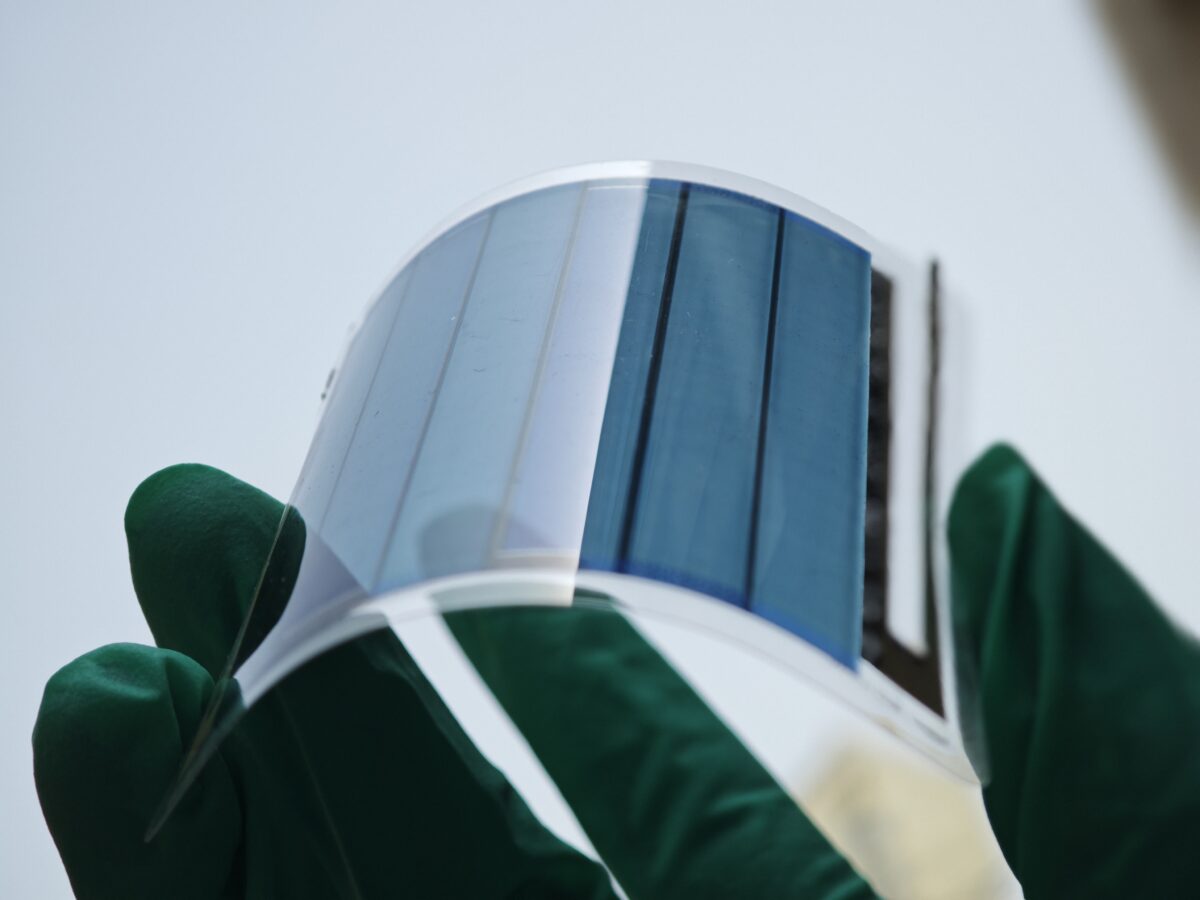
The polymer solar cell can maintain 97% of its performance after 2,000 hours in the air. By mixing small molecule acceptors into polymeric matrices, the research team improved molecular packing, improving both stability and charge transport for ‘ultrastable’ flexible devices.
A group of researchers The Wuhan University of Technology in China has manufactured a polymer solar cell that can achieve an efficiency of 19.1% while maintaining remarkable levels of stability.
Polymer solar cells are a subset of organic solar cells where the active light-absorbing material is specifically a conjugated polymer.
“Polymer solar cells using polymer electron donors and acceptors exhibit superior mechanical properties and thermal stability compared to their small molecular counterparts,” said the corresponding author of the study. Wei Litold pv magazine. “However, the long conjugated backbones of polymer semiconductors are prone to self-entanglement into large and disordered aggregates, due to inferior PCE and faster degradation during operation. We found that the incorporation of linearly packed small molecule acceptor can help to untangle the polymer chains, converting the disordered molecular packing into ordered stacking.
“This simple strategy simultaneously creates efficient charge transport routes and reduces free volume in the photoactive layer,” said co-author Tao Wang. “The resulting devices retain 97% of initial efficiency after 2,000 hours of airborne operation, with an extrapolated lifespan of more than 100,000 hours. This work clarifies how molecular and morphological structures of organic semiconductors determine device lifetimes and provides a practical path to the commercialization of flexible organic solar photovoltaics.”
In the study “Ultra-stable polymer solar cells with T97 lifespan more than 2,000 hours in air”, published in Matterthe researchers explained that they used polymer acceptors (PMAs) instead of other types of polymers because they provide a distinctive balance between structural stability and photovoltaic performance.
In contrast to small molecular acceptors (SMAs), polymeric macromolecular acceptors (PMAs) are composed of long conjugated backbones. This macromolecular architecture reduces the free volume in the active layer and limits large-scale molecular motion. As a result, PMA-based devices exhibit superior thermal and morphological stability, which translates into significantly longer operational life.
Mechanical properties provide another important advantage of PMAs. Compared to small molecule systems, polymeric acceptors form more robust and flexible films. Intertwining chains improves both mechanical durability and film-forming ability, which is especially valuable for large-area flexible solar cells. In contrast, small molecules tend to crystallize excessively or undergo phase separation over time, causing morphological instability and device degradation.
However, PMAs also have disadvantages. Their long chains can entangle themselves into disordered aggregates in the solid state, reducing structural order in the active layer. This disorder increases charge carrier recombination, typically resulting in lower energy conversion efficiency compared to state-of-the-art SMA-based devices. Consequently, there is a trade-off between efficiency and stability.
The research team addressed this challenge by introducing a small portion of the carefully selected small molecule acceptor into the PMA matrix. This approach reportedly improves molecular packing and structural order while limiting recombination losses and maintaining the intrinsic thermal stability of the polymer system.
The solar cell is fabricated on an indium tin oxide (ITO) substrate with a molybdenum trioxide (MoO₃) hole transport layer (HTL), a wide band gap conjugated polymer donor PM6, a poly(methyl acrylate) (PMA) based active layer, a buckminsterfullerene (C60) electron transport layer (ETL), a bathocuproin (BCP) buffer layer and a silver (Ag) metal contact.
Under standard lighting, the device achieved an energy conversion efficiency of 19.1%, an open-circuit voltage of 0.941 V, a short-circuit current density of 26.3 mA/cm² and a fill factor of 77.3%. Absorption spectroscopy measurements indicated that the cell lifetime was more than 2000 hours in air.
“In conclusion, ultra-stable polymer solar cells were achieved through a special design of the photoactive and charge transport layers,” the researchers said.
This content is copyrighted and may not be reused. If you would like to collaborate with us and reuse some of our content, please contact: editors@pv-magazine.com.
