

Researchers in Italy have found that combining residential air-source heat pumps with air-geothermal heat exchangers can reduce energy consumption by up to 30%. They tested the proposed combination using Matlab in a passive single-family building in Valtellina, northern Italy.
Researchers from the University of Padua in Italy have proposed improving the performance of residential air source heat pumps with air-geothermal heat exchangers and found that this combination can reduce energy consumption by up to 30%.
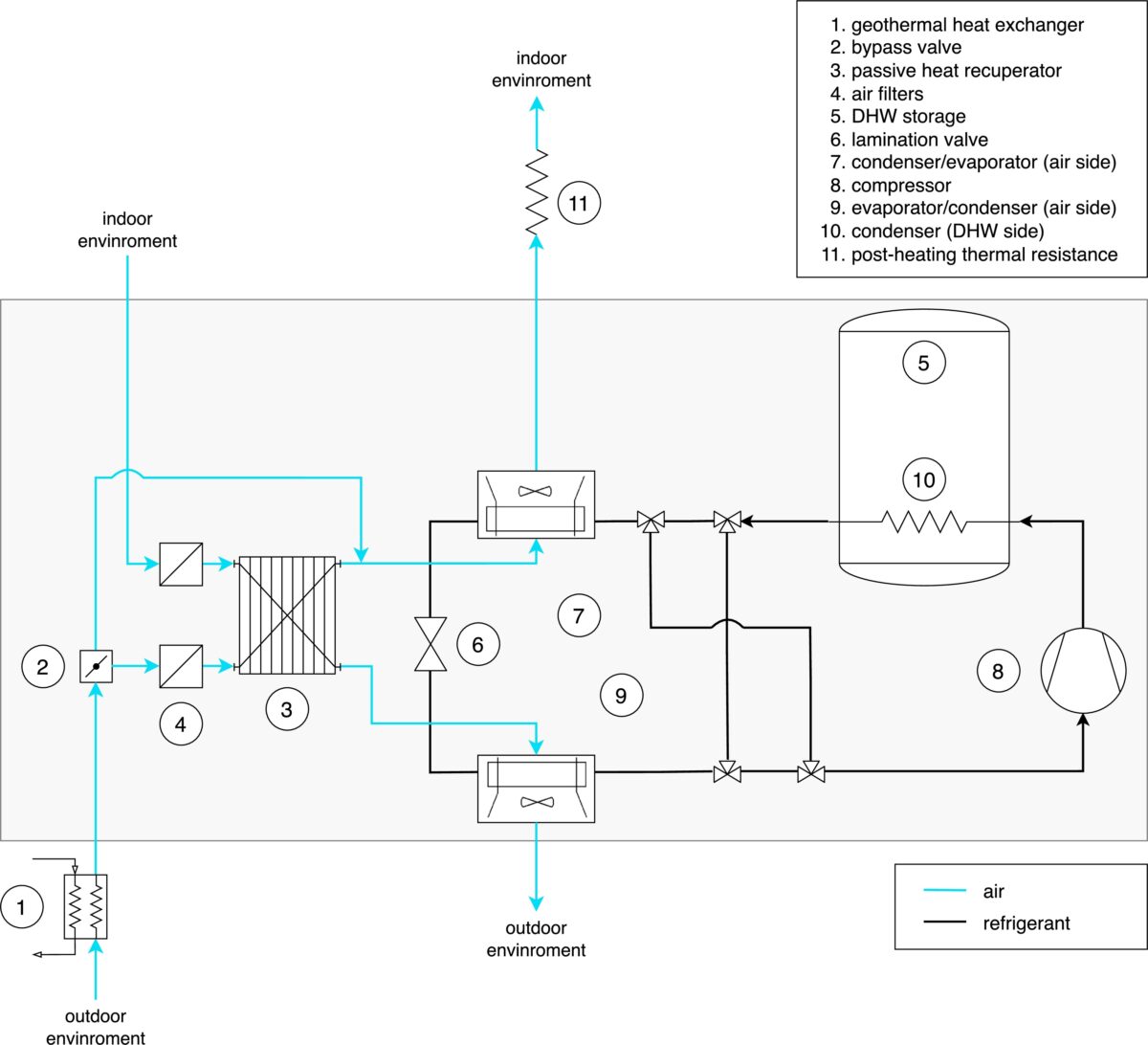
The scientists assessed how the proposed combination would perform in a heating, ventilation and air conditioning (HVAC) system deployed in a passive single-family building in Valtellina, northern Italy. The HVAC unit is described by the research group as a completely air-type unit that relies on a preheating/precooling air-geothermal heat exchanger, a heat pump unit and an integrated thermal reheating resistance.
“The aim of the study is to investigate the behavior of an air-geothermal heat pump system to identify the main factors affecting the performance of the system under real operating conditions and to determine quantitatively the reduction in energy consumption resulting from the integration of the air-geothermal heat exchanger in the heating/cooling system,” the academics said.
In the proposed system configuration, the air-geothermal heat exchanger is used to preheat or precool air depending on the season. “This layout guaranteed a nearly constant temperature in the heating and cooling seasons, independent of the outside air temperature,” the research team added.
The heat pump unit used in the experiment is a Compact P model from the Danish manufacturer Nilan, which is intended to operate both as an HVAC system and as a domestic hot water (DHW) generator. The thermal resistance provides heat during periods of high heat demand. “The unit is designed to operate in a stand-alone configuration, and therefore the air input can be outdoor air in the case of direct supply from the outdoor environment, or air pre-treated by the air-geothermal exchanger,” the group pointed out.
During the heating season, the heat pump is activated when the passive heat recovery from the geothermal heat exchanger is not sufficient to guarantee the desired level of comfort, or when the demand for hot water is particularly high. In mid-season, the air pretreated by the air-geothermal heat exchanger is transported to the heat pump, and the inlet air supplies directly to the internal environment, without heat exchange. In the summer season, when the air supplied to the heat pump unit becomes too warm to meet the cooling needs of the building, the compressor is activated and the air is cooled in the evaporator.
The system was modeled using Matlab software and was found to benefit from the air-geothermal heat exchanger as it significantly reduces heating and cooling demand during the operating year in the modelling, which in turn results in a 30% reduction in the electricity consumption.
“From a quantitative point of view, the analysis estimated that without the geothermal air unit in winter 2019, electricity consumption would be 130% of the measured consumption, due to the higher thermal demand, which in turn led to a higher operation of the geothermal unit. electric reheater,” the scientists further explained. “In the summer of 2019, the heat pump could not meet the cooling needs of the house.”
They also emphasized that minimizing indoor ventilation, at low outdoor temperatures, is a key factor in reducing indoor heat demand. “The results confirmed the influence of air inlet conditions and control strategy on unit performance in both heating and cooling modes,” they concluded.
The proposed combination was described in the study “Analysis of a domestic air heat pump integrated with an air-geothermal heat exchanger in real operating conditions: the case study of a single-family house,” published in Energy and Buildings.
Another research team from the University of Padua last year presented a 5 kW solar-assisted direct expansion heat pump that alternates between two different evaporator technologies. This system uses a spiral heat exchanger with air fins or photovoltaic-thermal (PVT) solar collectors as the evaporator.
This content is copyrighted and may not be reused. If you would like to collaborate with us and reuse some of our content, please contact: editors@pv-magazine.com.
