

Computer simulations provide new insights into improving solar cell materials
Researchers at Chalmers University of Technology in Sweden have made progress in understanding halide perovskites, a promising class of materials for solar cells. These materials could serve as an efficient and cost-effective alternative to traditional silicon-based cells, but they face stability challenges. The new insights are expected to contribute to the development of more reliable and efficient solar cells, important components in the transition to sustainable energy.
Halide perovskites refer to a group of materials known for their potential in flexible, lightweight solar cells and various optical applications, such as LEDs. They exhibit high efficiency in light absorption and emission, making them suitable for next-generation solar energy technologies. However, understanding the causes of rapid degradation remains a hurdle in optimizing these materials.
Advanced computer simulations reveal material behavior
The research team used advanced computer simulations and machine learning to study 2D perovskite materials, which tend to be more stable than their 3D counterparts. The findings, published in *ACS Energy Letters*, provide new insights into the factors that influence the properties of the materials.
“By mapping the material in computer simulations and subjecting it to different scenarios, we can draw conclusions about how the atoms in the material react when exposed to heat, light, etc.,” explains Professor Paul Erhart from the research team. “We now have a microscopic description of the material that is independent of what experiments have shown, but which we can show leads to the same behavior as the experiments.”
Simulations allow researchers to analyze material behavior at a detailed level, providing a unique view that complements experimental data. This approach has made it possible to observe what leads to specific results in experiments, deepening the understanding of the functionality of 2D perovskites.
Machine learning enables broader and deeper analyses
By integrating machine learning techniques, the researchers were able to study larger systems over longer periods of time than previously feasible.
“This has given us both a much broader overview than before, but also the opportunity to study materials in much more detail,” says Associate Professor Julia Wiktor. “We can see that in these very thin layers of material, each layer behaves differently, and that is something that is very difficult to detect experimentally.”
The composition and interaction of layers in 2D perovskites
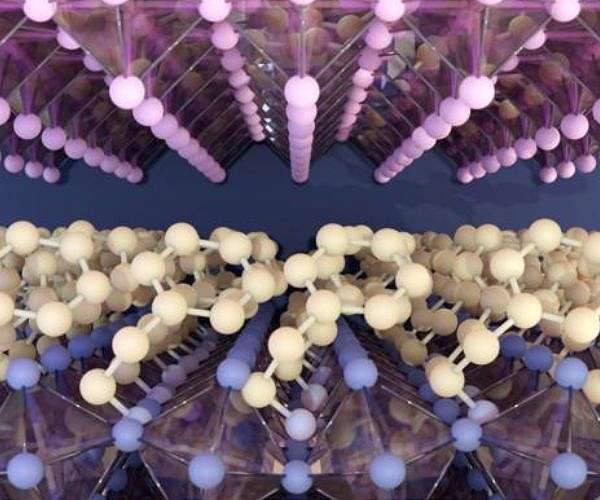
2D perovskites consist of inorganic layers separated by organic molecules, which play a crucial role in determining the stability and optical properties of the material. Understanding the atomic movements within these layers and their connection to the organic linkers is essential for designing efficient devices.
“In 2D perovskites you have perovskite layers connected to organic molecules. What we have discovered is that you can directly control how atoms move in the surface layers by the choice of the organic linkers,” says Erhart. “This movement is crucial to the optical properties, creating a domino effect that extends deep into the material.”
Future research directions
The results of the study pave the way for the development of more stable and efficient optoelectronic devices by identifying which molecular configurations could improve performance. The researchers want to expand their work to more complex systems, focusing on interfaces that are essential for device functionality.
“Our next step is to move to even more complex systems and in particular to interfaces that are fundamental to the operation of devices,” said Wiktor.
Research report:Impact of organic spacers and dimensionality on templating of halide perovskites
