

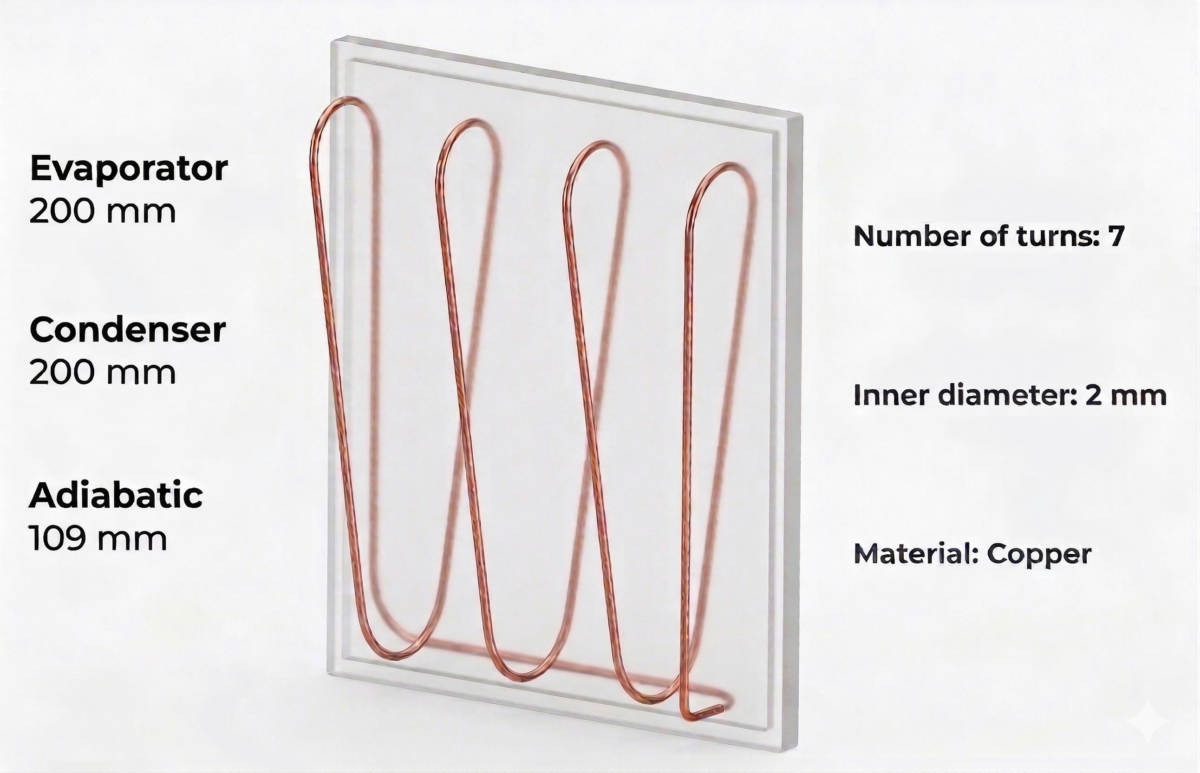
An international research group has developed a new passive cooling system for solar panels that integrates three-dimensional oscillating heat pipe (3D-OHP) with various combinations of nanofluids based on hybrid graphene oxide (GO) and a two-dimensional titanium carbide, known as MXeen (Ti3C2Tx).
MXeen compounds take their name from their graphene-like morphology and are made via selective etching of certain atomic layers from a bulk crystal known as MAX. Recently, these materials have also shown promise for use in PV technology due to their unique optoelectronic properties, such as their high charge carrier mobility, excellent metal conductivity, high optical transmission, and tunable work function (WF).
“The main novelty lies in integrating a 3D-OHP with a surfactant-free hybrid GO-MXene nanofluid for urban PV cooling, and comprehensively evaluating it from thermal, electrical, exergy and economic perspectives in real outdoor conditions,” said corresponding author Mahyar Kargaran. pv magazine. “To our knowledge, this is the first experimental study that combines and holistically evaluates 3D-OHP + GO-MXene for urban PV.”
Kargaran explained that the system is passive, stable and free of surfactants. “We are currently investigating the simultaneous use of multiple 3D-OHP units, two or three of which work together, to cool larger PV arrays and evaluate the thermal behavior of multiple units,” he added. “Additional follow-up work will include geometry and concentration optimization, integration with PV battery systems, and comparisons with other advanced nanofluids and surface treatments.”
The OHP is a sealed tube in which liquid and vapor move back and forth naturally, transporting heat from a warm space to a cooler space without a pump. In this study, the 3D-OHP was coupled to a 50 W PV module, with an efficiency of 13.82%. The cooling device was constructed from red copper tubes, with an inner diameter of 2 mm and an outer diameter of 4 mm. It had a 7-winding configuration consisting of three different sections: a 200mm evaporator, a 109mm adiabatic zone and a 200mm condenser.
Half of the tube volume was filled with deionized water-based nanofluids. GO, MXene or a 1:1 hybrid of both was added at concentrations of 0.1 wt% and 0.2 wt%. The 3D-OHP system was therefore tested with GO, MXene and the hybrid fluid at both concentrations, and compared to a reference PV panel without cooling. Experiments were conducted in August in Mashhad, northeastern Iran, under solar irradiance ranging from 660 to 1,090 W/m².
“Two findings were particularly notable,” Kargaran said. “First, the performance improvements exceeded expectations, with temperature reductions of more than 24 C, a 14.9% increase in power (from 42.1 W to 48.3 W) and an improvement in efficiency from 10.02% to 11.51%. Second, despite a 31% increase in viscosity, the hybrid nanofluid maintained excellent stability and delivered strong exergy performance of up to 30.9%, while it remained economically competitive, with a levelized cost of electricity (LCOE) of $0.083/kWh and a levelized cost of storage (LCOS) of $0.273/kWh.”
The system was presented in “Hybrid GO-MXene nanofluids in 3D oscillating heat pipes for efficient urban PV cooling: improved energy, exergy and economic performance”, published in Energy and Buildings. Researchers from China’s Xi’an University of Science and Technology, Iran’s Islamic Azad University, the University of Tabriz, America’s Texas A&M University and London’s South Bank University in Britain participated in the study.
This content is copyrighted and may not be reused. If you would like to collaborate with us and reuse some of our content, please contact: editors@pv-magazine.com.
