

Scientists in India have conducted a comprehensive review of all direct expansion solar heat pump technology in an effort to broaden its application in homes. Such a system can produce hot water from 15 C to 60 C with an average coefficient of performance of 1.5 to 4.5.
A group of researchers MIT World Peace University in India has conducted a comprehensive review of all direct expansion solar heat pump (DX-SHP) technology for domestic heating applications such as water heating, solar drying, space heating and industrial process heating.
These systems can reportedly produce hot water from 15 C to 60 C with an average coefficient of performance (COP) of 1.5 to 4.5 and can perform optimally under freezing conditions.
“This paper presents models for analyzing the energy and exergy performance of components in a DX-SHP system,” the academics pointed out. “Research shows that for optimal performance of a solar heat pump, solar radiation varies from 350 W/m2 up to 700 W/m²2wind speed from 0.5 m/s to 2.5 m/s and ambient temperature from 5 C to 35 C.”
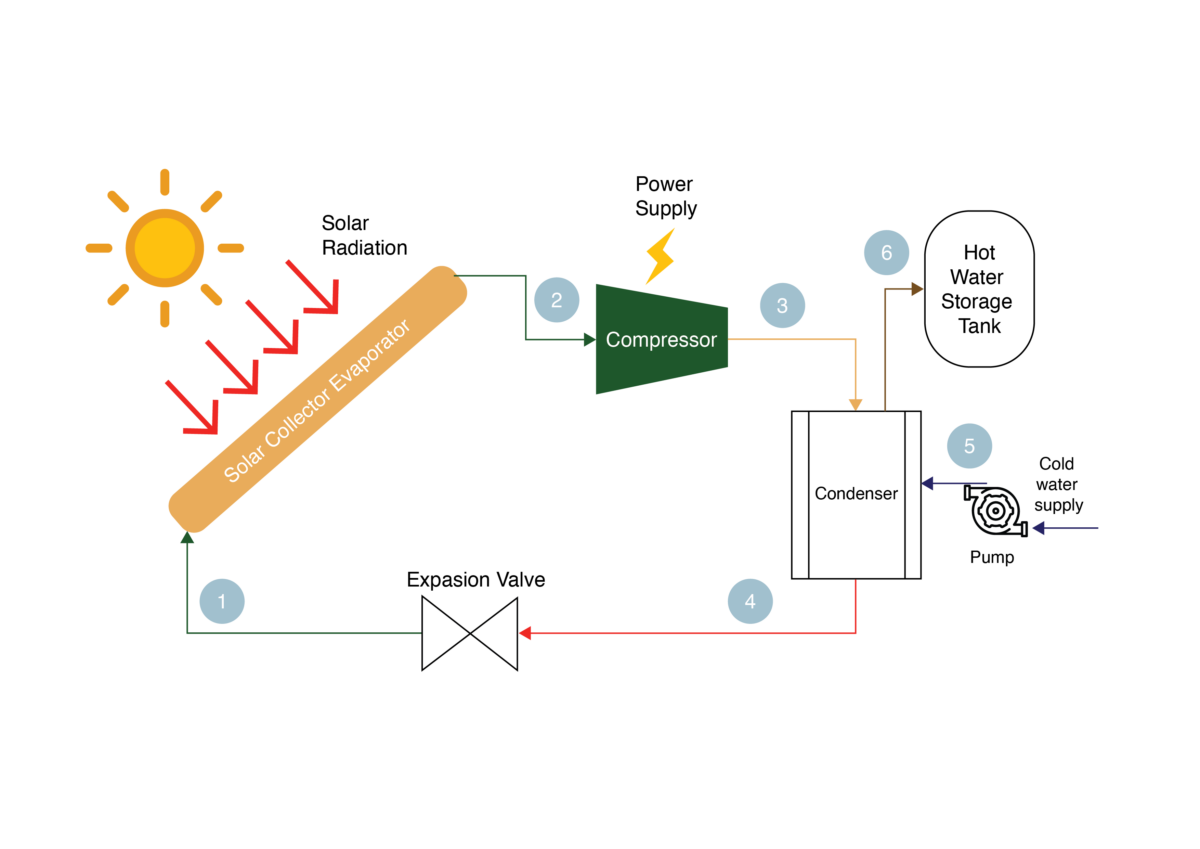
They typically consist of a solar collector-evaporator, a compressor, a condenser and an expansion valve operating within a heat pump cycle. The solar collector, which can be based on a solar thermal unit alone or on a photovoltaic-thermal (PVT) panel, is defined by the research group as the crucial part of the system, as it directly expands the coolant and collects heat from both solar – and ambient air, the latter predominating on cloudy days.
“The solar collector-evaporator is directly exposed to solar radiation,” it explains. “The coolant flowing through the tubes absorbs heat energy from the solar thermal energy and the ambient air. The refrigerant then pumps the heat from the evaporator via the compressor to the condenser.”
In all system configurations, waste heat energy, direct heating or heated wastewater is used as heat energy input to the evaporator, which is crucial for capturing solar thermal energy and transferring it to the refrigerant.
The researchers emphasized that fin tube collector evaporators are preferable because they work well in all weather conditions and their use is not affected by temperature or mode of operation. “As temperature and solar radiation increase, COP increases and heating time decreases,” she added. “Increasing the compressor frequency reduces heating time and energy consumption, while increasing evaporator heat gain.”
They also recommended using environmentally friendly refrigerants such as R290, R600, R1234ze (E), R1270 and R1234yf, as well as the use of nanofluids to improve thermal and electrical performance in PVT collector evaporators.
“Future research should investigate the use of heat transfer fluids in roll-bond and air source evaporators as indirect expansion heat exchangers instead of refrigerants,” they concluded. “This includes evaluating performance, optimizing different fluids and exploring system integration and sustainability for broader implementation.”
Their review was presented in the newspaper “Recent developments in the field of solar collector-evaporator for direct expansion solar heat pumps”, published in the International Journal of Thermofluids.
This content is copyrighted and may not be reused. If you would like to collaborate with us and reuse some of our content, please contact: editors@pv-magazine.com.
