

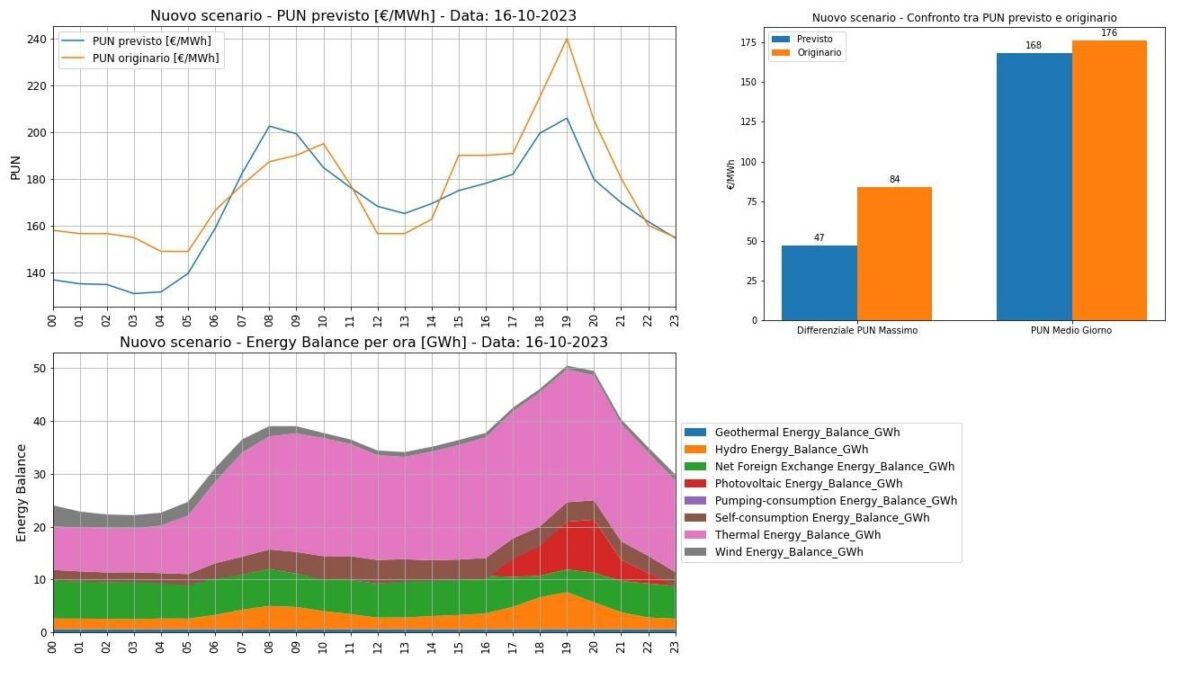
Donato Leo is the author of a study on the relationship between solar photovoltaics, batteries and wholesale energy prices in Italy. Leo’s deep learning simulations suggest changes in energy prices as installed battery capacity increases.
From pv magazine ESS news place
As an energy expert embedded in utilities, Leo uses deep learning and machine learning codes for analysis and forecasting to analyze and simulate market scenarios and optimize portfolio management strategies. In his latest analysis, Leo used deep learning techniques to simulate PUN trends related to battery installation at scale. The PUN (Italian acronym for Prezzo Unico Nazionale, “National Single Price”) – the wholesale reference price of electricity purchased on the Borsa Elettrica Italiana market (IPEX – Italian Power Exchange) – represents the national weighted average of the zonal sales prices of electricity for each hours and for every day.
Electricity demand graphs in electricity networks look a bit like a duck or a camel (here called the camel’s back curve), with highs in the morning and evening when people rely on the electricity grid, and a big dip in the middle of the day, which is also is the moment when many people use their own solar energy and need less from the electricity grid.
According to Leo, BESSs reduce the maximum electricity price, increase the minimum price and have a seasonally dependent effect on the average price: it would decrease on days with little sunshine and increase slightly on high PV production.
With BESS, PV can avoid feeding the grid during low PUN hours during the day and to supply electricity to the grid during hours of dark, high PUN hours. This could pay off the higher costs for BESS and increase revenue, but it depends on the context, right? Can you explain?
Donato Leo: The shape of the PUN curve is closely related to the peculiarities of the generation fleet, which, in the case of PV, is not yet massively equipped with BESS and is therefore limited to produce and feed during the hours when Sun shines. The gradual adoption of BESS (and the development of storage services provided by third parties) will mean that PV operators will need to store energy during the current low-paying sunshine hours and then supply it to the grid during the PUN peak hours, likely reducing the current camelback are flattened. curve. If this is a plausible scenario, it is clear that in such a context, temporarily greater profits will be achieved by PV company operators using BESS for the first time, as they will initially leave the current PUN ‘camel back curve’ unchanged (or almost), with its significant daily spread between PUNmax and PUNmin during the day.
You used deep learning techniques to create an algorithm that understands how the PUN curve – which is now exactly the shape of a camel – might change. Going into details, it seems that the curve would lose the second evening bump and only retain the first during the hours when the energy input is absent. Or would both bumps be smoothed out anyway, right? What would that mean for the battery reimbursement?
DL: Let me preface this by saying that the algorithm whose results you saw in my Linkedin posts is the result of an initial convolutional neural network (CNN) training based on historical hourly stock market and energy balance data from 2023, and this first part of 2024. Therefore, the relevant predictions should be taken with caution, also taking into account the fact that in the examples I posted I assumed drastic, massive shifts in PV production from daytime to evening hours: in between, however, there are the consequences of operators’ unpredictable strategies, in response to the strategies of first movers.
To read further, visit our new ESS news place
This content is copyrighted and may not be reused. If you would like to collaborate with us and reuse some of our content, please contact: editors@pv-magazine.com.
