

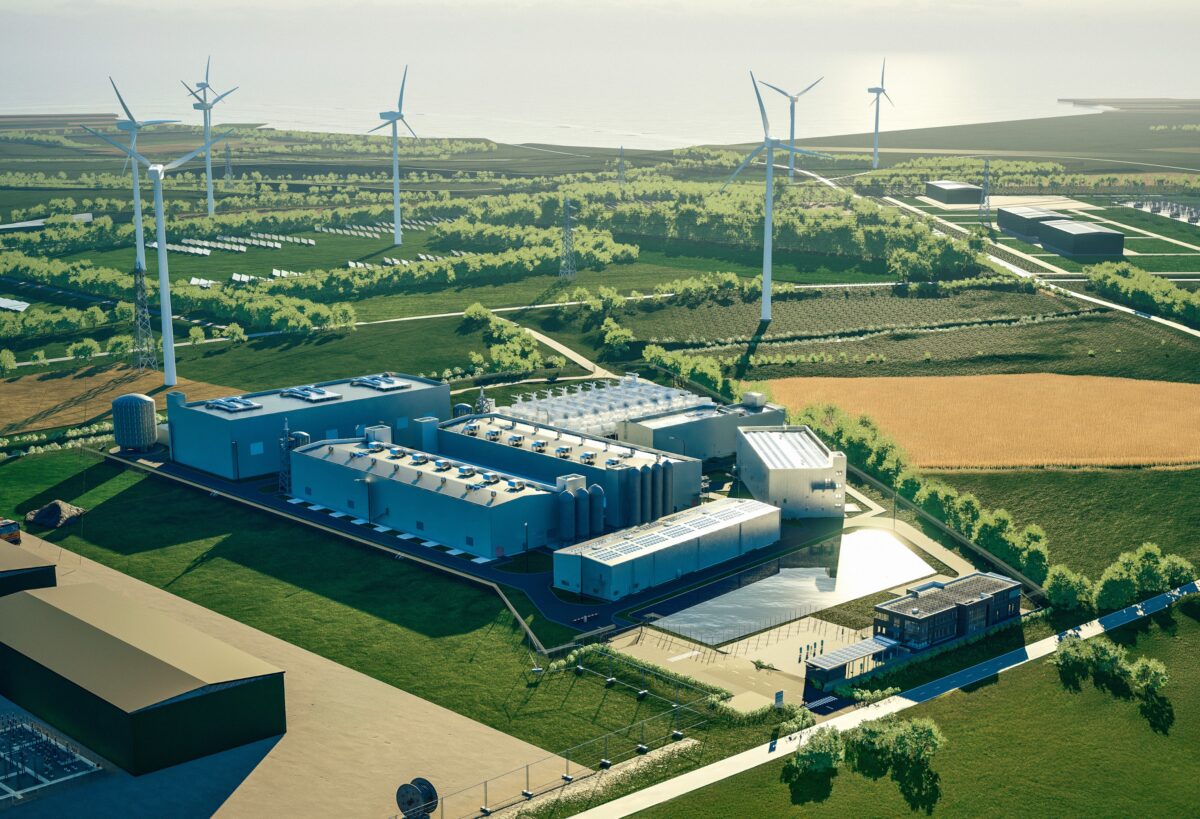
EWE says construction has begun on its 320 MW hydrogen plant in Germany as it seeks regulatory reforms, while Japan’s Suiso Energy and Kawasaki Heavy Industries have broken ground on a commercial-scale liquid hydrogen terminal set to become operational in 2030.
EWE has officially started construction of the 320 MW hydrogen production plant in Emden, East Friesland, with the award of the contract for civil engineering and structural works to a consortium of three construction companies (Ludwig Freytag, Gebrüder Neumann and MBN). “The plant will be one of the first electrolysers in Germany on a market-relevant scale. The first green hydrogen should be produced in Emden and supplied to industrial customers from the end of 2027,” said EWE, explaining that the factory is part of a system that includes production, storage and transport, including a pipeline axis between Wilhelmshaven, Leer and Emden. EWE calls on the German authorities to reform the RFNBO rules and the demand support mechanism, including the introduction of quotas for green industrial products.
Japan Suiso Energy (JSE) And Kawasaki heavy industry held the groundbreaking ceremony for the Kawasaki LH2 Terminal, a liquid hydrogen base in Ogishima, Kawasaki City. “As the world’s first commercial-scale facility to handle liquid hydrogen, this terminal will be equipped with the world’s largest liquid hydrogen storage tank of 50,000 m3, along with facilities for maritime cargo handling (capable of loading and unloading operations), hydrogen liquefaction, hydrogen gas delivery and liquid hydrogen shipment by truck.” said Kawasaki. JSE will manage the project, while a joint venture led by Kawasaki will be the main contractor responsible for the design and construction of the facilities. The project is expected to begin commercial operations in 2030.
A group of Moroccan researchers emphasized that addressing freshwater constraints through the integration of seawater and brackish water desalination technologies is essential to realize the full potential of green hydrogen. “Future efforts should prioritize: (1) sustainable technological innovation in desalination to improve efficiency, reduce energy consumption, and manage brine more sustainably; (2) comprehensive life cycle assessments and techno-economic analyzes of integrated WEH [water-energy-hydrogen] systems to optimize their environmental and economic footprint; and (3) the urgent development and implementation of robust policy frameworks, including standardization, certification and targeted financial incentives,” the researchers recently wrote in the review article “Water-Energy-Hydrogen Nexus: Addressing Water Scarcity in Sustainable Green Hydrogen Production.” published in Results in technology. The researchers also emphasized that standardization and certification make it possible to reduce the risks of investments and promote a globally interconnected green hydrogen market.
Researchers from the University of CaliforniaBerkley, are developing a new electrolysis technology based on water electrolyzers with anion exchange membrane, using ion-conducting polymers as anode electrodes, where oxidation takes place. The team led by Shannon Boettcher combines an inorganic polymer of zirconium oxide with an organic polymer that conducts ions and separates gases to prevent degradation of the organic polymer. “The zirconium polymers accumulate around the anode electrode and create a passivation layer that protects the more sensitive organic polymer from losing electrons when the oxygen is created,” the research team said. The result is that the degradation rate is significantly lower. “We get a hundred times lower degradation rate. We’re not quite on the path to a commercially viable electrolyzer yet, but this is by far the biggest button we’ve found to get there,” said Boettcher.
NASA has selected Plug-in power supply And Air products and chemicals to provide up to approximately 36,952,000 pounds of liquid hydrogen for use in facilities throughout the agency. The contracts start on Monday 1 December. The NASA agency-wide Supply of Liquid Hydrogen awards are firm-fixed-price contracts that include multiple fixed-price supply orders that are critical to the agency’s centers because they use liquid hydrogen, combined with liquid oxygen, as fuel in cryogenic rocket engines, and the product’s unique properties support aerospace development. The total value of the combined prizes is approximately $147.2 million.” said the American agency.
This content is copyrighted and may not be reused. If you would like to collaborate with us and reuse some of our content, please contact: editors@pv-magazine.com.
