

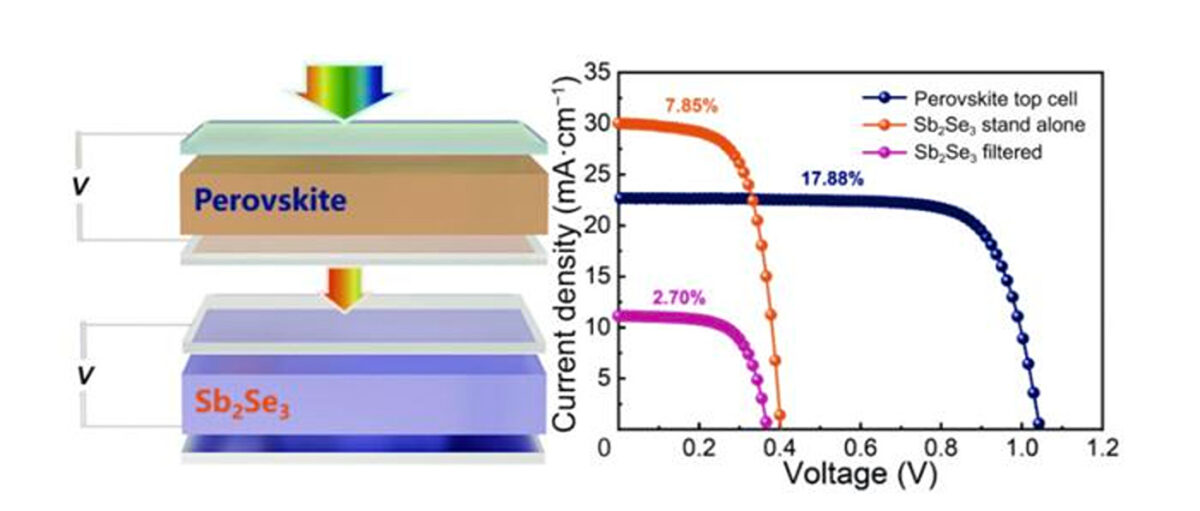
Scientists in China built a four-terminal tandem perovskite cell for the first time, with a 17.88% efficient perovskite device on the top and a 7.85% efficient lower antimony selenide cell on the bottom. The main features of the tandem cell are the transparent conductive electrode used to enhance the spectral response of the top cell and the “double” electron transport layer of the antimony selenide cell.
A group of researchers from the University of Science and Technology of China have fabricated a four-terminal (4T) tandem solar cell based on an upper cell that relies on a perovskite absorber and a lower device that uses an absorber made of antimony selenide.
“Antimony selenide is a suitable soil cell material for tandem solar cells,” the scientists said. “However, due to the rarity of reported tandem solar cells using them as a bottom cell, little attention has been paid to their application.”
Antimony selenide (Sb2Se3) is a p-type inorganic semiconductor with a one-dimensional crystal structure and a direct band gap in the range of 1.2 eV to 1.9 eV. It has excellent optoelectronic properties. In recent years, it has also been used as an absorbent material to build solar cells. The efficiency achieved by such devices is between 5% and 9.2%.
These efficiency levels are still present far behind those of other thin-film technologies, such as cells based on copper, indium, gallium and selenide (CISG), cadmium telluride (CdTe), kesterite (CZTSSe) and amorphous silicon (a-Si). This technology gap may depend on the fact that features such as mobility, carrier lifetime, diffusion length, defect depth, defect density and band tail remain largely unknown to the scientific community for the Sb2Se3 cell technology, as not many of these types of devices have been manufactured to date.
The Chinese group presented its tandem cell in the study “Zb2Se3 as bottom cell material for efficient perovskite/Sb2Se3 tandem solar cells,” published in Energy materials and equipmentand said the key features of the device are the transparent conductive electrode that they used to improve the spectral response of the top cell and the “double” electron transport layer (ETL) of the antimony selenide cell.
The academics designed the top cell with a substrate made of f-doped tin dioxide (FTO), an ETL made of tin oxide (SnO2), a perovskite absorber, a hole transport layer (HTL) based on Spiro-OMeTAD, a buffer layer made of molybdenum trioxide (MoO3), and a transparent contact based on indium zinc oxide (IZO).
Image: Energy Materials and Devices, Tsinghua University Press, Creative Commons License CC BY 4.0
The bottom cell is designed with a substrate made of FTO, an ETL made from tin(IV) oxide (SnO2) and cadmium sulfide (Cds), the Sb2Se3 absorber, an HTL that relies on Spiro-OMeTADand a gold (Au) metal contact.
“We have successfully fabricated 4-T perovskite/Sb2Se3 tandem solar cells,” the scientists said. “The IZO films prepared by magnetron sputtering generate both good conductivity and excellent transparency.”
Tested under standard lighting conditions, the top cell achieved an efficiency of 17.88% and the bottom cell of 7.85%. “Ultimately, the energy conversion efficiency of the 4-T perovskite/Sb2Se3 tandem solar cells reached 20.58%, which is higher than that of the independent subcells,” the scientists pointed out.
“Our work provides a novel tandem device structure and demonstrates that antimony selenide is a promising absorber material for soil cell applications in tandem solar cells,” concluded the study’s lead author, Tao Chen.
This content is copyrighted and may not be reused. If you would like to collaborate with us and reuse some of our content, please contact: editors@pv-magazine.com.
