Scientists have used open source models to simulate heat pump rollout scenarios for the year 2030. Additional investments of approximately 54 GW to 57 GW of solar PV capacity in a cheapest solution would enable the installation of 10 million heat pumps by the end of this year. the decade.
Researchers from the German Institute for Economic Research (DIW Berlin) have analyzed different scenarios for the expansion of decentralized heat pumps in Germany by 2030. They focused on the role of buffer heat storage in limiting electricity needs and on the effect of different methods for electricity generation on costs, capacity investments and emissions. They discovered that investing in PV can cost-effectively guide the rollout of heat pumps.
“In our analysis, we use the open-source capacity expansion TEASER model that takes into account the hourly variability of renewable electricity generation and heat demand over an entire year,” the team explains. “It also takes into account additional electrical loads associated with electric vehicles and green hydrogen production. To our knowledge, no such analysis has been conducted to date.”
In the first tested scenario, the reference scenario, the team assumed 1.7 million decentralized heat pumps in 2030, reflecting the stock of heat pumps installed in Germany in 2024. An annual heat supply of 24.7 TWh was also assumed. In the slow rollout scenario, it was assumed that the number of heat pumps would reach 3 million in 2030, installed exclusively in one- and two-family houses built between 1995 and 2009. In that case, the annual heat supplied would reach 53.2 TWh.
In the government rollout scenario, the team assumed that they would reach the official German targets of 6 million heat pumps by 2030, representing most single- and two-family homes built after 1995 and 92.9 2 TWh per years of consumption. Finally, they proposed a rapid scenario in which 10 million heat pumps are installed by 2030, providing 226.3 TWh of heat. In this scenario, heat pumps would be installed in more single-family and two-family homes, even in old homes built before 1979 that have very low energy efficiency standards.
“Across all building types, air source heat pumps are responsible for 80% of the installed heat pumps and ground source heat pumps for the remaining 20%,” the team explains. “The assumed size of the energy storage is expressed in energy-power ratios (E/P), ranging from 0 to 168 hours (0, 2, 6, 24 and 168 hours). In this terminology, a heat storage with an E/P ratio of 2 hours has a total heat storage capacity equal to 2 hours of the maximum heat output of the heat pump.”
Image: German Institute for Economic Research (DIW Berlin), Communications Earth & Environment, CC BY 4.0
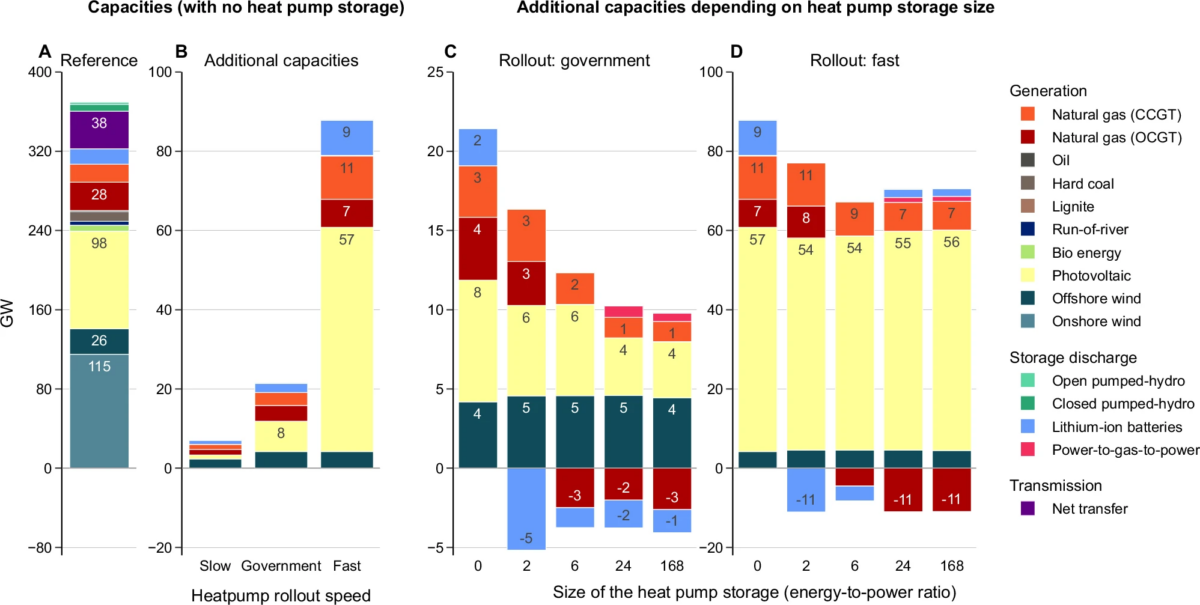
For the energy mix in the simulation, the group has limited coal and oil plants at current levels. Gas-fired power stations, open cycle (OCGT) and combined cycle (CCGT) could be expanded beyond current levels. Based on government statistics, onshore wind power plants were limited to 115 GW and offshore to 30 GW. The capabilities of solar PV know no limits.
“We find that expanding Germany’s heat pump supply from 1.7 to 10 million would require additional investments of around 54-57 GW of solar PV capacity in a cheapest solution, depending on how much heat storage is available,” the academics said. said. “A slower rollout speed, which still meets the German government’s target of 6 million heat pumps by 2030, will require additional PV capacities of around 4 to 8 GW.”
According to the academics, compared to the reference scenario, the government rollout will save Germany €2.0 to €6.7 billion per year, depending on natural gas prices, which were expected to be between €50 and €150/MWh . In the event of a rapid rollout, savings would amount to €27.1 billion per year.
“Introducing heat storage with an E/P ratio of 2 hours (h) reduces the need for additional solar PV capacity, for example 6 GW instead of an additional 8 GW in the government rollout compared to the reference” , the scientists concluded. “In addition, the need for battery storage is reduced by approximately 7 GW compared to the case without heat storage in the government rollout and by 5 GW compared to the reference.”
Their findings were introduced in “Benefits of flexible heat pumps in the energy sector in 2030 scenarios”, published in Communication Earth & Environment.
This content is copyrighted and may not be reused. If you would like to collaborate with us and reuse some of our content, please contact: editors@pv-magazine.com.
Popular content