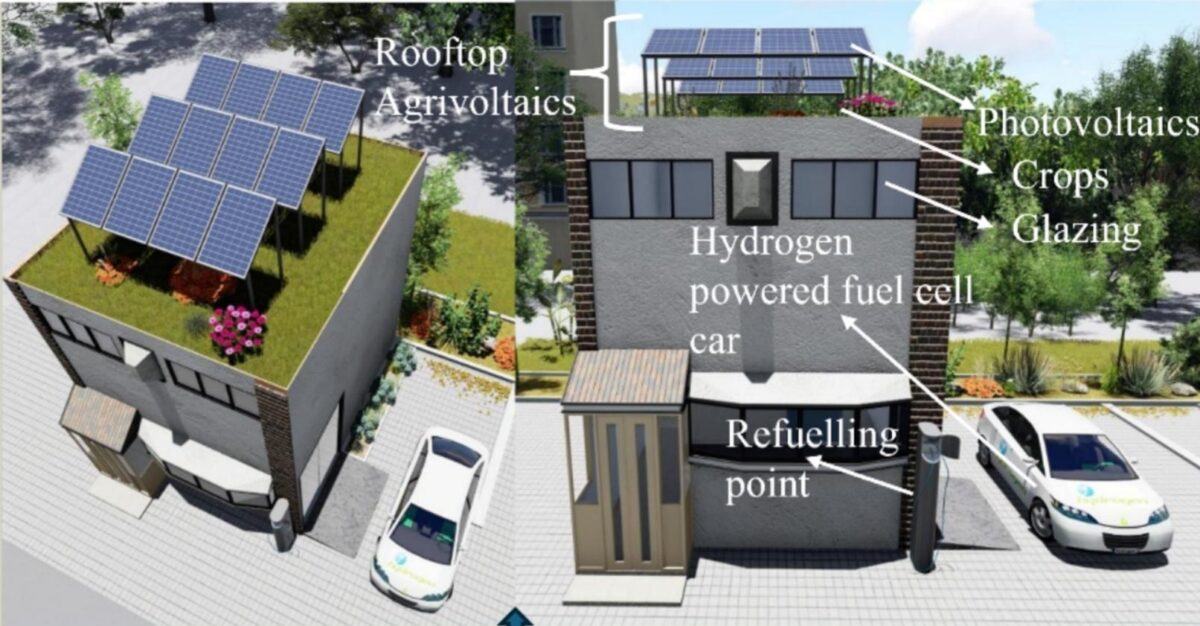
Scientists have simulated a residential building based on a real two-storey house in the UK, combining rooftop agrivoltaic energy with on-site hydrogen production. The electricity generated by the solar system is used to produce hydrogen, which is then supplied to a hydrogen vehicle and insulated gasochrome smart windows.
A research group at the University of Exeter investigated a modular agricultural voltaic-powered hydrogen production concept for households. Agrivoltaic solar panels on the roof power an electrolyzer that produces hydrogen for hydrogen vehicles and for insulated gasochrome smart windows. The windows are a form of thermally insulating glass that darkens or clears through reversible reactions with hydrogen and oxygen, allowing control over light and heat.
“This research presents a new building-integrated energy concept, connecting agricultural voltaics, hydrogen, smart facades and mobility. It offers a fresh perspective on how buildings can become active, multifunctional energy hubs, an idea that is increasingly relevant for future urban energy systems,” said researcher Aritra Ghosh. pv magazine. “While the limited roof area obviously limits total hydrogen production, the value of the concept lies in its system integration and novelty, rather than large-scale production.”
Using multiple software tools, the team simulated a real two-story residential home in Birmingham, England. The building has a total floor area of approximately 142.7 square meters, a height of 4.8 meters and a roof area of 55 square meters available for agrivoltaic energy. It includes 16 windows spread over nine thermal zones. Birmingham experiences moderate temperature extremes, with peak temperatures in summer around 21 degrees Celsius and lows in winter around 1 degree.
12 solar panels were installed on the flat roof in three configurations: vertical, dome-shaped with a slope of 20 degrees or an optimized slope of 30 degrees. Each configuration was tested with 600 W monofacial modules or 605 W bifacial modules. Tomatoes were grown under the panels, which required six to eight hours of direct sunlight per day and night temperatures of about 13 degrees.
A 7 kW electrolyzer with an efficiency of 88% was used to produce hydrogen from the solar energy. The hydrogen was modeled for three uses: fueling a 2017 Toyota Mirai, powering the gasochrome windows, or both. The performance of gasochrome vacuum windows was also compared with double glazing, electrochromic and standard gasochrome alternatives.
“Using a roof area of 55 m2, the system was able to produce enough hydrogen to meet the annual demand for smart glazing, which was calculated at just 52.56 grams per year,” said Ghosh. “Additionally, when hydrogen production is assessed in terms of mobility, the same roof system – using a bifacial PV configuration tilted at 30 degrees – could theoretically support up to 64.23 km of driving per day. This estimate is based on the performance of a 2017 Toyota Mirai, which has a hydrogen tank capacity of 5.6 kg.”
The results showed that the 30 degree tilt bifacial system generated the most electricity at 7,919 kWh per year, while the 30 degree monofacial configuration generated the lowest levelized electricity cost at GBP 0.061 ($0.082)/kWh. Tomato yields were consistent across all configurations at 0.31 kg per square meter. Of the glazing options, vacuum gasochrome windows achieved the best thermal performance, with a U-value of 1.32 W per square meter Kelvin, but with a greater thickness of 24.62 mm.
“While absolute hydrogen volumes are modest, the results demonstrate how small roof areas can support multiple building-scale hydrogen applications, amplifying the potential of modular, on-site hydrogen PV systems,” said Ghosh. “The impact of agrivoltaic energy on home insulation and the optimal use of the produced hydrogen for home heating will be the aim of our further research.
The results have been published in Energy and Buildings under the title “Agrivoltaically powered on-site rooftop hydrogen production for insulated gasochromic smart glazing and hydrogen vehicles: a holistic approach to sustainable housing.”
This content is copyrighted and may not be reused. If you would like to collaborate with us and reuse some of our content, please contact: editors@pv-magazine.com.
Popular content