

Researchers in Canada found that semi-transparent PV modules made from 69% transparent crystalline silicon can improve yields in tomato greenhouses by up to 38%, while maintaining healthy plant growth through favorable partial shade. Their simulations also showed that combining rooftop agrivoltaic energy with heat pumps can completely eliminate fossil fuel heating.
Researchers from Western University in Canada investigated different types of semi-transparent photovoltaic (STPV) modules with different levels of transparency in tomato greenhouses in an attempt to identify the best panel configuration.
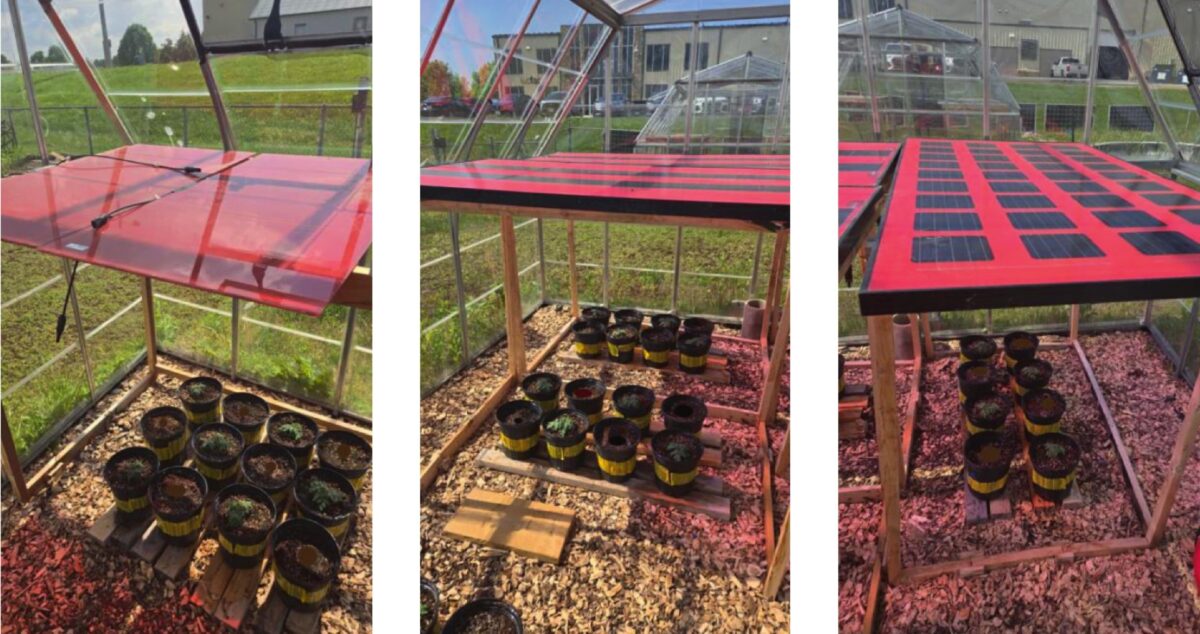
“Experimentally, we tested a number of semi-transparent PV configurations for greenhouses growing Red Robin tomatoes, including crystal silicon with 44% and 69% transparency, as well as luminous solar concentrators with 53% and 69% transparency, and red and blue thin-film panels with 50% transparency,” said corresponding study author Joshua M. Pearce. pv magazine. “The agrivoltaic systems maintained stable leaf chlorophyll levels and similar growth trends to the control systems, but 69% transparent crystal silicon PV improved yield the best by 38%. We’ve seen this before: crops often respond well to the mix of full sun and partial shade created by these types of modules. The effect is similar to the dappled shade that plants experience under a canopy, where they still receive sufficient sunlight while benefiting from periods of reduced heat and light stress.”
Based on the experiments, the research team ran an open source stack with EnergyPlus, Python and SAM to model industrial-scale greenhouses. “The results show that replacing the typical gas heater with a heat pump completely eliminated fossil fuel consumption and only increased electricity consumption by about 1.5 times,” Pearce continued. “The integration of the selected 69% transparent PV system with a heat pump enabled full electrification of an agrivoltaic greenhouse. This covered only about 13% of the total annual electricity demand. This indicates that if you want a fully agrivoltaic greenhouse including heating, it must be supplemented with agrivoltaic installations on the fields.”
In the study “Integration of semi-transparent photovoltaic modules and heat pumps in agrivoltaic tomato greenhouses: energy, economic and ecological savings”, published in Energy and BuildingsThe researchers explained that while previous experimental and simulation studies have demonstrated the potential of solar PV systems to meet some or all of the energy needs of heat pump-integrated greenhouses, none of them have examined the use of roof-mounted STPV modules nor specifically examined the direct impact of partial shading or transparency on plant growth metrics.
The team evaluated agrivoltaic greenhouse systems through five main phases: agrivoltaic experiments, greenhouse gas modeling, greenhouse gas and heat pump integration, semi-transparent photovoltaic (STPV) modeling, and general system analysis. Three software tools – EnergyPlus, Python and SAM – were used to simulate and analyze three greenhouse scenarios: a conventional gas-heated greenhouse, a heat pump-based greenhouse and an agrivoltaic greenhouse integrated with a heat pump and STPV modules on the roof.
Experimental research was conducted on the WIRED platform in London, Ontario, Canada, using two identical tomato greenhouses. Red Robin tomatoes were grown for 19 weeks under different agrivoltaic treatments and a control condition. Several bifacial STPV technologies with different transparency levels and spectral properties were tested, including crystalline silicon, cadmium telluride (CdTe) thin film, and luminescent solar concentrator modules (LSC).
Plant growth conditions were identical except for differences in light intensity and spectrum caused by the STPV modules. Chlorophyll content and environmental conditions were monitored, while thermal interactions between the greenhouse and the outdoor environment were modeled using local meteorological data and heat transfer principles. Additional LED lighting, evaporative effects, recirculation fans, humidity control and ventilation strategies were integrated to reproduce realistic greenhouse conditions for tomato production.
The performance of the entire system was evaluated using key performance indicators related to energy intensity, electricity and fuel consumption, operating cost savings, greenhouse gas yield and CO2 emissions reduction. Economic analyzes took into account local electricity and natural gas rates, while environmental impacts were assessed using Ontario-specific emission factors for electric grid and natural gas combustion.
The experiments showed that healthy cherry tomatoes could be successfully grown under all semi-transparent photovoltaic (STPV) treatments, as well as under conventional greenhouse conditions. Measurements of chlorophyll content and harvested fresh mass showed that most agrivoltaic treatments maintained plant health and productivity comparable to or better than the control.
Of the configurations tested, the 69% transparent crystalline silicon modules produced the most consistent and statistically reliable improvements in crop yield. Additionally, total harvested tomato yield under some STPV treatments increased by as much as 74% compared to the control, largely because partial shade reduced excessive light and heat stress on plants.
In addition, simulation results showed that replacing natural gas heating with heat pumps completely eliminated the use of fossil fuels while significantly reducing greenhouse gas emissions. Although electrification increased annual electricity demand, the higher efficiency of heat pumps limited the increase in operating costs.
“This marriage of agrivoltaic fields with partially powered agrivoltaic greenhouses, I think, makes for a nice synergistic strategy,” Pearce concluded. “You can use the incredible amounts of energy you can generate in agrivoltaic field crops with net behind-the-meter metering to make year-round greenhouse production economically and sustainably feasible.”
This content is copyrighted and may not be reused. If you would like to collaborate with us and reuse some of our content, please contact: editors@pv-magazine.com.
