
Close Menu
  • News
  • Industry
  • Solar Panels
  • Commercial
  • Residential
  • Finance
  • Technology
  • Carbon Credit
  • More
    • Policy
    • Energy Storage
    • Utility
    • Cummunity
What's Hot

Fraunhofer ISE develops colored film technology for patterned solar panels

April 23, 2026

Thermoacoustic heat pumps are on the verge of commercial breakthrough – SPE

April 23, 2026

The federal court has halted Trump administration orders that hinder solar and wind energy development

April 23, 2026
Facebook X (Twitter) Instagram
Solar Energy News
Thursday, April 23
  • News
  • Industry
  • Solar Panels
  • Commercial
  • Residential
  • Finance
  • Technology
  • Carbon Credit
  • More
    • Policy
    • Energy Storage
    • Utility
    • Cummunity
Solar Energy News
Home - Energy Storage - Hydrogen detection system for safety, quality control – SPE
Energy Storage

Hydrogen detection system for safety, quality control – SPE

solarenergyBy solarenergyNovember 7, 2024No Comments3 Mins Read
Facebook Twitter Pinterest LinkedIn Tumblr Email
Share
Facebook Twitter LinkedIn Pinterest Email

Researchers in Japan have developed an optimized hydrogen gas measurement using the TDLAS technique. Reportedly, it can achieve a detection range of hydrogen gas concentration from 0.01% to 100%. The group said it could improve the safety of hydrogen and therefore its adoption.

November 7, 2024
Lior Kahana

Scientists from Japan have developed a new method for measuring hydrogen gas, using tunable diode laser absorption spectroscopy (TDLAS) at different pressures and a high-pressure gas cell.

TDLAS is widely used for gas analysis, but has previously had difficulty quantifying low hydrogen concentrations due to its lower absorption compared to other gases in the near-infrared (NIR) region.

“Our system can significantly improve hydrogen detection systems for safety and quality control, facilitating wider adoption of hydrogen fuel,” explains Tatsuo Shiina, who led the research. “For example, this system can be used reliably to detect leaks in hydrogen fuel cell cars.”

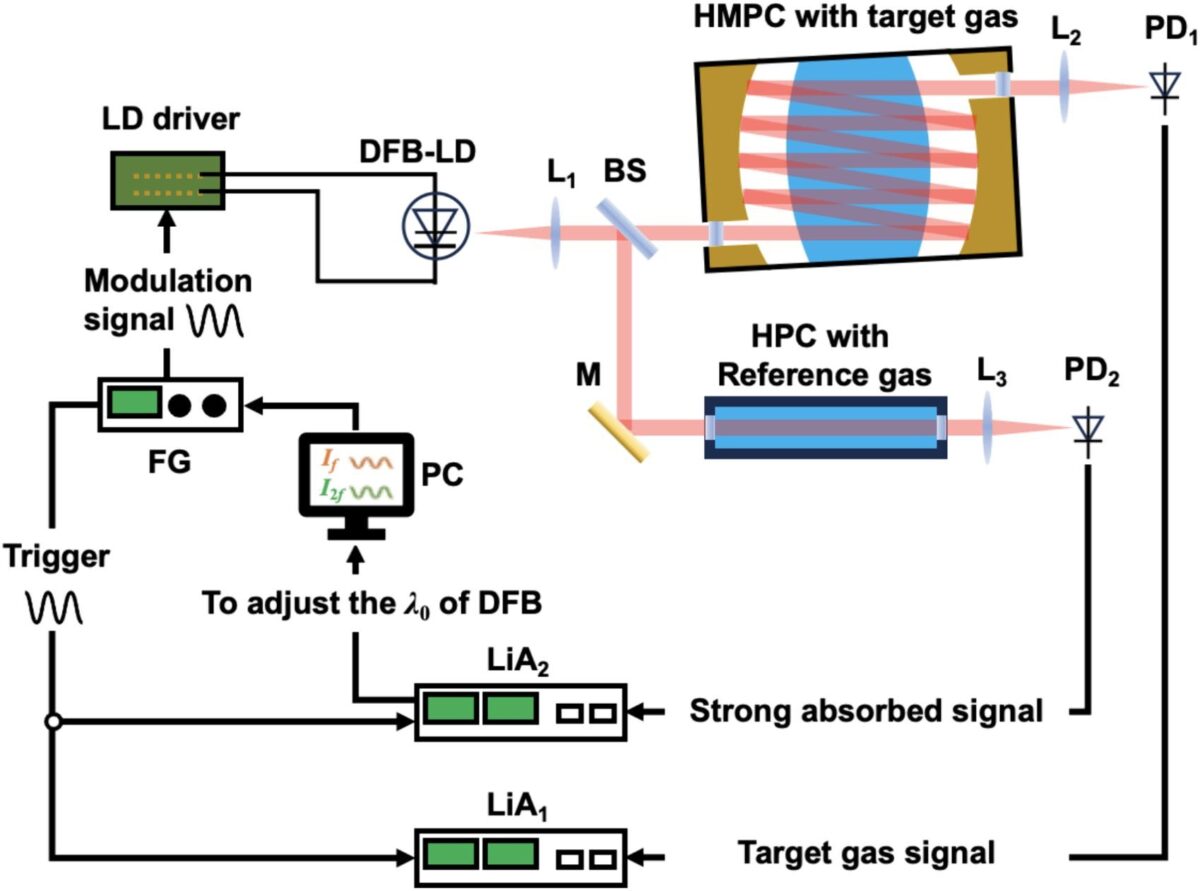
In TDLAS methods, a laser is passed through a Herriott multipass cell (HMPC) containing the target gas. The laser wavelength is modulated around the target absorption line of the gas to remove ambient noise, while the cell pressure can be tuned to influence the absorption line.

The researchers analyzed the width of hydrogen’s strongest absorption line at different pressures and, through a series of simulations, identified the optimal pressure for a wider absorption linewidth and the most effective modulation parameters within this linewidth.

Deviation from measured concentration

Image: Optics and Laser Technology, Chiba University, CC BY 4.0 license

They then applied those results to a calibration-free technique. Essentially, instead of processing just the second harmonic signal, as done in traditional TDLAS, they used the ratio of the first and second harmonics. By doing this, the academics were able to normalize the research and achieve the optimal measurement conditions for increasing the gas detection limit and stabilizing the wavelength lock for the laser diode.

See also  Key takeaways from the World Future Energy Summit in Abu Dhabi – SPE

The researchers also achieved accurate measurements of hydrogen concentrations in a wide detection range from 0.01% to 100%. “In addition, the results improved with longer integration times, the time period during which light is allowed to be absorbed. At an integration time of 0.1 second, the minimum detection limit was 0.3% or 30,000 ppm, which improved to 0.0055% or 55 ppm at an integration time of 30 seconds,” they explained. “However, after 30 seconds the minimum detection limit was increased.”

Concluding the study, the group added that despite identifying limitations related to optical elements and laser properties, “the experimental method shows excellent overall performance in measuring hydrogen concentrations. This innovative method for accurate hydrogen measurement offers potential applications in trace gas detection for hydrogen stations or hydrogen vehicles in the future. It can also be used for quality checks of hydrogen.”

Their findings were presented in “Optimization for quantitative measurement of hydrogen gas using tunable diode laser absorption spectroscopy”, published in Optics and laser technology. Scientists from Chiba University, Mitsubishi Electric Corporation, Kyushu University, Shikoku Research Institute and Tokai University conducted the research.

This content is copyrighted and may not be reused. If you would like to collaborate with us and reuse some of our content, please contact: editors@pv-magazine.com.

Popular content

Source link

control detection hydrogen quality safety SPE system
Share. Facebook Twitter Pinterest LinkedIn Tumblr Email
solarenergy
  • Website

Related Posts

Thermoacoustic heat pumps are on the verge of commercial breakthrough – SPE

April 23, 2026

Zendure launches battery ranges for residential PV – SPE

April 23, 2026

Solar energy’s rebound effect could increase European electricity demand by 5% by 2050 – SPE

April 23, 2026
Leave A Reply Cancel Reply

Don't Miss
News

How AI is driving new approaches to solar energy planning

By solarenergyJune 7, 20240

Panelists discuss AI and machine learning and their applications in finding greater revenue for PV…

The California vineyard will be 100% solar powered with a floating PV system

December 17, 2025

‘Landmark’ PPA with low carbon ink for London Hotels in Maybourne

February 12, 2025

Connecticut adds 8.3 MW of Solar Port Folio to seven correction facilities

April 26, 2025
Stay In Touch
  • Facebook
  • Twitter
  • Pinterest
  • Instagram
  • YouTube
  • Vimeo
Our Picks

Fraunhofer ISE develops colored film technology for patterned solar panels

April 23, 2026

Thermoacoustic heat pumps are on the verge of commercial breakthrough – SPE

April 23, 2026

The federal court has halted Trump administration orders that hinder solar and wind energy development

April 23, 2026

Zendure launches battery ranges for residential PV – SPE

April 23, 2026
Our Picks

Fraunhofer ISE develops colored film technology for patterned solar panels

April 23, 2026

Thermoacoustic heat pumps are on the verge of commercial breakthrough – SPE

April 23, 2026

The federal court has halted Trump administration orders that hinder solar and wind energy development

April 23, 2026
About
About

Stay updated with the latest in solar energy. Discover innovations, trends, policies, and market insights driving the future of sustainable power worldwide.

Subscribe to Updates

Get the latest creative news and updates about Solar industry directly in your inbox!

Facebook X (Twitter) Instagram Pinterest
  • Contact
  • Privacy Policy
  • Terms & Conditions
© 2026 Tsolarenergynews.co - All rights reserved.

Type above and press Enter to search. Press Esc to cancel.