

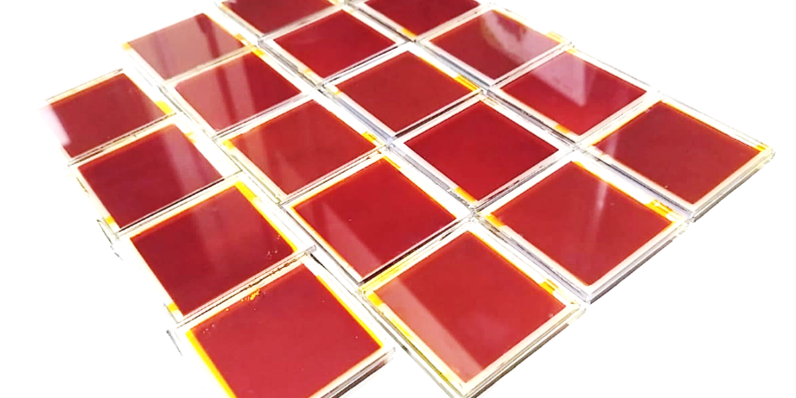
An India-based research team has increased the energy conversion efficiency and stability of dye-sensitized indoor solar cells based on co-sensitized organic dyes. The best indoor PV devices achieved 40% efficiency under 4000 lux fluorescent lighting and 10.40% under standard AM 1.5G one solar lighting.
A group of scientists led by India’s National Institute of Interdisciplinary Science and Technology (CSIR-NIIST) claims to have improved the stability and efficiency of dye-sensitized solar cells for indoor PV applications.
This type of solar cell, also called a Grätzel solar cell, named after its inventor, EPFL professor Michael Grätzel, is used to power electronic devices such as wireless sensors or Internet-of-things., with interior lighting.
“Our study introduces a significant advance in the field of dye-sensitized solar cells (DSCs) by using starburst-triphenylamine dye cocktails with a stiff, triple conjugated π-backbone. This molecular design improves light-gathering capabilities in the visible region, providing excellent overlap with indoor light spectra,” said Suraj Soman, corresponding author of the study. pv magazinenoting that the design included an asymmetric copper(II/I) electrolyte of two types introduced in previously published research by the group.
The team developed the cell with a novel starburst triphenylamine sensitizer (RJ-C6) that was combined with XY1b dye and its own dual-species asymmetric copper(II/I) electrolyte. “The precise structural design of the dyes promotes synergistic effects, allowing efficient molecular packing, enhanced dye loading and enhanced visible light absorption,” Soman continued. “Additionally, this configuration creates a robust barrier against electron transfer and recombination.”
The most challenging aspect of the research was identifying the ideal combination of dyes for co-sensitization. “Small variations in molecular structures, such as changing the length of alkyl chains or incorporating triple bonds, can profoundly affect photovoltaic performance under low-intensity indoor light. Achieving optimal dye packing on the semiconductor (TiO₂) is critical,” said Soman.
The combinations of dyes, electrolytes, semiconductor porosity, and device architecture that perform well under indoor lighting differ significantly from those optimized for standard sunlight conditions. “Customizing all these parameters specifically for indoor applications was the key to our success,” Soman explains.
The best performing devices had panchromatic absorption that overlapped the entire fluorescent light spectra. According to the researchers, it achieved 35% under 100 lux, 37% under 1000 lux and a record efficiency of 40% under 4000 lux, which they say brings DSCs one step closer to being used as an “attractive candidate for indoor photovoltaic applications.” ”
The cell also achieved an efficiency of 10.40% under standard AM 1.5 G solar radiation, and an energy conversion efficiency of 40% under indoor warm white compact fluorescent lamp (CFL).
In terms of stability, the academics reported that the RJ-C6:XY1b co-sensitized devices showed “promising stability” under accelerated indoor stability testing without degradation, even after 800 hours.
The cell measures 1.5 cm2 and has an active surface area of 0.32 cm2. The scientists pointed out that two of them, combined in series with an active area of 0.68 cm2, could power a clock and a temperature sensor under 1000 lux CFL lighting.
“These developments provide a sustainable alternative to conventional primary batteries, potentially reducing the environmental impact of millions of discarded batteries that contribute to landfill,” Soman said.
There are plans to transfer the technology from the laboratory to practical indoor and outdoor PV applications. “We are working to develop battery-free, self-powered devices, and some innovative products are already undergoing field trials. In addition, we are expanding our research into building-integrated solar photovoltaics (BIPVs) by developing colored, semi-transparent solar cells, with the aim of integrating aesthetics and functionality for energy-efficient buildings,” said Soman.
The design and details of the study appear in “Improved indoor photovoltaic efficiency of 40% in dye-sensitized solar cells using cocktail starburst triphenylamine dyes and dual species copper electrolyte”, published in Journal of Materials Chemistry A. The team also includes scientists from the Academy of Scientific and Innovative Research (AcSIR) and the National Institute of Technology Uttarakhand (NITUK).
This content is copyrighted and may not be reused. If you would like to collaborate with us and reuse some of our content, please contact: editors@pv-magazine.com.
