

Indian scientists developed a cadmium-free CIS thin-film solar cell using indium oxide as the electron transport layer and achieved a simulated efficiency of 29.79% with SCAPS-1D modeling. Through sensitivity analysis, they demonstrated that low defect density, optimized absorber thickness, and effective thermal management are critical for minimizing recombination losses and enabling high-performance, scalable devices.
Researchers from India’s Nirma University have designed a cadmium-free thin-film solar cell with a copper-indium selenide (CIS) absorber and an indium oxide (In₂O₃) electron transport layer (ETL).
They noted that although CIS thin films are promising solar absorbers due to their direct bandgap of about 1.5 eV and high absorption coefficient, device performance is often limited by trap-assisted recombination and inefficient collection of interfacial carriers.
“Historically, materials such as cadmium sulfide (CdS), titanium dioxide (TiO₂), zinc oxide (ZnO) and tin oxide (SnO₂) have been widely used as electron transport layers in thin-film solar cells,” said corresponding author Shibu G. Pillai. pv magazine. “However, they pose significant challenges for sustainable scale-up. CdS poses serious environmental and toxicity concerns, while Cd-free alternatives also have disadvantages: TiO₂ suffers from UV-induced photocatalytic degradation and low electron mobility, ZnO exhibits chemical instability, and SnO₂ often requires processing at high temperatures that can introduce interfacial trap states.”
“We chose In₂O₃ because it offers a unique combination of properties,” he added. “It offers high electron mobility, low resistivity, excellent optical transparency in the visible range and strong chemical stability. These characteristics enable efficient electron extraction from the CuInS₂ absorber and reduce interfacial recombination. In₂O₃ also avoids photocatalytic degradation and supports processing at lower temperatures, making it suitable for flexible substrates and lower energy consumption.”
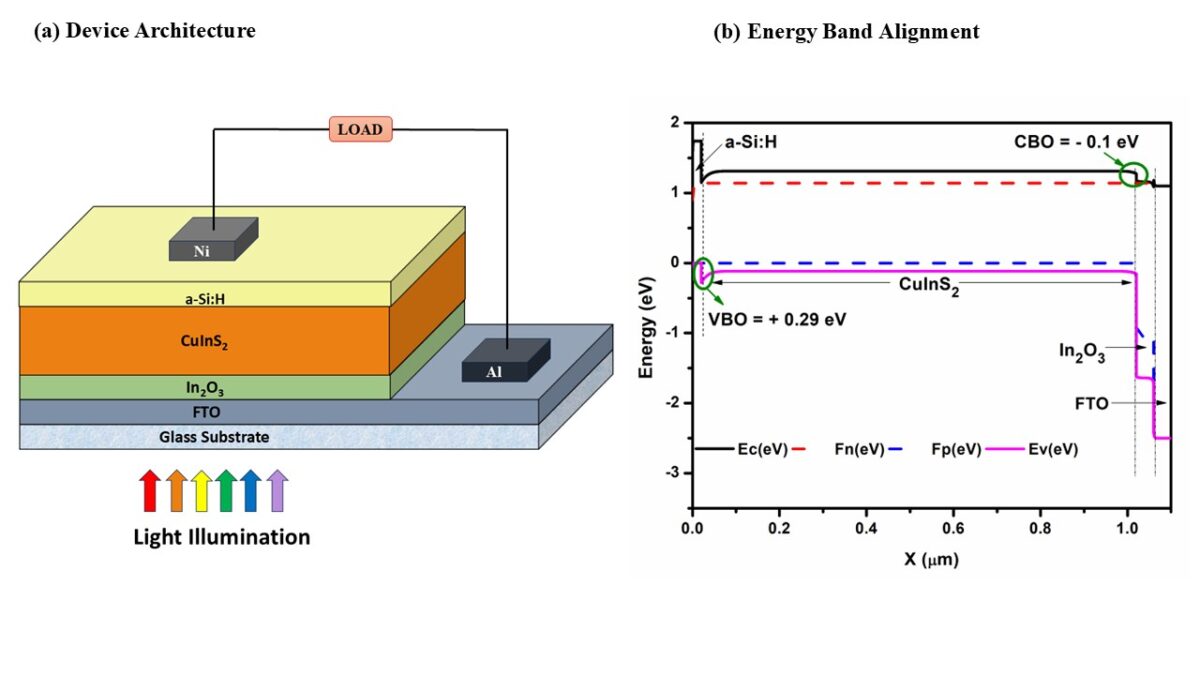
The proposed device structure consists of an aluminum (Al) front contact, a fluorine-doped tin oxide (FTO) substrate, an In₂O₃ ETL, a CuInS₂ absorber, an amorphous silicon (a-Si:H) hole transport layer, and a nickel back contact.
To evaluate the practical feasibility and robustness of the device, the researchers conducted an extensive parametric sensitivity analysis. By systematically varying absorber thickness, doping concentration, and defect density, they assessed tolerance under non-ideal conditions and identified an absorber thickness of approximately 1 μm. They also found that increased doping improves open-circuit voltage and fill factor, while excessive defect density promotes Shockley-Read-Hall recombination and degrades performance. Maintaining low bulk and interfacial defect densities is therefore critical for maintaining photovoltage and minimizing recombination losses.
Temperature-dependent simulations further showed that thermal effects significantly influence efficiency, underscoring the need for effective thermal management to limit carrier life degradation at higher temperatures. Furthermore, Voc decreases with increasing absorber thickness due to higher bulk recombination and increased saturation current density, while FF remains relatively stable, indicating limited resistive losses.
The optimized device achieved a peak power conversion efficiency of 29.79% in SCAPS-1D simulations. However, this value is based on idealized defect assumptions and represents a theoretical upper limit. Therefore, a detailed sensitivity analysis was used to assess the real-world applicability and stability of the device.
“Overall, combining CIS absorbers with In₂O₃ ETLs provides a clear, cost-effective and fully environmentally friendly path to high-performance flexible thin-film solar photovoltaics,” Pillai concluded.
The new cell concept was introduced in “Indium oxide as a powerful ETL for CuInS₂ thin-film solar cells”, published in Following materials.
This content is copyrighted and may not be reused. If you would like to collaborate with us and reuse some of our content, please contact: editors@pv-magazine.com.
