
Close Menu
  • News
  • Industry
  • Solar Panels
  • Commercial
  • Residential
  • Finance
  • Technology
  • Carbon Credit
  • More
    • Policy
    • Energy Storage
    • Utility
    • Cummunity
What's Hot

Fraunhofer ISE develops colored film technology for patterned solar panels

April 23, 2026

Thermoacoustic heat pumps are on the verge of commercial breakthrough – SPE

April 23, 2026

The federal court has halted Trump administration orders that hinder solar and wind energy development

April 23, 2026
Facebook X (Twitter) Instagram
Solar Energy News
Thursday, April 23
  • News
  • Industry
  • Solar Panels
  • Commercial
  • Residential
  • Finance
  • Technology
  • Carbon Credit
  • More
    • Policy
    • Energy Storage
    • Utility
    • Cummunity
Solar Energy News
Home - Technology - Korean researchers build back-contact perovskite solar cells with lower recombination losses – SPE
Technology

Korean researchers build back-contact perovskite solar cells with lower recombination losses – SPE

solarenergyBy solarenergyMarch 5, 2026No Comments3 Mins Read
Facebook Twitter Pinterest LinkedIn Tumblr Email
Share
Facebook Twitter LinkedIn Pinterest Email

The research team developed the perovskite solar cell with a spin-coated bilayer tin oxide electron transport layer that boosts charge extraction, achieving 4.52% efficiency and improved stability.

March 5, 2026
Ev Foley

Researchers from the University of Seoul (UOS) and Joenbuk National University (JNU) in South Korea have developed a novel double-layer tin oxide (SnO2) electron transport layer (ETL) via a simple spin-coating method, which significantly improves the efficiency and stability of back-contact perovskite solar cells (BC-PSCs).

“We chose SnO2 for the ETL because of its favorable conduction band alignment with perovskite and superior electron mobility compared to conventional titanium oxide,” Kim explains. “As a result, our double-layer ETL improves interfacial contact, reduces recombination losses and optimizes energy alignment for electron charge carriers.”

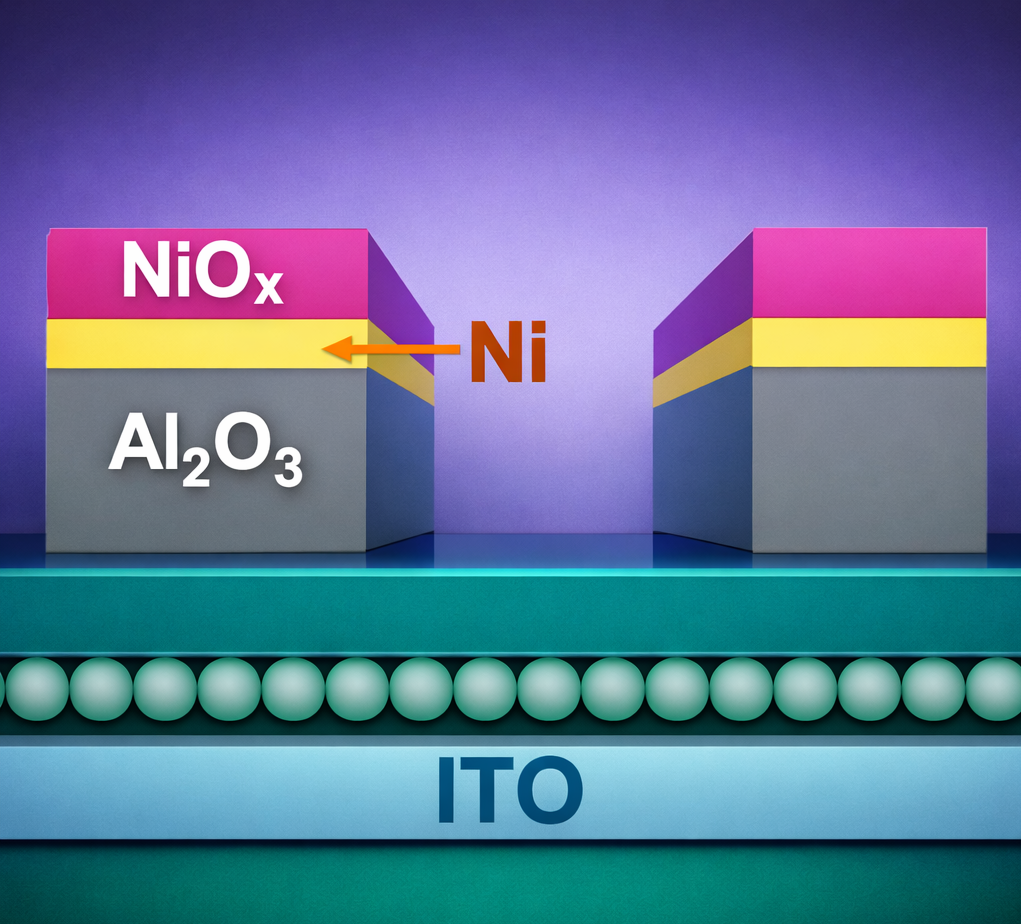
The device is built on a glass substrate covered with patterned indium tin oxide (ITO), the SnO₂ ETL, and a perovskite absorber. A line pattern nickel (Ni) electrode is fabricated using photolithography and then thermally oxidized to form nickel oxide (NiOx), which functions as the hole transport layer (HTL). The SnO₂ ETL and NiOx HTL were arranged side by side in an interdigitation pattern on the back of the device, allowing lateral charge collection. An aluminum oxide (Al2O3) insulating layer was applied to electrically insulate the electrodes and prevent short circuits, while a thin polymethyl methacrylate (PMMA) passivation layer was applied to protect the perovskite surface and reduce recombination.

In this architecture, light illuminates the perovskite layer directly from above without obstruction by front electrodes, while both electrons and holes are selectively extracted laterally via the back-contact SnO₂ and NiOx electrodes, respectively.

See also  Conflicts in the Middle East lift PPA ratings, says Pexapark – SPE

To evaluate the role of ETL engineering, the researchers fabricated three BC-PSC devices with different SnO2-based ETLs: a colloidal SnO2 made of nanoparticles, a sol-gel SnO2, and a bilayer SnO2 consisting of a nanoparticle-SnO2 layer combined with a sol-gel layer. Each ETL was spin-coated onto indium tin oxide substrates and patterned via photolithography.

A series of experiments compared the performance of the devices, showing that the bilayer SnO2 device yielded the highest average photocurrent of 33.67 picoamps (pA), outperforming the sol-gel SnO2 device at 26.69 pA and the colloidal SnO2 device at 14.65 pA.

The dual-layer SnO2 device also achieved a maximum energy conversion efficiency of 4.52%, which was the highest among the three and improved operational stability due to improved charge recombination suppression.

“BC-PSC devices hold promise for a variety of applications, including flexible devices and large-area solar panels, due to their high efficiency, improved stability and scalable design,” said Baek. “We believe our findings will help accelerate the development of practical BC-PSC technologies for real-world applications while advancing sustainable energy solutions.

The “Interface engineering for efficient and stable back-contact perovskite solar cells” study, led by UOS Department of Chemical Engineering Associate Professor Min Kim and JNU School of Chemical Engineering PhD student Dohun Baek, was published in the Power Sources Journal.

This content is copyrighted and may not be reused. If you would like to collaborate with us and reuse some of our content, please contact: editors@pv-magazine.com.

Popular content

Source link

backcontact build cells Korean losses perovskite recombination researchers solar SPE
Share. Facebook Twitter Pinterest LinkedIn Tumblr Email
solarenergy
  • Website

Related Posts

Fraunhofer ISE develops colored film technology for patterned solar panels

April 23, 2026

Thermoacoustic heat pumps are on the verge of commercial breakthrough – SPE

April 23, 2026

The federal court has halted Trump administration orders that hinder solar and wind energy development

April 23, 2026
Leave A Reply Cancel Reply

Don't Miss
News

Fera Science appoints Meson Electrical for a tailor-made solar installation

By solarenergySeptember 23, 20240

The solar installation at Fera. Image: Fera/Meson Fera Science has chosen electrical specialist Meson Electrical…

Saudi -Arabia characters 5 Solar PPAs of a total of 12 GW – PV Magazine International

July 14, 2025

The Treasury Department announces final rules for 45x domestic manufacturing tax credits

October 24, 2024

Molecular adjustments increase the efficiency of organic solar cells

September 17, 2024
Stay In Touch
  • Facebook
  • Twitter
  • Pinterest
  • Instagram
  • YouTube
  • Vimeo
Our Picks

Fraunhofer ISE develops colored film technology for patterned solar panels

April 23, 2026

Thermoacoustic heat pumps are on the verge of commercial breakthrough – SPE

April 23, 2026

The federal court has halted Trump administration orders that hinder solar and wind energy development

April 23, 2026

Zendure launches battery ranges for residential PV – SPE

April 23, 2026
Our Picks

Fraunhofer ISE develops colored film technology for patterned solar panels

April 23, 2026

Thermoacoustic heat pumps are on the verge of commercial breakthrough – SPE

April 23, 2026

The federal court has halted Trump administration orders that hinder solar and wind energy development

April 23, 2026
About
About

Stay updated with the latest in solar energy. Discover innovations, trends, policies, and market insights driving the future of sustainable power worldwide.

Subscribe to Updates

Get the latest creative news and updates about Solar industry directly in your inbox!

Facebook X (Twitter) Instagram Pinterest
  • Contact
  • Privacy Policy
  • Terms & Conditions
© 2026 Tsolarenergynews.co - All rights reserved.

Type above and press Enter to search. Press Esc to cancel.