

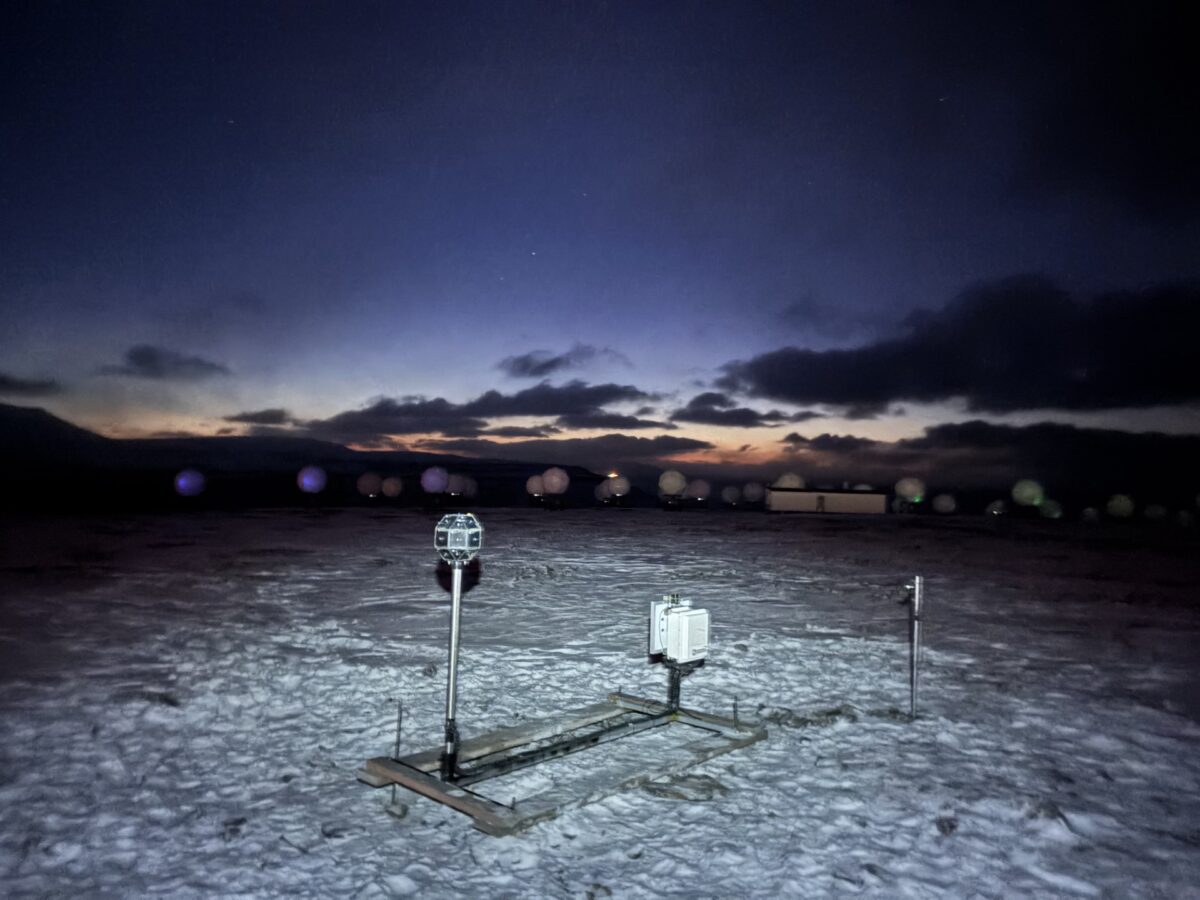
Norwegian researchers have developed a multi-pyranometer method to more accurately estimate global tilted radiation (GTI) in the Arctic by separating beam, diffuse and reflected solar components. This approach was validated in the world’s northernmost settlement and was found to outperform conventional models in high-latitude conditions and improve the design of PV systems for extreme environments.
A research team from Norway has proposed a new method to estimate global tilted radiation (GTI) in the Arctic.
The approach uses measurements from a 25-pyranometer array developed by the team to reconstruct the components of solar radiation: direct beam, diffuse airborne radiation and radiation reflected from the ground. These components are then used to calculate solar radiation for each tilt and orientation.
“Our multipyranometer instrument GLOB was first used in the Arctic, where the sun is low on the horizon, to provide an accurate picture of the solar energy potential on inclined planes,” said lead author Arthur Garreau. pv magazine. “We have now also installed it at a location where a PV installation is planned in the coming years.”
The project site is located in Longyearbyen, the world’s northernmost settlement, approximately halfway between the northern coast of mainland Norway and the North Pole. According to the researchers, conventional GTI models often perform poorly at high latitudes due to low solar elevation angles, strong snow reflectivity, and reliance on empirical models developed for mid-latitude conditions.
“The Longyearbyen project will be the northernmost solar PV plant in the world,” Garreau added. “Our goal is to support project stakeholders at the design stage by providing accurate data on the solar energy potential on the selected slope.”
GLOB consists of 25 silicon cell pyranometers mounted on a geometric structure, with each sensor pointed at a different slope and azimuth to capture incoming radiation from the opposite side of the sky. An additional downward-facing sensor measures the reflected radiation from the ground.
Image: The University Center in Spitsbergen
By capturing the radiation from multiple angles simultaneously, the system provides a detailed characterization of the incoming solar radiation. The measurements are combined using a least-squares inversion to linearly estimate the direct and diffuse components of solar radiation. In a second, non-linear estimation approach, the same dataset is also used to derive the ground reflectivity. Once these components are determined, a transposition model is applied to calculate the global tilted irradiance (GTI) for any desired surface tilt and orientation.
However, the researchers did not always rely on all 25 pyranometers. Suspecting that a larger number of sensors might introduce noise, and with the goal of assessing the potential for a lower-cost configuration, they tested combinations of 3, 4, 5, 9, 13, and 25 pyranometers under both linear and nonlinear processing schemes. When validated against high-quality reference data from a Baseline Surface Radiation Network (BSRN) station, the nonlinear configuration of 13 pyronometers provided the best overall performance, with a normalized root mean square error (nRMSE) of approximately 36% for beam irradiation and 23% for diffuse irradiation.
“We were surprised by the accuracy achieved by a five-pyronometer setup,” noted lead author Arthur Garreau. Using only five sensors and a linear inversion method, the system achieved an nRMSE of approximately 38% for beam irradiation and 23% for diffuse irradiation. The results were compared to conventional decomposition models and consistently showed improved accuracy.
Using the optimal non-linear configuration of 13 pyranometers, the team then calculated the GTI for Adventdalen, near Longyearbyen. The results indicate that, for monofacial systems, peak irradiation occurs at a slope of approximately 45° facing south. For bifacial configurations, the highest values were found at an inclination of approximately 70°, with south and southeast orientations.
“We also found that the solar energy potential at high latitudes for bifaces is nearly optimal over a wide range of azimuths and for tilt angles between 60° and 90°,” Garreau concluded. “This provides greater design flexibility for PV installations in harsh Arctic environments.”
The new approach was described in “Improving solar energy estimates for tilted surfaces in the Arctic using a multi-pyranometer array”, published in Solar energy. Researchers from the Norwegian University Center in Spitsbergen and the Norwegian University of Science and Technology contributed to the study.
This content is copyrighted and may not be reused. If you would like to collaborate with us and reuse some of our content, please contact: editors@pv-magazine.com.
Popular content

