

MXene additive increases heat resistance and efficiency in perovskite solar cells
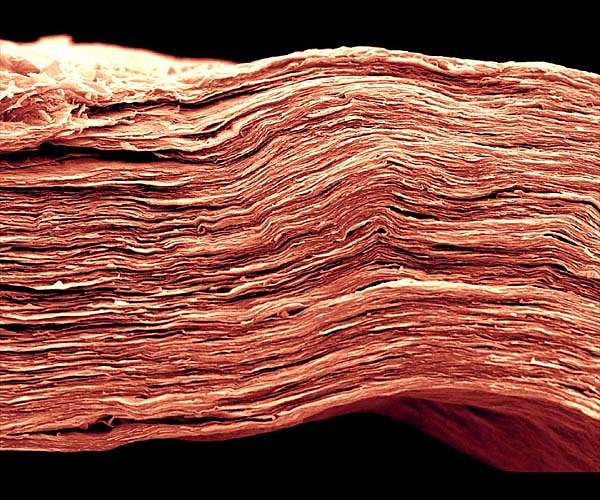
As perovskite solar cells move closer to mass production, heat-induced degradation continues to hinder their long-term stability. Researchers from the University of Electronic Science and Technology of China, led by Professors Zhongquan Wan, Junsheng Luo and Chunyang Jia, have now demonstrated a multifunctional approach using Ti3C2Tx MXene nanosheets that improve both thermal conductivity and optoelectronic properties.
The incorporation of Ti3C2Tx MXene into the perovskite layer significantly improves thermal transport, increases conductivity from 0.236 to 0.413 Wm-1-K-1 and reduces operating temperatures by approximately 3 C under illumination. At the same time, surface terminations on the nanosheets passivate Pb2+ defects, reducing non-radiative recombination losses. Adjustments to the material’s work function further optimize charge extraction and transport across device interfaces.
By embedding Ti3C2Tx nanosheets along perovskite grain boundaries, the team established efficient thermal conduction pathways and achieved a smoother film morphology, reducing surface roughness from 24.9 to 15.2 nm. This integrated approach combines heat removal, defect suppression and energy level tuning within a single additive, providing a route to more sustainable and efficient perovskite photovoltaics.
The modified devices achieved a peak power conversion efficiency of 25.13 percent, compared to 23.70 percent in control samples. They also showed superior thermal endurance, maintaining 80 percent of initial performance after 500 hours at 85 C and 30 +/- 5 percent relative humidity, while the control devices dropped to 58 percent after 200 hours. During continuous monitoring of maximum power in nitrogen, the MXene-enhanced cells retained 70 percent of their efficiency after 500 hours, compared to only 20 percent for unmodified cells.
The researchers note that future work will focus on large-scale synthesis, cost optimization and compatibility with encapsulation processes. The findings underscore the potential of MXene materials to overcome thermal management challenges in perovskite solar technology, enabling the next generation of highly efficient, thermally resilient solar photovoltaics.
Research report:Multifunctional MXene for thermal management in Perovskite solar cells
