
Close Menu
  • News
  • Industry
  • Solar Panels
  • Commercial
  • Residential
  • Finance
  • Technology
  • Carbon Credit
  • More
    • Policy
    • Energy Storage
    • Utility
    • Cummunity
What's Hot

Why the UK solar industry needs to own its safety story

April 23, 2026

Fraunhofer ISE develops colored film technology for patterned solar panels

April 23, 2026

Thermoacoustic heat pumps are on the verge of commercial breakthrough – SPE

April 23, 2026
Facebook X (Twitter) Instagram
Solar Energy News
Thursday, April 23
  • News
  • Industry
  • Solar Panels
  • Commercial
  • Residential
  • Finance
  • Technology
  • Carbon Credit
  • More
    • Policy
    • Energy Storage
    • Utility
    • Cummunity
Solar Energy News
Home - Technology - New pulse width modulation technology to reduce switching losses in three-phase inverters – SPE
Technology

New pulse width modulation technology to reduce switching losses in three-phase inverters – SPE

solarenergyBy solarenergyJuly 1, 2024No Comments3 Mins Read
Facebook Twitter Pinterest LinkedIn Tumblr Email
Share
Facebook Twitter LinkedIn Pinterest Email

Scientists in the Emirates have devised a new space vector pulse width modulation method that reportedly reduces switching losses and increases efficiency in three-phase photovoltaic inverters. The proposed technique was found to have higher efficiency while delivering lower common-mode voltage, leakage current, and total harmonic distortion compared to traditional pulse-width modulation approaches.

July 1, 2024 Emiliano Bellini

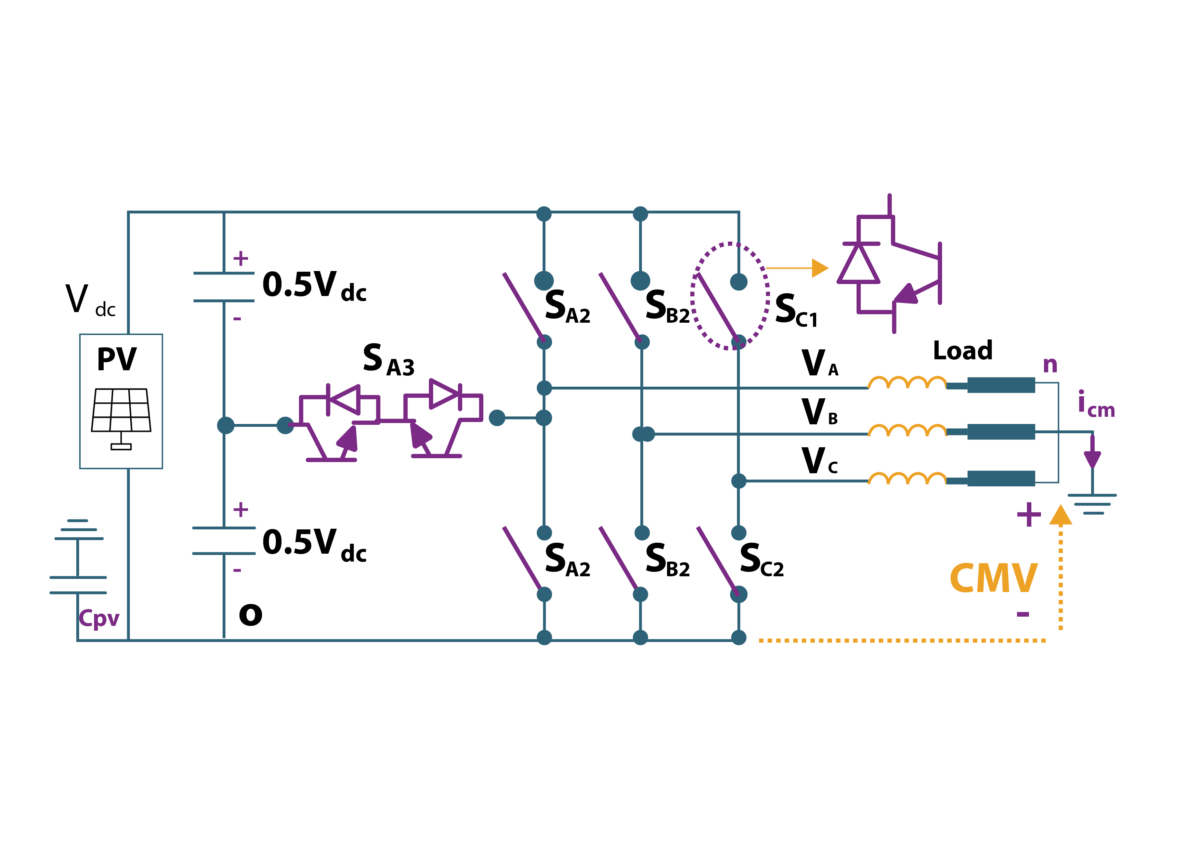
Researchers from Khalifa University in the United Arab Emirates have developed a new space vector pulse width modulation (SVPWM) technique for controlling the switches and reducing switching losses in three-phase photovoltaic inverters.

The proposed approach aims to reduce the common-mode voltage (CMV), which is generated by the switching action of pulse-width modulation (PWM) converters and which commonly leads to bearing failure and electromagnetic interference (EMI) and, in some cases, ground leakage current , insulation failure and defective motor bearings.

In the study “An energy-efficient control method for a photovoltaic system using a new three-phase inverter with a lower common-mode voltage,” published in Heliyonthe group stated that the new SVPWM method effectively reduces and minimizes inverter losses the derivative of the voltage with respect to time (dv/dt) of the CMV, reduces the maximum peak value of the CMV and simplifies the duty cycle calculation.

The proposed technique is intended for use in inverters with one 3-level leg, two 2-level legs and 12 possible switching states: 10 active vectors and 2 zero vectors. “These additional voltage vectors help reduce the maximum peak value of the CMV and the dv/dt,” the scientists explained. “The new SVPWM generates the reference output voltage using only eight vectors.”

See also  Australian grid operator backs community battery to boost grid stability – SPE

The performance of the new method was tested through a series of simulations and compared with that of other conventional pulse width modulation (PWM) techniques. The scientists assumed a switching frequency of 2 kHz, a DC link voltage of 100 V, a load resistance of 11 Ω, a load inductance of 0.06 H, a PV parasitic capacitance of 500 nF and a DC link capacitor of 4,700 nF. μF.

The analysis showed that the peak value of CMV achieved by the new technique was up to 33.33% lower than the value achieved by the conventional PWM methods. The new approach was also found to achieve 12.92% lower total losses and 0.65% higher efficiency, and require less complex and numerous mathematical calculations to calculate duty cycles and identify sectors, compared to existing PWM approaches .

The researchers also said that the new technique is able to achieve balanced DC link voltage and higher efficiency at a higher modulation index compared to traditional PWM methodologies.

“In conclusion, the proposed PWM offers higher efficiency, lower CMV, leakage current and total harmonic distortion (THD) of phase current compared to the other PWMs,” she added. “The new SVPWM offers the best THD of phase currents, which is 32.8% lower than the THD of phase currents in other PWMs.”

Popular content

This content is copyrighted and may not be reused. If you would like to collaborate with us and reuse some of our content, please contact: editors@pv-magazine.com.

Source link

Inverters losses modulation pulse reduce SPE Switching technology threephase width
Share. Facebook Twitter Pinterest LinkedIn Tumblr Email
solarenergy
  • Website

Related Posts

Fraunhofer ISE develops colored film technology for patterned solar panels

April 23, 2026

Thermoacoustic heat pumps are on the verge of commercial breakthrough – SPE

April 23, 2026

Zendure launches battery ranges for residential PV – SPE

April 23, 2026
Leave A Reply Cancel Reply

Don't Miss
Solar Industry

New York Bulk Energy Storage RFP is looking for 1 GW, part of Nyserda Roadmap

By solarenergyAugust 13, 20250

By Chris Crowell August 13, 2025 Governor Kathy Hochul and Nyserda open competitive request for…

Patents to add AI to electricity grids are increasing, says IEA – SPE

December 15, 2024

Estonia records 1.1 GWh heat storage, 250 MWh BESS and 800 MWh battery park – SPE

February 22, 2026

Statkraft and FP Lux sign Scurf Dyke PPA

July 19, 2024
Stay In Touch
  • Facebook
  • Twitter
  • Pinterest
  • Instagram
  • YouTube
  • Vimeo
Our Picks

Why the UK solar industry needs to own its safety story

April 23, 2026

Fraunhofer ISE develops colored film technology for patterned solar panels

April 23, 2026

Thermoacoustic heat pumps are on the verge of commercial breakthrough – SPE

April 23, 2026

The federal court has halted Trump administration orders that hinder solar and wind energy development

April 23, 2026
Our Picks

Why the UK solar industry needs to own its safety story

April 23, 2026

Fraunhofer ISE develops colored film technology for patterned solar panels

April 23, 2026

Thermoacoustic heat pumps are on the verge of commercial breakthrough – SPE

April 23, 2026
About
About

Stay updated with the latest in solar energy. Discover innovations, trends, policies, and market insights driving the future of sustainable power worldwide.

Subscribe to Updates

Get the latest creative news and updates about Solar industry directly in your inbox!

Facebook X (Twitter) Instagram Pinterest
  • Contact
  • Privacy Policy
  • Terms & Conditions
© 2026 Tsolarenergynews.co - All rights reserved.

Type above and press Enter to search. Press Esc to cancel.