

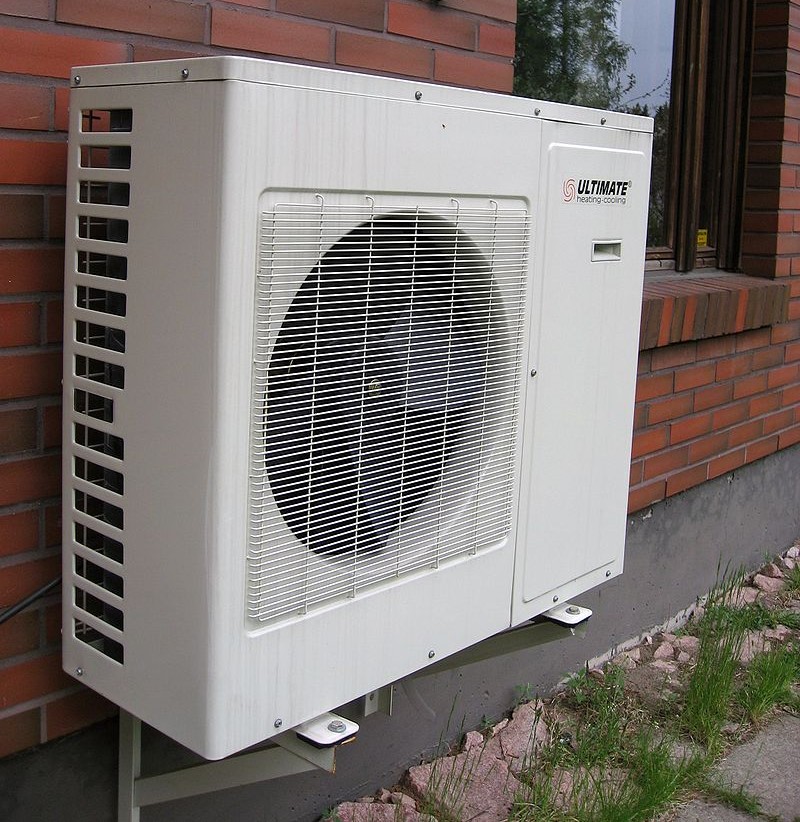
The new refrigerant, developed by a Chinese research group, is made from a mixture of carbon dioxide (CO2) and a non-flammable hydrofluorolefin. It has a slightly higher cost compared to conventional compounds, but its makers claim that these costs can be significantly reduced with large-scale industrial production.
A group of scientists led by Zhejiang University in China have developed a new zeotropic refrigerant that can reportedly improve the performance of air source heat pumps (ASHPs), while also offering a number of safety and stability benefits.
“The cost of this new refrigerant is only slightly higher than that of commonly used counterparts,” said the study’s lead author, Jeilin Luo. pv magazine. “For example, based on our experience, the new refrigerant is approximately €15/kg higher than the most commonly used refrigerant R134a on the market. And we believe costs will continue to fall as industrial production increases and traditional refrigerants are phased out.”
In the study “Energy, exergy, economic and environmental studies on a non-flammable environmentally friendly mixture for efficient heating in cold areas”, published in Energy conversion and managementexplained to the group that tThe refrigerant is made from a mixture of carbon dioxide (CO2) and a non-flammable hydrofluorolefin (HFO) known as trans-1,1,1,4,4,4-hexafluoro-2-butene (R1336mzz(E)). this is the first time it has been tested in ASHPs.
The group also explained that azeotropic refrigerants typically cannot achieve high efficiency without flammability or high global warming potential (GWP). “Zeotropic refrigerants still pose safety and environmental risks,” they said, noting that CO2/HFO blends have the potential to achieve safety and environmental friendliness. “CO2 and R1336mzz(E) are both non-flammable with a GWP lower than 7.”
The scientists carried out a series of simulations to assess the performance of the proposed refrigerant and considered its use in an ASHP consisting of a compressor (COMP), a condenser (CON), a separator (SEP), a recuperator (REC), an evaporator (EVA), expansion valves (EXV1 and EXV2), control valves (CV1-CV3) and connecting pipes.
In the proposed system configuration, the zeotropic CO2/R1336mzz(E) mixture is initially brought to high pressure and high temperature by COMP. Then the CON releases heat to heat water and the mixture of CON splits into two streams, with the stream through CV1 being separated into vapor and liquid by SEP.
“The vapor is mixed with the stream flowing through CV2 and is cooled in REC into a supercooled liquid,” the scientists explain. “This supercooled liquid is smothered by EXV1 to reach an even lower temperature before EVA.”
The flow of coolant also absorbs heat from the air in EVA and then exchanges heat in REC, where it is mixed with the liquid being throttled by EXV2. The mixed flow continues to absorb heat in REC and then returns to the inlet of COMP.
The simulations were carried out in a MATLAB environment and showed that the ASHP using the new refrigerant can achieve a 21.2% higher coefficient of performance (COP) and a 13.5% higher seasonal performance factor (HSPF) for heating compared to heat pumps using use conventional coolants. “And the improvement is more evident in central-north China, which has a high population density,” the academics specified.
Further economic analysis also showed that the proposed ASHP system has a payback period of less than 7.5 years and annual cost savings of up to 14.5%. It also achieved significant CO2 emissions reductions of more than 15.7% compared to traditional ASHP systems.
“We test the refrigerant in a practical system,” Luo said. “We conducted a series of laboratory-scale tests and confirmed its applicability and performance superiority. The experiment is still running and we have confidence in it.”
This content is copyrighted and may not be reused. If you would like to collaborate with us and reuse some of our content, please contact: editors@pv-magazine.com.
