

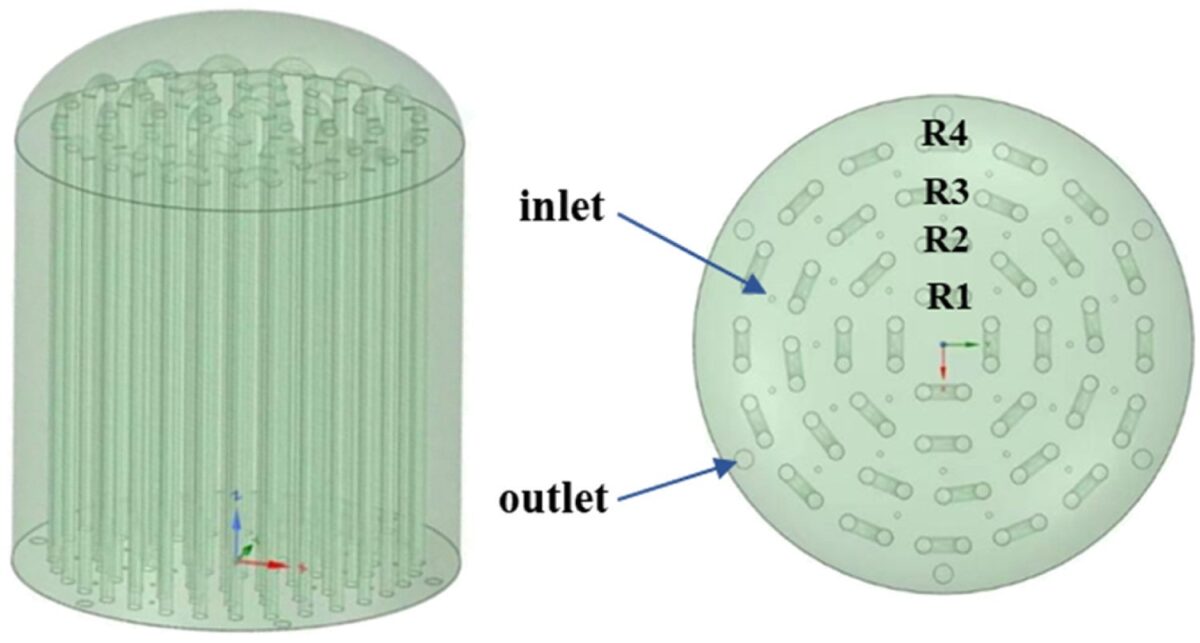
Chinese researchers developed an electric heating model to support uniform material temperature in a new four-ring, 80-rod industrial Siemens reactor.
A Chinese team led by researchers from Kunming University of Science and Technology and Yunnan Yuntong Zinc Co. built a model to simulate the electrical heat processing of U-shaped silicon rods in a new four-ring, 80-rod industrial Siemens reactor.
The research team noted that previous studies showed that using high-frequency alternating current (AC) “could significantly improve temperature uniformity in polysilicon rods due to the skin effect,” albeit in much smaller reactors, and developed a new heating model. It covered thermal and electrical behavior and multi-ring interaction for large-scale polysilicon reduction furnaces.
In the study “The temperature uniformity within U-style silicon located in a new Siemens reactor with 80 rods and a high silicon core”, published in Results in technologythe team described its research into the effects of direct current (DC) and AC heating on the thermal and electrical performance within the polysilicon reduction furnace.
The goal was to support a more uniform temperature distribution between the center and surface of the silicon rods to improve the energy efficiency of the process.
The numerical simulations of the polycrystalline silicon material were done with Comsol software. The study also used the Joule heating model, the direct current model and the heat transfer model. Details were also given on the boundary conditions, key parameters and how the temperature gradients in the reactor were determined.
To validate the accuracy of the simulation, the stress obtained from the model was compared with data from an industrial 80-bar polysilicon reduction reactor.
The analysis showed that the model “accurately” predicts thermal and electrical behavior with a relative error of less than 10%, the article said.
The researchers said that AC heating “significantly improves temperature uniformity” and that adjusting the frequency can reduce the center temperature. The regression equation, based on the average data from four rings, developed by the team reportedly predicts accurately with an average relative error of only 4.62%.
The team also noted the “strong” interaction between frequency and diameter between 5 kHz and 200 kHz. Above 300 kHz the temperature difference stabilizes and the interaction effect weakens.
The research team included members from Yunnan Yuntong Zinc Co., Kunming University of Science and Technology, Yunnan Tongwei High Purity Crystal Silicon, a unit of Tongwei, and Kunming Metallurgical Research Institute.
This content is copyrighted and may not be reused. If you would like to collaborate with us and reuse some of our content, please contact: editors@pv-magazine.com.
