

NREL researchers found that UV exposure can cause significant, some of it non-repairable degradation in TOPCon solar cells, with strong cell-to-cell and intra-cell variability related to passivation and processing inconsistencies. While some UV-related losses recover quickly under light and are unlikely to affect field performance, the findings highlight gaps in current qualification testing and the need for better UV aging standards.
Researchers at the U.S. Department of Energy’s National Laboratory of the Rockies (NREL) have quantified the performance loss due to ultraviolet (UV) light in TOPCon solar cells and found that cells with high UV-induced degradation (UVID) exhibit injection-dependent effective carrier lifetime and high variability within a cell, indicating potential processing inconsistencies.
“Degradation under UV exposure is of particular interest, both because it results in this interesting phenomenon of recoverable versus non-recoverable losses in TOPCon, but also because UV light exposure is severely underrepresented in existing qualification tests,” said the study’s lead author, Dana Kern. pv magazine. “That means UV sensitivity can go undetected for PV products that pass other typical accelerated test sequences. This is widely recognized in our community, which has resulted in global efforts to standardize UV aging testing on PV cells and modules.”
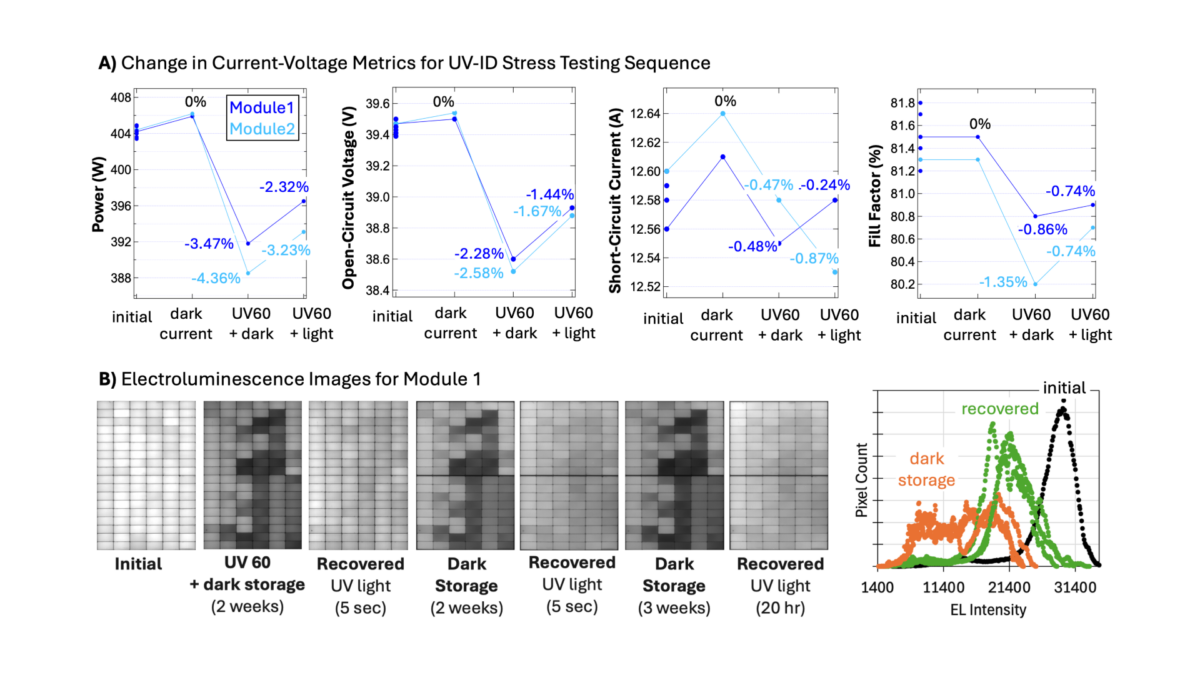
Kern also explained that UV aging tests must take into account the mechanisms of UVID and associated metastability, to recover the energy loss associated with dark storage before characterization in accelerated testing environments. “Only the field-relevant loss should be considered, and the dark storage loss is quickly recovered in sunlight, which limits how much impact this metastability would have on modules operating outdoors,” she pointed out. “The severity of module degradation could be seriously overestimated by leaving the modules in the dark after UV aging, or even leaving modules in the dark awaiting characterization after being removed from outdoor aging if the modules have been affected by outdoor UVID.”
“We applied a non-destructive approach at the module level,” Kern continued. “Using in-situ electroluminescence (EL) imaging, we watched the modules deteriorate for up to 500 hours in the dark. We then turned on UV-LED spotlights and saw the modules recover quickly within seconds to minutes. Importantly, we saw a wide range of how severe the dark storage degradation was for each cell within the same module. However, all cells had a similar time-dependent response, even as the maximum severity varied from cell to cell.”
After noting that the magnitude of UVID and metastability varied between cells within the same module, the scientists further wondered whether non-uniformity of UV sensitivity exists even within a given cell. To address this, they performed intensity-dependent photoluminescence (PL) and EL imaging, which showed that cells with more severe loss of dark storage have both higher severity of trap-assisted recombination and higher non-uniformity in their dark storage condition. “We believe that this variance of the injection-level dependence indicates non-uniformity in the passivation or interface quality, which we hope to investigate further,” Kern said.
The researchers concluded that a non-recoverable UVID of 2.3% to 3.2% after one year of equivalent UV dose represents severe degradation that would exceed typical warranty limits for modules. They added that while recoverable dark metastability is unlikely to be relevant in the field, it provides insight into degradation mechanisms and could help differentiate samples if it scales up with non-recoverable UVID.
This content is copyrighted and may not be reused. If you would like to collaborate with us and reuse some of our content, please contact: editors@pv-magazine.com.
