

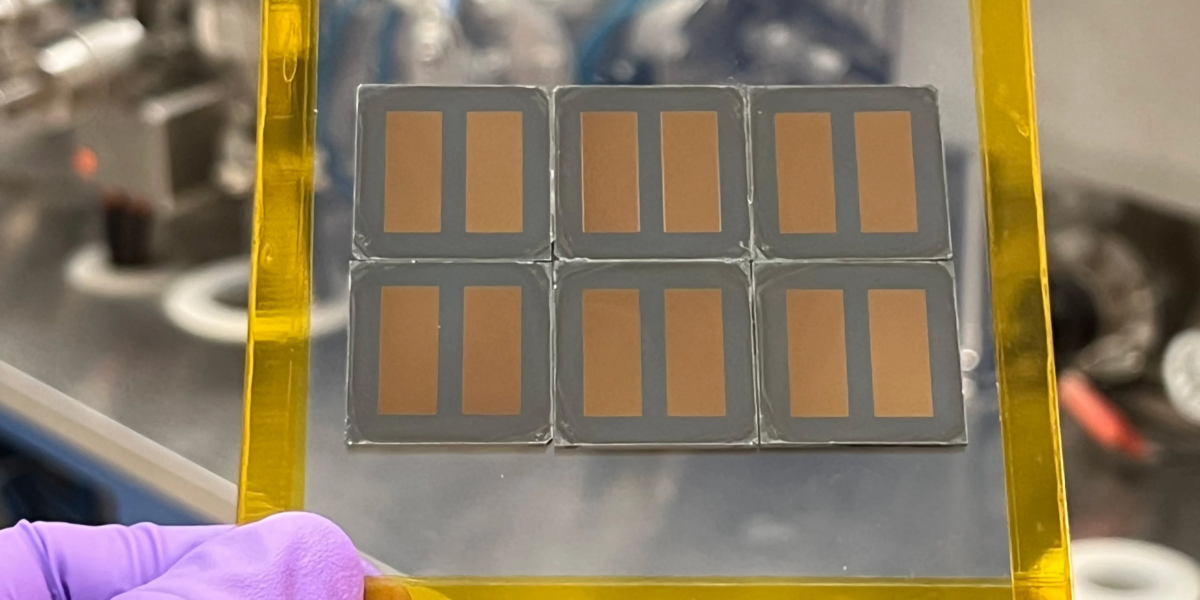
Researchers from Nanyang Technological University have demonstrated a method to integrate chemically inert low-dimensional interface materials into the fabrication of inverted perovskite solar cells. Their prototype solar cells retained more than 93% of the initial energy conversion efficiency of 25.1% after 1,000 hours of operation and 98% after 1,100 hours at 85 C.
A research team from Nanyang Technological University (NTU) in Singapore has developed a selective template growth method that enables the use of certain chemically inert materials in perovskite thin films, overcoming issues with solubility processes and reactivity, to enable more stable yet efficient perovskite solar cells (PSC).
“Our strategy enables access to a class of chemically inert interface materials that previously could not be used due to reactivity and solubility limitations, opening a new avenue for interface engineering in perovskite devices,” said co-corresponding author Tze Chien Sum in an NTU statement.
The group’s new Selective Templating Growth (STG) method for chemically inert low-dimensional (CI LD) materials allows interfaces to grow via an organic cation exchange process.
The research is described in “Selective template growth of chemically inert low-dimensional interfaces for perovskite solar cells”, recently published in Nature energy. It is the latest achievement from NTU, which has been working on stable and efficient perovskite devices.
In the study, the team deposited a layer of phenylammonium lead iodide (PA2PbI4), a representative CI LD interface, on the perovskite surface. Next, a chemically inert bulky cation – 2-piperidin-1-ium-1-ylethylammonium (PiEA2+) was introduced by spin-coating an alcohol-based PiEA2+ solution onto the PA2PbI4 layer, according to an NTU statement.
“Through a controlled organic cation exchange process, in which PA+ is replaced by PiEA2+, a more stable ultra-thin layer of (PiEA)PbI4 is formed,” the report said.
The prototypes are made with a pin architecture. The active areas of the tested solar cells were 0.060 cm2 for small-area devices and 1.235 cm2 for large-area devices. The PSC devices had a hole transporting layer based on MeO-2PACZ or MPA-CPA. The 3D perovskite layer was based on a formamidinium-cesium (Cs0.15FA0.85PbI2.8Cl0.2) composition.
The 2D (PiEA)PbI4 interface layer was fabricated on top of the 3D perovskite. The electron transport layer was based on phenyl-C61-butyric acid methyl ester (PCBM), a bathocuproine (BCP) buffer layer, followed by a silver or gold metal contact.
The best-performing 1 cm2 prototype achieved an energy conversion efficiency of 25.1%, which the team says is “one of the highest reported perovskite solar cells of this size.” It retained more than 93% of its initial efficiency after 1,000 hours of operation and 98% after 1,100 hours at 85°C.
The new approach “provides substantially better protection” for the 3D perovskite against ambient air erosion compared to the traditional 2D PEA2PbI4 interface layer, the team said. It further noted that the STG approach described in the study uses spin coating, but because it is solution processable, there is potential to scale up with industrial processes such as blade coating.
According to the study, the STG strategy has potential beyond documented-type cells and devices. “Our strategy provides a versatile and scalable interface design platform. It can be extended not only to the production of lead-free perovskite solar cells, but also to other perovskite optoelectronic devices such as light-emitting diodes and photodetectors,” said co-corresponding author Yeng Ming Lam in a statement.
This content is copyrighted and may not be reused. If you would like to collaborate with us and reuse some of our content, please contact: editors@pv-magazine.com.
