

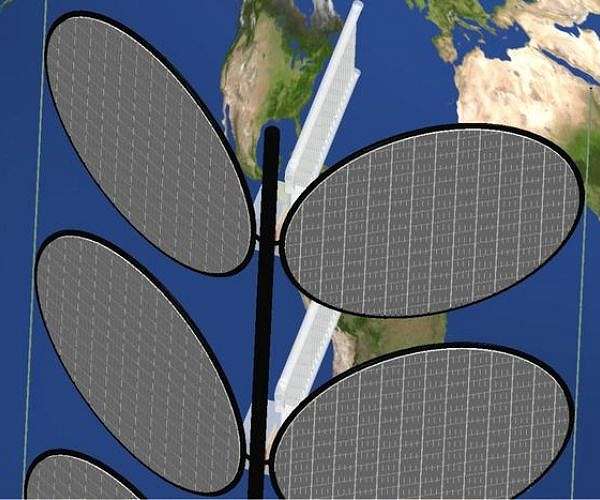
Penn Engineers have proposed a solar-powered orbital data center architecture that can scale to meet growing demand for artificial intelligence without drawing electricity from terrestrial networks. The concept uses flexible, tether-based structures in orbit to house thousands of computing nodes for AI inference, relying on established space tether technology rather than massive rigid platforms or huge constellations of independent satellites.
The design resembles a green plant, with multiple stems containing computer hardware and branching, leaf-like solar panels. Each trunk is essentially a long cable, populated with identical nodes containing computer chips, solar power systems and cooling hardware, forming a modular chain that can be expanded by adding more nodes.
Cables in orbit experience competing forces from Earth’s gravity and the centrifugal effect of orbital motion, causing them to naturally tighten and become vertically aligned with one end toward Earth and the other end toward space. Distributing computer nodes along these cables allows the system to maintain a stable orientation while supporting many interconnected modules in one structure.
The architecture is optimized for passive orientation rather than active pointing systems. Solar panels are placed at a slight angle and the gentle but continuous pressure of sunlight acts like wind on a weather vane, keeping the panels and computer hardware properly oriented without relying on motors or thrusters.
According to the researchers, a single tethered structure could extend several or even tens of kilometers in orbit. Simulations indicate that such a system could house thousands of computing nodes and support up to 20 megawatts of computing power, comparable to a medium-sized terrestrial data center used for AI inference.
Data processed by these orbital data centers would be transmitted to and from Earth using laser-based optical links, a technology already used in satellite communications. While the latency and throughput requirements for AI training make full on-orbit training impractical, the team notes that future growth in AI use will largely come from running already trained models, a role that suits the proposed system.
The researchers position their approach as a middle ground between unscalable satellite constellations and impractically large rigid structures. Constellations of many small satellites would require millions of independent spacecraft to rival large terrestrial data centers, while massive assembled platforms would exceed current production and deployment capabilities.
The tether-based architecture, on the other hand, leverages decades of research and testing of tethers in space. The use of repeated, modular nodes allows incremental scaling, similar to adding beads to a chain, without fundamentally changing the structural concept as capacity increases.
The team also investigated how the impact of micrometeoroids and orbital debris would affect such a large orbital system. Using computer simulations, they examined the cumulative effects of many collisions rather than focusing on isolated collisions with individual components.
The results suggest that the tethered structure is naturally resilient to these effects. A blow may cause a brief wobble or rotation, but the disturbance travels along the cable and gradually disappears, a behavior the researchers liken to the way the movement in a wind chime decays after it is disturbed.
In a wide range of simulated scenarios, the system deviated only a few degrees from its optimal orientation, remaining within acceptable limits for solar energy collection and stable operation. The design also includes multiple ropes supporting each node, so that if a rope is severed by a collision, the node and larger structure can continue to function.
Managing heat in space poses a separate challenge, because orbital systems can only reject heat by radiating it away. The design includes radiators to dissipate waste heat from persistent computer loads, and the researchers plan to refine these radiators to make them lighter and more durable.
The next step is to go beyond simulations and develop a small-scale prototype with a limited number of nodes to validate the cable-based orientation, force and thermal concepts. The team emphasizes that the dominant growth in AI use comes from repeated inferences rather than training new models, and they argue that transferring these inferences to orbit could reduce the environmental impact of data centers on Earth.
The work, conducted at the University of Pennsylvania’s School of Engineering and Applied Science, highlights how existing space technologies can be adapted to support emerging AI workloads. By placing modular, solar-powered data centers in orbit, the researchers aim to create a path to scaling AI computing while easing demand for terrestrial electricity and water resources.
Research report:Tether-based architecture for solar orbital data center
