

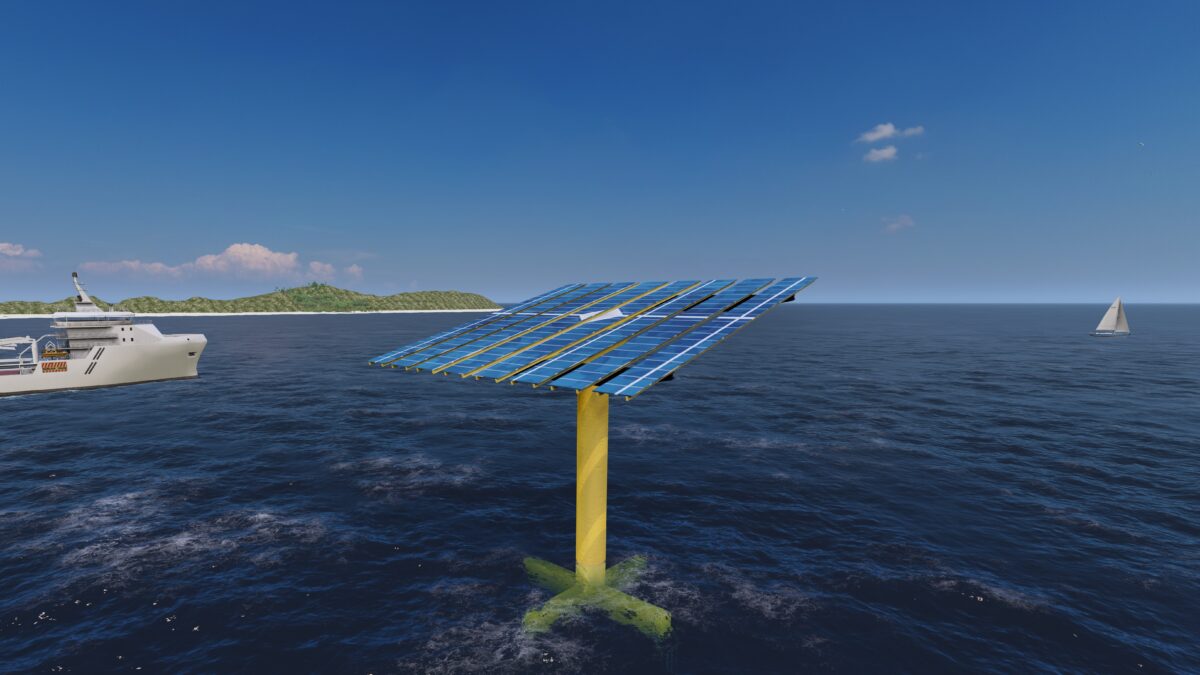
The HelioSea system, developed by scientists in Spain, can reportedly ensure structural reliability in challenging marine environments. The research group proposed using tension leg platforms that have been successfully applied to offshore drilling platforms, where stability is also paramount.
Researchers led by the University of Oviedo in Spain have developed a new floating PV system for applications in offshore waters.
“The novelty of the system lies in the combination of a dual-axis solar tracker and a mini-tension leg platform (TLP),” the study’s corresponding author Mario Lopez Gallego told pv magazine. “To our knowledge, this is the first time that these two concepts have been proposed for a floating photovoltaic system, and HelioSea integrates both. The former maximizes production, while the latter provides the required stability. TLPs are well known in the oil and gas industry, where they are successfully applied to drilling platforms, where stability is also of paramount importance.”
The scientists explained that the TLP usually consists of a deck structure, a floating hull based on vertical cylindrical columns, submerged horizontal pontoons and tubular reinforcements. The main advantage of this configuration is that the net buoyancy force is greater than the weight of the structure. This excess buoyancy is in turn compensated by tight tendons or ropes, which allow the floating platform to be moored vertically.
The new TLP consists of a mast and four pontoons that are connected to the seabed via tight mooring lines. “The proposed TLP substructure is self-contained and monolithic, eliminating the need for mobile components and interconnections apart from the mooring system,” the scientists said. “This feature ensures that the platform remains nearly horizontal with limited wave and sway movements,” the group said, noting that the system is mobile and reusable while ensuring minimal vertical movement.
According to the team, the TLP is resistant to various degradation mechanisms, such as erosion, abrasion, UV-induced degradation, extreme temperature fluctuations, increased humidity and saltwater corrosion. It is manufactured with surface preparation and a double layer protection system via hot dip galvanizing.
Image: University of Oviedo
The prototype system is designed with a capacity of 75 kW and can accommodate 138 bifacial PV panels with a nominal power of 545 W. The modules are arranged in 6 rows of 23 on a top-of-pole mounting. Vertical and horizontal dual-axis trackers are included to automatically adjust two angles throughout the day using servo motors.
Both the TLP and top-of-pole mountings can be mounted separately and joined at the dock before being brought offshore. “HelioSea’s smaller size makes it possible to ship on a small vessel instead of towing,” the researchers explain.
They also said the system can provide a capacity density of 64 MW/km2 and a levelized cost of energy (LCOE) of €0.16 ($0.17)/kWh to €0.27/kWh. “Although these values differ significantly from those of ground-mounted solar energy systems, they correspond to a similar order of magnitude to floating offshore wind systems and are significantly lower than other marine renewable energies, such as wave and tidal energy,” added them to it.
According to Lopez Gallego, the concept is currently in the early stages of development and has a technology readiness level (TRL) of 3. The TRL measures the maturity of technological components for a system and is based on a scale of one to nine, with nine represent mature technologies for full commercial application.
“The stability of the system in waves was confirmed in a scale model wave tank, and the structural verification of the main elements was also completed,” he concluded.
The researchers introduced the new concept in the study “Promoting offshore solar energy generation: the HelioSea concept,” published in Applied energy.
This content is copyrighted and may not be reused. If you would like to collaborate with us and reuse some of our content, please contact: editors@pv-magazine.com.
