

In a new weekly update for pv magazineOPIS, a Dow Jones company, provides a brief overview of the major price trends in the global PV industry.
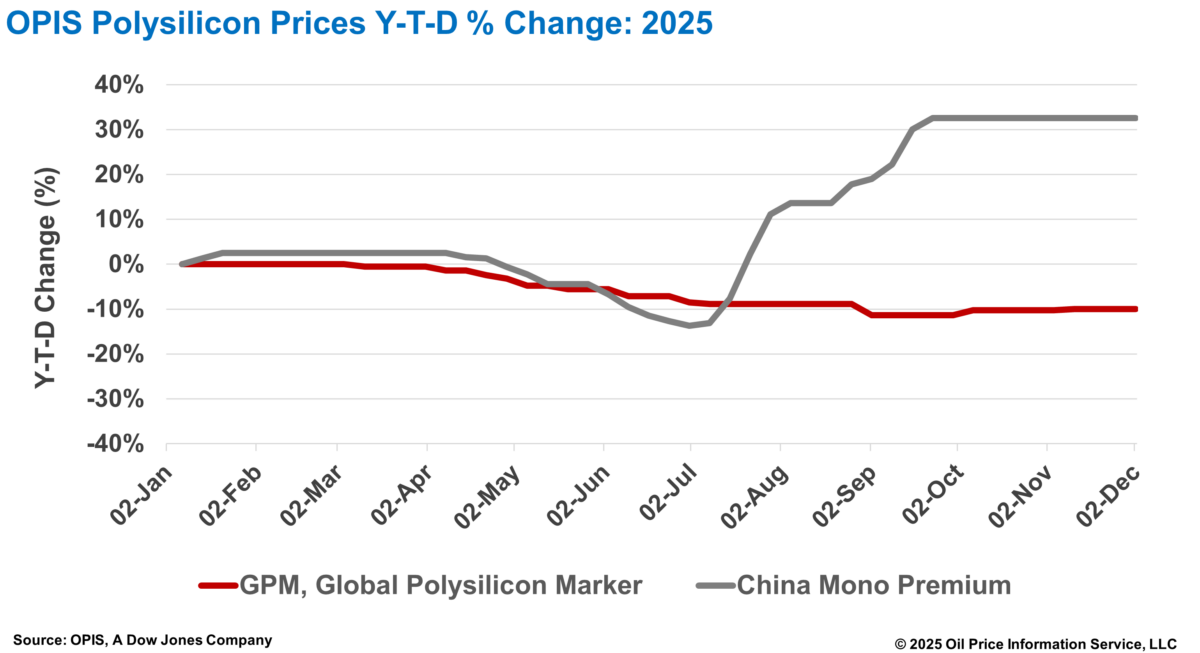
The Global Polysilicon Marker (GPM), the OPIS benchmark for polysilicon produced outside China, was valued at $18,319/kg, or $0.038/W, this week, remaining unchanged week-on-week, according to the OPIS Global Solar Markets Report published on December 2.
Trading activity in the global polysilicon market remained limited, without significant fundamental shifts. Industry insiders describe current transactions as “intermittent.” Downstream manufacturers are reportedly discouraged by the high premiums on global polysilicon, while at the same time prioritizing securing downstream orders for U.S. exports and sourcing the “safe” raw materials to fill those orders.
Market participants note that escalating global trade barriers – particularly import restrictions introduced for regional protection – are likely to cause further fragmentation and regionalization of the global polysilicon sector, both in terms of pricing and supply structure.
A recent development supports this view. Morocco has announced plans to build its first green polysilicon production facility, with an annual capacity of 30,000 tons, under an investment agreement with GPM Holding SA, a Morocco-based renewable energy company.
According to a market insider, polysilicon produced in new regions could provide alternative sourcing options for wafer and module manufacturers amid increasingly strict trade barriers, such as for European manufacturers looking for supply diversification and reduced dependence on a single region.
Sources, however, remain cautious about the feasibility of the project. They point out that polysilicon facilities, unlike relatively less complex downstream segments of the solar supply chain, require substantial capital investments, deep technical expertise, long-term operational support and sustained government support.
Even with strong engineering and technical partners, building a polysilicon plant ultimately depends on securing sufficient financing, while long-term viability depends on effective cost control, a veteran polysilicon insider told OPIS. The source added that the near-term prospects for newly announced initiatives remain unclear. Currently, the only projects with visible short-term production potential are a polysilicon plant in the Middle East and a project by a major Indian photovoltaic manufacturer.
Meanwhile, market fundamentals in China’s polysilicon sector remain largely unchanged. The China Mono Premium – OPIS’s rating for mono-grade polysilicon used in the production of n-type ingots – remained unchanged week on week at CNY 52,200 ($7.38)/kg or CNY 0.110/W.
According to industry sources, although two major producers of Siemens polysilicon and Fluidized Bed Reactor (FBR) granular polysilicon have reduced production, these adjustments reflect the optimization of operating rates in response to cost changes due to fluctuating electricity prices on different production bases. Sources stressed that these measures are not enough to result in a “significant reduction in supply.”
Weaker end-market demand has led wafer manufacturers to scale back polysilicon purchasing, with significant transactions recently concentrated in FBR granular polysilicon, according to one market participant.
The source noted that regular transaction prices for FBR granular polysilicon are currently about CNY 4/kg lower than regular prices for Siemens polysilicon. Given that the operating figures of FBR’s granular polysilicon makers are consistently higher than those of Siemens’ polysilicon makers, the market share of granular polysilicon could rise to around 25% by 2025, the source added.
As 2025 nears its end, market feedback indicates that polysilicon inventory levels are likely to end the year at around 600,000 tonnes, significantly higher than the approximately 400,000 tonnes recorded at the end of 2024.
However, the polysilicon futures market, which was launched in late 2024, is likely to maintain an average of 100,000 tons of inventory per month on the futures platform, easing pressure on inventory circulation in the spot market.
Meanwhile, the much-discussed consolidation plan for the polysilicon industry is progressing slowly, according to industry sources. In addition to core issues such as share structure and financing arrangements, an insider noted that a key topic under discussion is the development of a regulatory framework to limit future entrants or significantly increase the sector’s barrier to entry in the future.
OPIS, a Dow Jones company, provides energy prices, news, data and analysis on gasoline, diesel, jet fuel, LPG/NGL, coal, metals and chemicals, as well as renewable fuels and environmentally friendly feedstocks. It acquired assets with pricing data from Singapore Solar Exchange in 2022 and now publishes the OPIS APAC Solar Weekly Report.
The views and opinions expressed in this article are those of the author and do not necessarily reflect those of the author pv magazine.
This content is copyrighted and may not be reused. If you would like to collaborate with us and reuse some of our content, please contact: editors@pv-magazine.com.
