

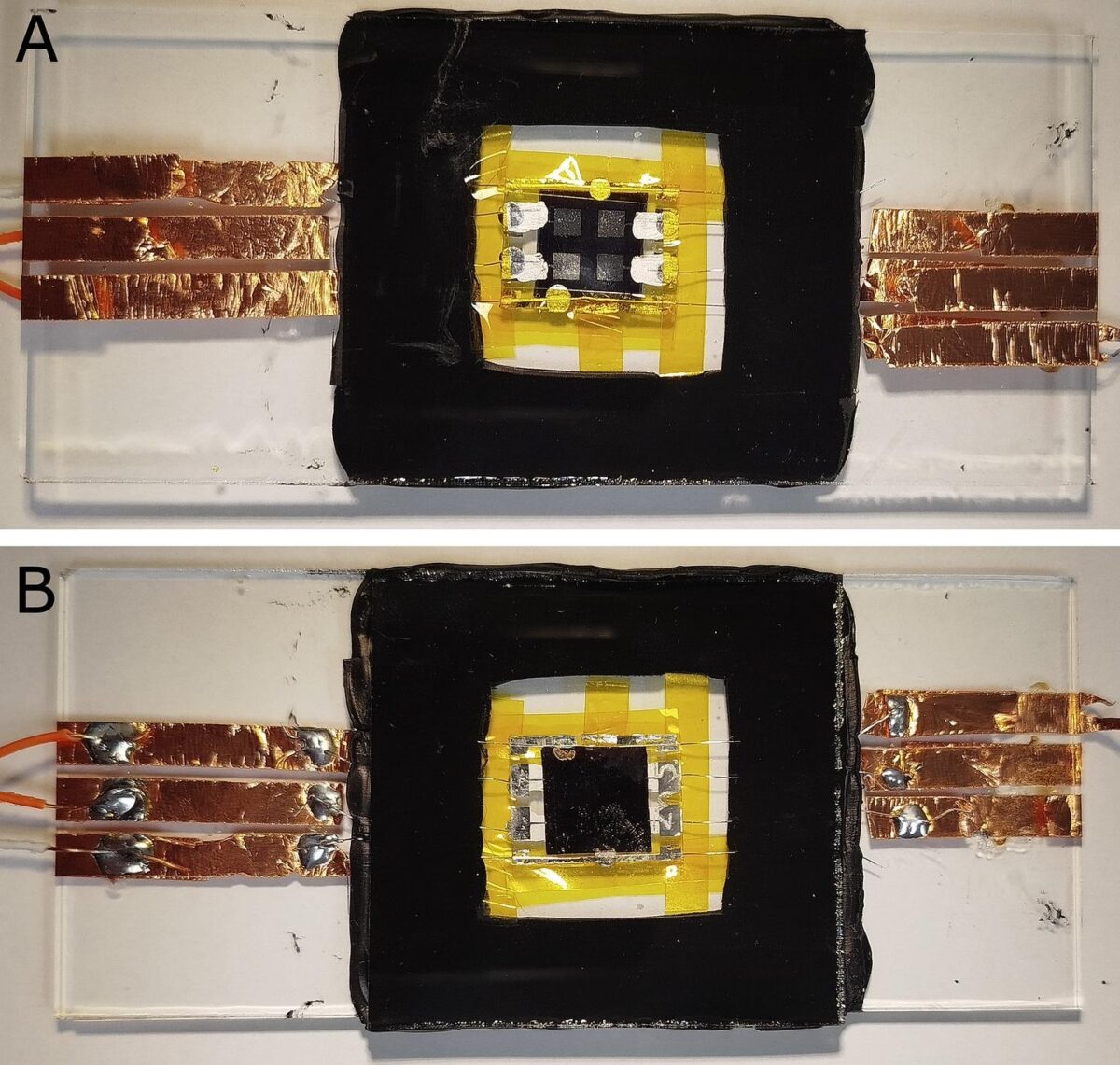
Tests conducted by a research team in outdoor environments in Spain and Poland have shown a strong correlation between the degradation of perovskite solar cells and the combined effects of climatic and operating conditions. The scientists found that open-circuit operation accelerates degradation, while operation at maximum power point and under short-circuit conditions has a lower impact.
An international research team investigated the performance of inverted perovskite solar cells under outdoor conditions in Spain and Poland, comparing the results with those obtained through commonly used accelerated aging protocols.
The novelty of their work lies in correlating accelerated degradation test parameters with real-world observations to more accurately identify the factors contributing to the degradation of perovskite PV devices.
“Potential investors and industry stakeholders need a reliable benchmark to assess the viability and long-term potential of the technology,” the scientists explained. “It is important to emphasize that there is currently no conclusive evidence showing that failure to pass such accelerated tests directly predicts device lifespan under real outdoor conditions, typically targeting 20 to 25 years for photovoltaic applications.”
The group tested inverted perovskite solar cells encapsulated with polyisobutylene (PIB) for 173 days in two facilities: one in Madrid, Spain, which has a warm Mediterranean climate in summer; and the other in Gdańsk, Poland, characterized by a humid continental climate in summer.
The cells are built with a glass and indium tin oxide (ITO) substrate, a hole transport layer (HTL) based on poly(triarylamine) (PTAA), a perovskite absorber, an electron transport layer (ETL) that relies on phenyl-C61-butyric acid methyl ester (PCBM)a bathocuproin (BCP) buffer layer and a silver (Ag) metal contact.
For the outdoor tests, the scientists followed the ISOS-O-2 protocol, taking current-voltage (JV) measurements every 60 minutes in Gdańsk and every 10 minutes in Madrid. The cells in Spain were mounted on a solar tracking system, while those in Poland were installed on a fixed structure.
The analysis revealed a major difference in long-term performance between the cells tested in Poland, which maintained relatively stable performance throughout the exposure period, and the cells operating in Spain, which suffered a constant decline.”
“This difference in device behavior may be influenced by several factors, including climatic conditions, operating mode, mounting configuration and measurement frequency, as the tests were performed under different setups,” they specified.
They also found that the main factors affecting cell performance are absorber degradation, bulk defects, and interfacial losses. Further analysis conducted in Gdańsk showed that the cellG open circuit (OC) “strongly” accelerates the degradation, while the maximum power point (MPP) and short circuit (SC) were found to have the least impact.
Outdoor degradation was found to be similar to that detected by light exposure, with no “noticeable” extraction issues reported.
Their findings can be found in the study “Degradation of perovskite solar cells: insights from accelerated testing versus outdoor aging in two climate zones”, published in Solar energy. The research team included scientists from Gdańsk University of Technology in Poland and Universidad Rey Juan Carlos in Spain.
“These findings highlight the need for consistent measurement methods, as factors such as sun tracking, specific operating conditions and JV scan frequency can influence outdoor stability assessments,” they concluded.
This content is copyrighted and may not be reused. If you would like to collaborate with us and reuse some of our content, please contact: editors@pv-magazine.com.
