

Lawmakers are trying to find solutions to the increasing economic weight of energy costs on utility customers. To address this, the Maine Legislature last year overhauled its Net Energy Billing (NEB) program for nonresidential participants, but in the process eliminated the state’s community solar market.

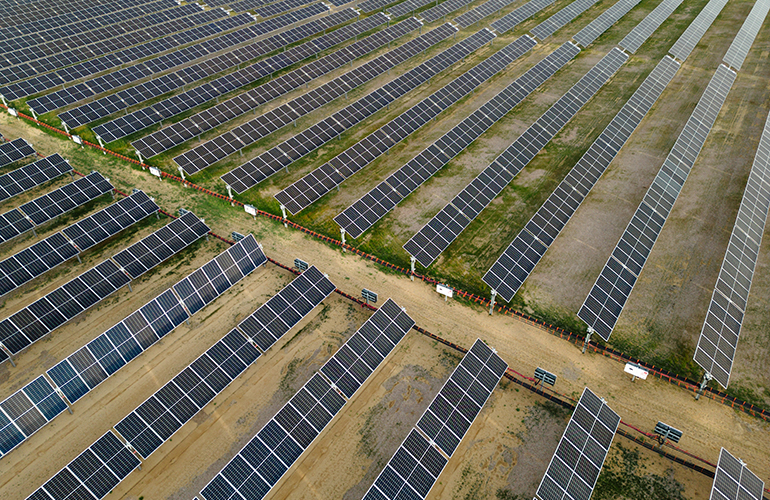
Nautilus Solar built a community solar farm on a former sand quarry in North Berwick, Maine. Credit: Nautilus Solar
“There’s not much the Legislature can do to change the price of natural gas when it’s being changed by wars abroad,” said Kate Daniel, Northeast regional director of the Coalition for Community Access to Solar Energy. “Solar energy programs are something they can do something about, and even if it’s not the driving force behind the bill, it makes them feel like they’re doing something.”
LD 1777 prohibits Maine utilities from accepting new community solar projects, reduces utility payments generated by community arrays and, in an industry first, retroactively applies monthly fees to certain existing community solar projects.
The amended NEB began issuing reimbursements on January 1 to existing community solar projects included in the kWh Credit Program. Projects with a capacity between 1 and 3 MWAC You will be charged $2.80/kWAC monthly; projects between 3 and 5 MWAC You will be charged $6/kWAC monthly.
Community solar developers Nautilus Solar And Nexamp have both stated that their companies will not bring any new projects to Maine.
“Every region will need additional energy generation over the next five years. Most of that will be clean energy,” said Jake Springer, Nexamp’s East Coast policy director. “By imposing retroactive policies, you at least increase the cost of capital, which will rise in response to increased risk. Or you discourage additional development in the state when you need additional generation.”
Maine’s community solar history
In 2019, Maine became the 20th state in the country to implement a community solar program after Governor Janet Mills ordered 250 MW of new community solar capacity. Over the past seven years, community solar developers have far exceeded that original goal.
Community solar projects allow customers without the space or money for their own solar panels to access renewable energy in an affordable way. Residents and businesses subscribe to a portion of the project’s capacity and earn renewable energy credits that are applied to their energy bills.
These shared arrays are long-term commitments, both for the subscribers and for the company managing the PV projects. They are much more involved in customer service because there is not just one customer. Eric Lamora, VP of community solar at Nautilus Solar, said the company manages a community solar customer base of approximately 15,000 subscribers in Maine alone.
“It has a significant impact on the overall value of the portfolio. You change the return significantly [and] the revenues expected to come from these projects,” he said. “These retroactive changes are very damaging. Not only for us as investors, of course. The part that’s not really being addressed, this has a huge impact on Maine… In good faith, the investment community has invested hundreds of millions of dollars in the market. Fast forward about seven years later, when these projects are largely built and completed, then this legislation comes out and that changes the state’s original proposal.”
The state claimed in a news release published by the Maine Office of the Public Advocate, a state body that represents electricity customers, that the decision to change NEB for community solar will save electricity customers. $1.2 billion over 16 years.
“Maine’s community solar program needs reform precisely because it has been so successful,” wrote Maine public advocate Heather Sanborn. “We wanted to build 750 MW of solar, and instead we built more than 1,600 MW. Now we need to ensure solar energy is delivered affordably to Mainers in the future.”
The release also claims that LD 1777 was drafted in collaboration with solar developers. Community solar companies did not characterize the process as collaborative.
The costs and pending lawsuits
This change to NEB has forced project owners to reassess the economics of their subscribed arrays. Brattle, a consulting firm, worked with developers prepare a report on how LD 1777 affects the Maine solar market.

A 7 MW community solar project covers brownfield land in Maine. Credit: Nautilus Solar
Co-authors Robert Mudge and Meten Celebi, principals of Brattle, reported that Maine’s solar community could see a $525 million loss in revenue. The policy change could force existing projects into the wholesale energy market. But community loans for solar projects stipulate that these solar panels remain in the NEB, otherwise they would violate these agreements and risk loss of financing.
Additionally, Brattle estimates that moving to the wholesale market, if possible, will offset solar projects with a 63% reduction compared to NEB. Despite this, both Nautilus and Nexamp plan to maintain their existing solar projects in Maine.
“As long as there are Nexamp assets in Maine, we will continue to operate them,” Springer said. “But we no longer view the Maine market as a safe place for investment. We are not doing any further community solar development there.”
Community solar developers have filed two separate lawsuits against the Maine Public Utilities Commission and its leaders. One represents developers responsible for 111 community solar projects, with a total capacity of approximately 415 MW in Maine.
Plaintiffs filed for a preliminary injunction to prevent these fees from retroactively triggering at the beginning of the year, but that request was denied. Deliberations in these lawsuits are still ongoing.
“We are still exercising all the rights we can,” Lamora said. “For us, it’s an attempt to mitigate some of the losses we’re experiencing. Hopefully the state will realize they made a mistake here.”
The Road Forward to Maine
Business can continue as usual for other forms of solar energy in Maine. But from 2022 to 2024Community solar was responsible for the majority of the state’s new PV deployment. By the end of 2025, Maine had installed nearly 1.9 GW of solar energy across markets. In 2019, Governor Mills signed legislation establishing state goals to use 80% renewable electricity by 2030, and 100% by 2040. reported that more than half of the state’s energy would come from renewables by 2024.
The goal of LD 1777 is to reduce energy costs, which are rising due to inflation, trade tariffs and the pressure of new data centers on the electricity grid. The Maine Legislature is taking into account a bill to limit the development of new data centers in the state, but if passed it wouldn’t take effect until late 2027.
But community solar developers see their immediate response to cost savings as short-sighted – both for the community solar market and for Maine itself.
“The impact of climate change is real there. Much of Maine’s economy is lobster fishing, and the waters around Maine’s coast are warming,” Lamora said. “Mainers are very sensitive to the impact of climate change. They have very aggressive energy goals, but the question now is how they will achieve those goals.”
LD 1777 directs the Maine Department of Energy Resources to create a new community solar program for the state. However, there is no specific deadline for when this could happen.
