

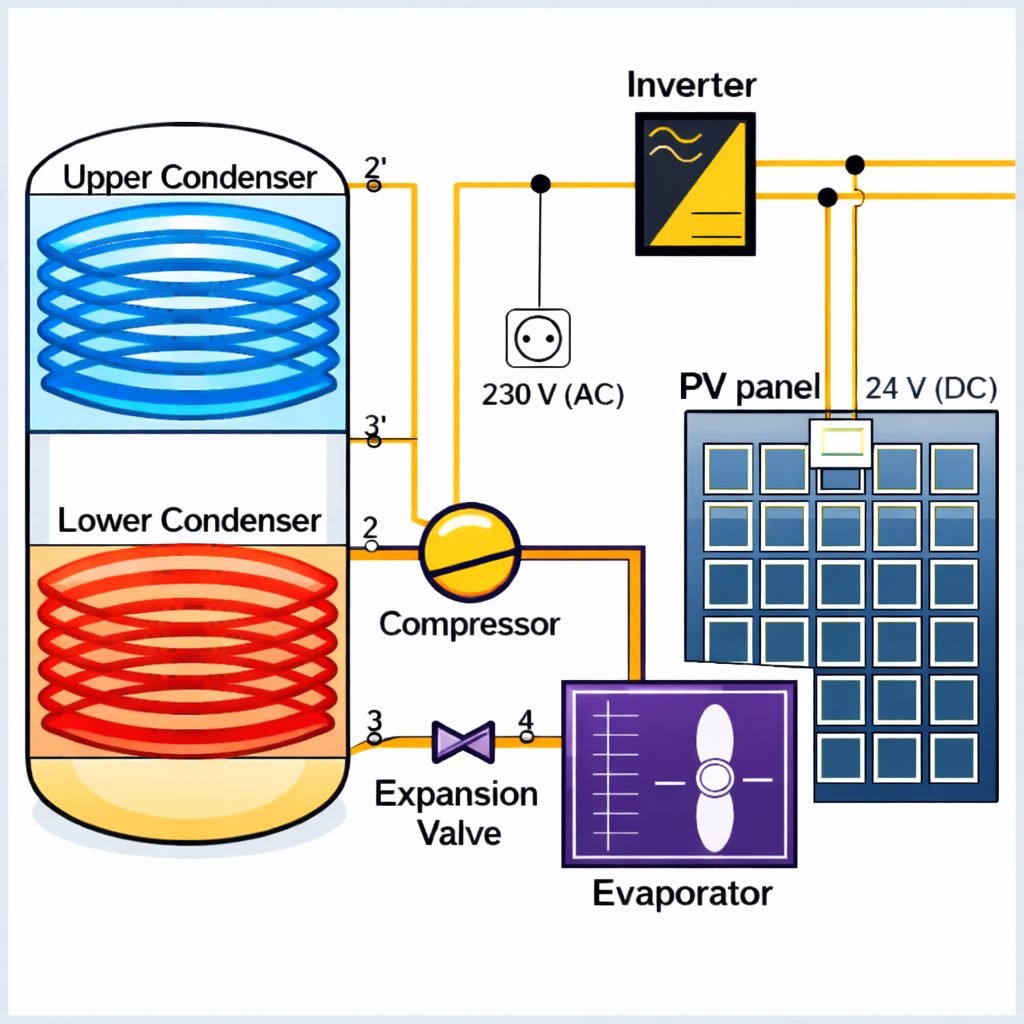
Researchers from the Miguel Hernández University of Elche in Spain have designed an air-to-water heat pump system that can shift hot water (DHW) production to central daylight hours, maximizing the use of PV power generation.
The novelty of the system lies in the use of two condensers instead of a single unit.
The researchers explained that a conventional compact domestic hot water heat pump includes a compressor, evaporator, expansion valve and a condenser around the bottom of the storage tank, which heats the entire volume of water by natural convection. The proposed dual condenser configuration adds a second condenser at the top of the tank, combined with an optimized control system to select the operating mode, while maintaining the standard components.
Both the lower and upper condensers consist of spiral tubes installed between the tank wall and the insulation layer. When the lower condenser is operating, heat is transferred to the bottom of the 215 liter tank, promoting stratification and heating the entire volume. When the top condenser is activated, only the top portion of the tank is heated, allowing for more focused operation and lower energy storage.
The prototype was developed based on a commercial split-type air-to-water heat pump equipped with a 600 W scroll compressor and refrigerant R134a. The original 2,400 W electric resistance heater was disconnected to ensure operation in heat pump mode only. The system had a manufacturer-rated coefficient of performance (COP) of 3.17 at 14 C. Changes included integrating the second condenser, redesigning the cooling circuit and upgrading the control system for testing under realistic DHW and PV operating conditions.
The experimental setup is designed to replicate actual household hot water demand using a closed system to avoid water wastage. It included two climate chambers, the heat pump with double condenser, a 600 W PV installation and a controlled hydraulic circuit. The heat pump was connected to both the electricity grid and the PV system, without taking into account any financial compensation for excess electricity supplied to the grid.
An auxiliary tank, circulation pump and water cooler maintained the inlet water temperature at 10 C to simulate mains supply conditions. An Arduino Mega controller managed the pumps, valves, chiller and heat pump to enable automated testing. The system was also equipped with 30 temperature sensors, flow meters and electrical monitoring equipment, recording data at one-minute intervals.
The researchers evaluated three configurations at an ambient temperature of 18 C: a conventional single condenser heat pump, the same system coupled with PV, and the double condenser heat pump with PV. Tests followed an EN 16147 based DHW consumption profile, ensuring supply temperatures above 45°C.
The results showed that the dual condenser configuration improved stratification control, reduced total energy consumption and maintained domestic hot water quality, while significantly increasing self-PV consumption.
The analysis showed that the average seasonal COP of the heat pump reached 3.55 in the single condenser configuration and 3.65 in combination with PV.
“As expected, both values are comparable, as there is no difference in the mode of operation between them,” the research team emphasizes. “In the third test, with two condensers and an improved control strategy allowing operation with a lower water temperature, this efficiency increases to 3.71. This trend is more evident when analyzing the efficiency of the hot water supply, where the results are 3.08 and 3.12 for the first two operating modes and 3.37 for the configuration with two condensers and PV panels. Since the tank is colder in the configuration with two condensers, there are fewer heat losses.”
Meanwhile, self-consumption of solar energy with the double condenser system increased from 9.9% to 55.5%.
“The results also highlight the need to take into account immediate self-consumption, using a calculation basis of at most minute-by-minute rather than hourly or daily, as the latter results in unrealistically high solar contributions,” the academics concluded. “Taking into account the energy supplied by the PV panels, the performance of the HP can be re-evaluated, leading to a COP of 3.46 when operating with one condenser and of 7.59 when operating with the double condenser configuration.”
The system was described in “Experimental assessment of a novel dual condenser photovoltaic heat pump design” published in Solar energy.
