

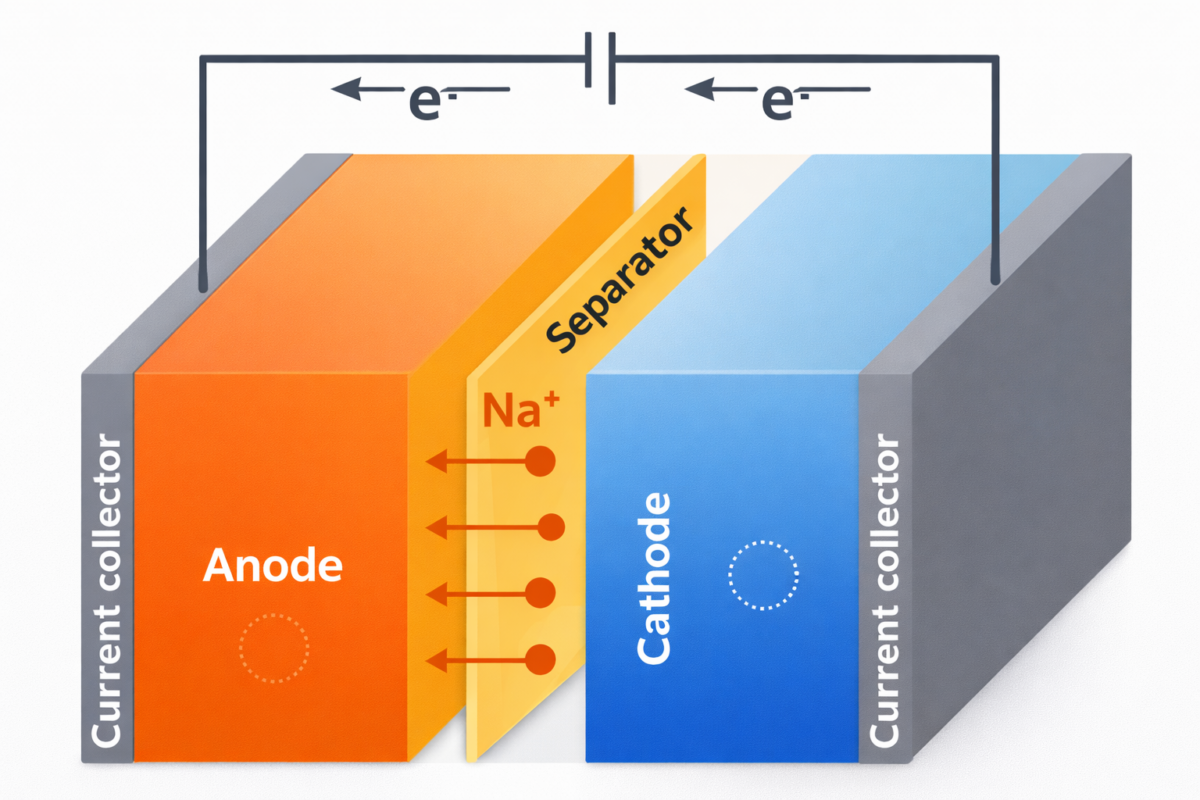
The proposed sodium-ion battery configuration is designed for stationary energy storage and is based on a P2-type cathode material and a hard carbon anode material that are said to ensure full cell performance. Electrochemical tests showed that the cathode had an initial capacity of 200 mAh/g and the anode of 360 mAh/g, with capacity retention of 42% and 67.4% after 100 cycles.
An international research team has designed a sodium-ion battery storage system (SIB) based on a P2-type cathode material known as Na0.67Mn0.33Ni0.33Fe0.33O2 and an anode based on hard carbon material made from lavender flowers.
The proposed system configuration aims for low-cost manufacturing while ensuring scalability and environmental sustainability, as the two electrode materials are described as “widely accessible” precursors.
“Plant diversity and production capacity are important factors influencing the commercialization of SIBs, as plant-derived hard carbons are both sustainable and economical,” the researchers explain. “Hard carbon derived from plants preserves the microstructures of plant tissues, improving electrolyte and sodium diffusion penetration.
The scientists estimate global lavender production at about 1,000 to 1,500 tons per year. However, only a small part of this production can be used for electrode materials, because only the flour residue is suitable for conversion into hard carbon.
They also noted that the hard carbon anode and P2-type cathode in the full cell have insufficient sodium reservoirs, leading to poor electrochemical performance. “The current work addresses this gap by evaluating the performance of P2-Na on whole cells0.67Mn0.9Ni0.1O2 in combination with lavender flower waste-derived hard carbon under different presodiation approaches,” they further explained.
The scientists used X-ray diffraction (XRD), scanning electron microscopy (SEM), X-ray photoelectron spectroscopy (XPS), Fourier transform infrared spectroscopy (FTIR) and Raman spectroscopy to characterize the cathode and anode of the SIB system and found that the cathode has a hexagonal P63/mmc structure, while the anode showed characteristic broad peaks of amorphous carbon.
In particular, SEM and TEM revealed micrometer-sized cathode grains and a porous hard carbon surface, with EDS and XPS indicating that the material has good structural stability. Further analysis also showed that the incorporation of nickel (Ni) improved the structural, electronic and electrochemical performance of the cathode.
Furthermore, electrochemical tests revealed initial capacities of 200 mAh/g for the cathode and 360 mAh/g for the anode with capacity retentions of 42% and 67.4% after 100 cycles. Overall, Ni doping was found to improve the conductivity and stability of the cathode, and the anode showed good sodium storage performance, which the researchers said supported strong half-cell and potential full-cell performance.
“This comprehensive study highlights the potential for the development of SIBs with low-cost and durable electrode materials,” they concluded. “The optimization of presodiation strategies offers opportunities for advanced commercial and scalable SIB technologies.”
The system was described in the study “Cost-effective sodium-ion batteries with a Na0.67Mn0.9Ni0.1O2 cathode and lavender flower waste-derived hard carbon using a comparative presodiation approach”, published in the Power Sources Journal. The research team included scientists from Turkey’s Inonu University, Istanbul Technical University, Malatya Turgut Ozal University and Aksaray University, as well as Korea Institute of Science and Technology and Pakistan’s Quaid-i-Azam University.
This content is copyrighted and may not be reused. If you would like to collaborate with us and reuse some of our content, please contact: editors@pv-magazine.com.
