

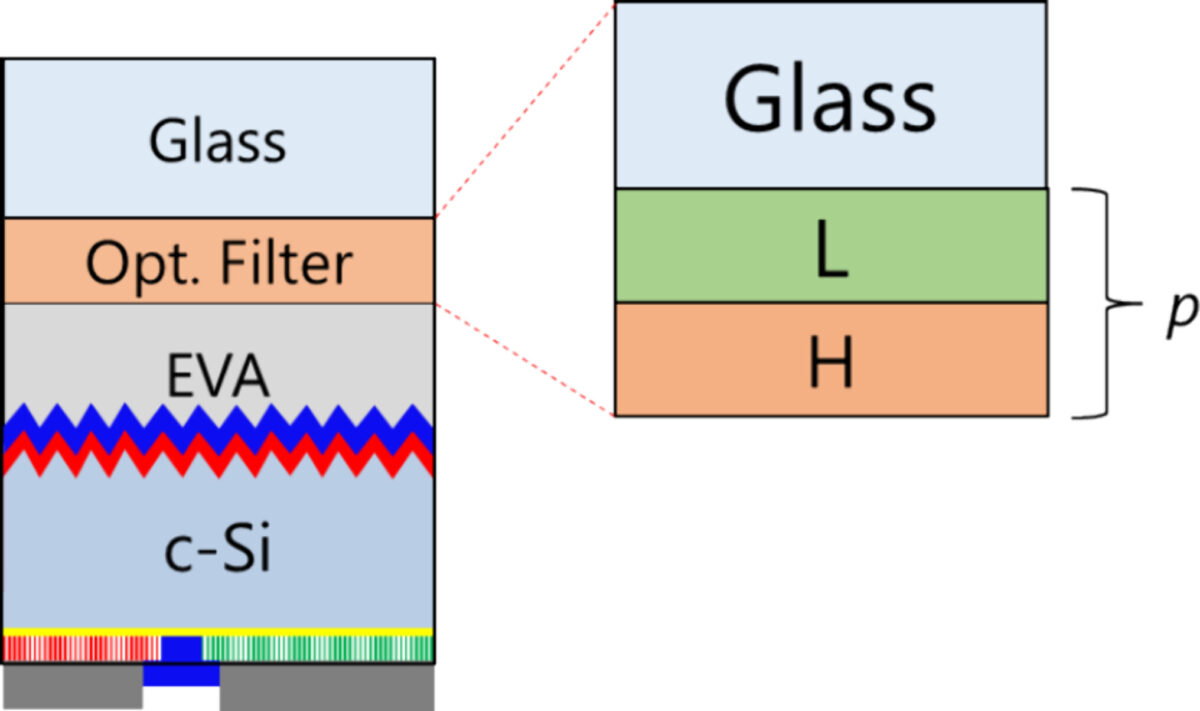
Researchers from Delft University of Technology have designed an optical filter for the thermal management of IBC photovoltaic modules. The proposed technology can reportedly reduce cell operating temperatures by up to 2.5 C and extend the life of a PV module by up to 2 years.
Scientists from Delft University of Technology in the Netherlands have designed a simplified optical filter for the passive thermal management of interdigitated back-contact (IBC) photovoltaic panels.
“The proposed design is tailored to IBC solar cells. However, the technological approach can be applied to any solar cell technology,” said the study’s lead author, Juan Camilo Ortiz Lizcano. pv magazine. “We wanted to develop a filter that could work on a solar cell architecture that already shows good thermal behavior. The approach also works on other cell technologies, such as Al-BSF [aluminum back surface field]. For example, our framework can predict whether rejecting only sub-bandgap radiation could improve energy yield for these solar cells.”
The research team analyzed whether simple and lossy designs can still provide energy yield benefits when degradation mechanisms are taken into account. “We would like to emphasize the importance of taking degradation into account when studying the feasibility of a cooling solution focused on solar panels,” added Ortiz Lizcano. “In addition, this double reflection principle is also interesting for multifunctional designs, such as providing cooling and color to a PV module, an idea that we hope to explore in the future.”
The research team developed the optical filter with two materials, one with a high refractive index, silicon nitride (SiNX), and another with a low refractive index, silicon dioxide (SiO2). It deposited the materials sequentially in pairs and calibrated their thickness depending on the wavelength value. “We selected these two materials because they differ significantly in refractive index and are non-absorbent in the range that solar cells produce electricity (300 – 1200 nm),” Ortiz Lizcano emphasized. “A significant difference between the refractive index of the materials translates into the number of lower layers to achieve high reflectance values over a wide wavelength range.”
The scientists compared the optical filter with a control device based on titanium oxide (TiO2) and magnesium fluoride (MgF2), as well as with a solar cell without a filter. “Although TiO2 and MgF2 offer advantages from an optical perspective, depending on the deposition conditions, the use of MgF2 in multilayer systems can can have reliability issues,” Ortiz Lizcano said. “Because our goal was practicality and simplicity, we selected two materials that are widely used in the PV industry and have proven reliable stability in multi-layer stacks.”
Through a computational modeling framework, the researchers ran a series of simulations to measure the effect of the filter on the operational cell temperature. They assumed that the filter would be applied to SunPower Maxeon bifacial IBC solar cells, and that the cells would operate in two different locations: Delft, the Netherlands, and Singapore.
The analysis showed that the filter can reduce the temperature of the cell in Delft by 2.20 C and that of the cell in Singapore by 2.45 C. The optical losses for the cells were found to be 9.76% and 10.01% respectively and these losses were not found to be compensated by the cooling by the filter. “However, looking at long-term reliability, the thermal filter extended the life of a PV panel by 2 years in Singapore and by 1 year in Delft,” the scientists said. “Taking into account the degradation effects, the extended thermal filter life in Singapore provides an overall positive result in terms of DC energy yield in both scenarios, with a relative gain of 3.12%.”
Ortiz Lizcano explained that research work so far has been limited to modeling and experimental validation, including degradation mechanisms. “We still need to thoroughly assess the economic impact of the solution,” he added. “Other researchers estimate that an eight-layer filter for PV applications will have a higher cost of $1.7/m2. How these costs will increase with higher layer count filters is our next step to assess their suitability.”
The passive cooling technology was introduced in the research “Practical design of an optical filter for thermal management of photovoltaic modules”, which was recently published in Progress in photovoltaics.
This content is copyrighted and may not be reused. If you would like to collaborate with us and reuse some of our content, please contact: editors@pv-magazine.com.
