

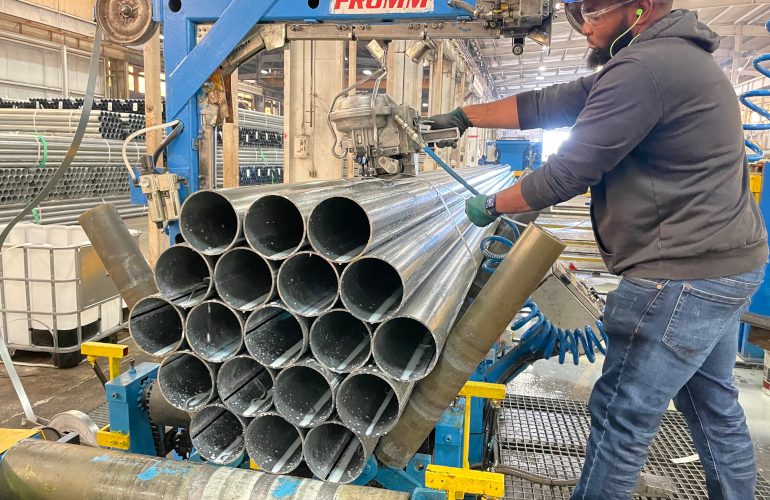
The photovoltaic industry is literally built on steel. As a critical component of racking and trackers for solar PV systems, a reliable steel supply is a necessity for the transition to solar energy. And as a material, steel is the most sustainable choice for mounting systems that ensure fair production a third of emissions per kilo of aluminum.
The steel industry is also working on sustainability in other ways, for example by using protective coatings made with vegetable oils instead of fossil fuel oil. But the sustainability relationship is not one-sided: solar energy is also becoming increasingly important for the steel industry. As pressure increases to decarbonize steel production, the two industries can work together to meet climate targets and develop a greener manufacturing environment.
The race to produce carbon-free steel
The United States has an abundant supply of steel, increasingly driven by domestic production. Imports show a downward trend: steel imports fell in 2023 8.7% compared to the previous year, for a total of just over 2 million tons. Increased concern about climate impacts is partly responsible for this new emphasis on domestic production.
Business representatives recently called for a new tax carbon-intensive steel imports, which is gaining supporters in Washington. The European Union has already pursued a similar policy with the Carbon border adjustment mechanism (CBAM). From 2026, steel made using fossil fuel-intensive production methods will become more expensive to import into the EU, regardless of country of origin. With an upcoming focus on steel emissions – both in the United States and globally – manufacturers have an incentive to start focusing on decarbonization now.
This is where solar energy comes into the picture. Secondary emissions from electricity consumption can already be significantly reduced as manufacturers around the world begin to decarbonize this part of their operations by using rooftop and on-site solar energy. In the United States, EVRAZ, a steel company, takes one Solar park of 300 MW which will power the largest solar-powered steel mill in the world; Turkish steelmaker Tosyali is using a 140 MW rooftop PV array, one of the largest in the world, to reduce its CO2 emissions; and in Europe, Swedish steelmaker SSAB recently announced that its Italian facility is now running on 100% fossil-free energy using a Rooftop installation of 756 kW of the Solnet group.
New technologies will depend on solar energy
Solar energy is also becoming increasingly important for the direct steel production process. While in the past the high temperatures required to produce steel could only be provided by fossil fuels, this is slowly starting to change with the development of new technologies such as electric arc furnaces. Using these ovens electricity as the main energy source, creating an electric arc that heats the material instead of using fuel to heat air to high temperatures. Electric arc furnaces are also compatible with up to 100% recycled scrapfurther reducing emissions and environmental impact.
Finally, the development of solar energy and other renewable energy sources is necessary to produce green hydrogen, another fossil-free fuel that can reach sufficient temperatures for steel production. Steelmakers are already starting to incorporate hydrogen into their operations in cases where electric arc furnaces are not yet suitable. The HYBRIT projecta joint effort between steel producers SSAB, LKAB and Vattenfall, aims to bring green steel to the Swedish market before 2030 using solar energy and other renewable energy sources to produce hydrogen.
As the steel industry focuses more on electric furnaces and hydrogen fuel, solar energy will only become more important as an energy source in the context of steel production. To meet climate targets, both the energy used to produce hydrogen and to power electric arc furnaces must come from renewable sources. already the most cost competitive.
For steel mills, on-site solar energy is a valuable investment to power today’s operations in a more climate-friendly way and to prepare for tomorrow’s technological developments.
