

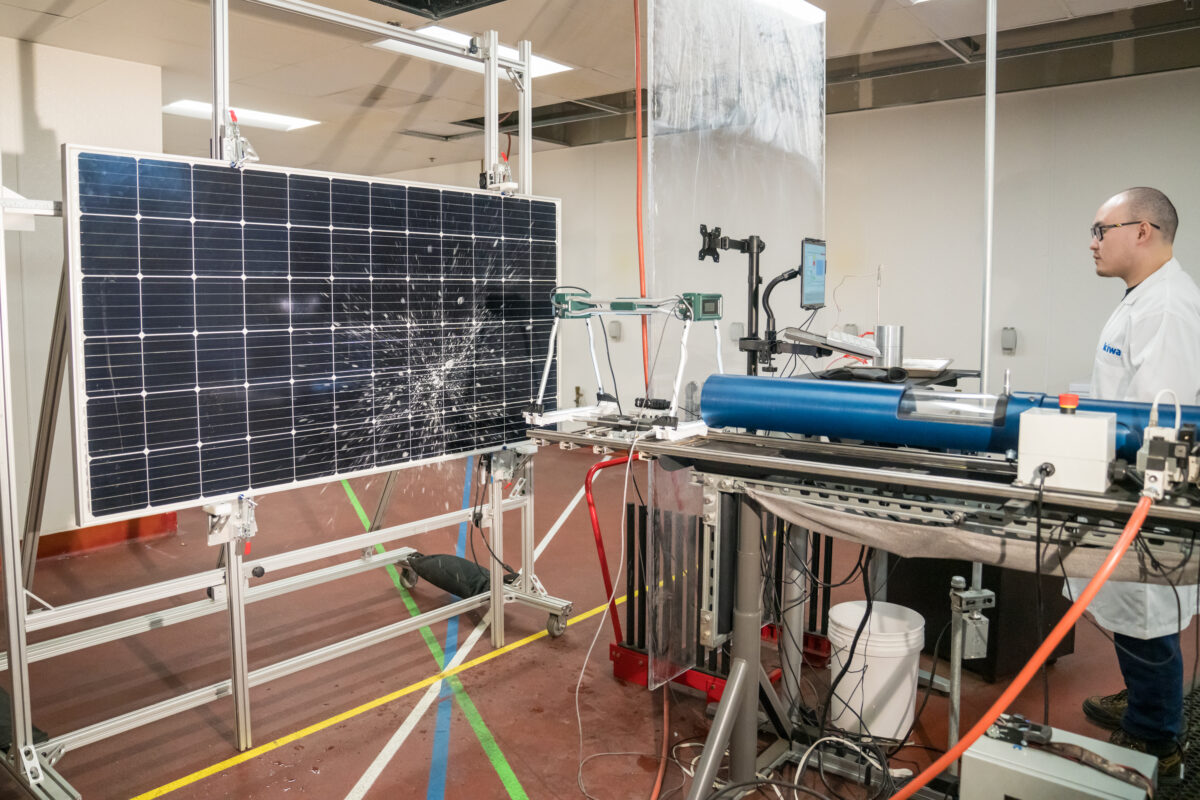
Once considered isolated incidents, spontaneous glass breaks in solar panels are becoming increasingly common, highlighting the limitations of some manufacturing choices and the need for stricter quality control.
With the rapid growth of solar photovoltaics, module reliability has become a central issue for the industry. Among the quality problems that have emerged recently, spontaneous glass breakage has received increasing attention. Glass breakages, long considered isolated incidents, are now becoming increasingly common, revealing the limitations of certain industrial choices and the need for increased vigilance.
The rise of solar energy is accompanied by the continuous evolution of technologies and production processes. To meet global demand and reduce costs, many manufacturers have opted for larger, more powerful, but also lighter modules. A lighter module has the undeniable advantage of reducing the weight of the structures, and therefore the costs of the building construction. Since glass represents more than half of the weight of the module, this search for lightness has naturally led to the use of increasingly thinner glass.
Although this development makes lighter constructions possible and simplifies logistics, it has consequences for the robustness of the modules. Thinner glass, even when tempered, is more sensitive to the mechanical and thermal stresses encountered during the life of the module, from production to on-site use.
Increase in cases of vulnerability
Independent quality tests, such as those conducted by RETC or Kiwa PVEL, indicate increased vulnerability of the modules (Kiwa PVEL’s 2025 scorecard indicates that 83% of manufacturers failed at least one module reliability test, compared to 66% in 2024). This trend is also supported by feedback from the field. Cases of cracked or broken modules, sometimes only a few weeks after installation, occur without any external shock or exceptional weather conditions.
Reduced impact resistance also increases breakage during installation and maintenance of the modules, especially when cutting vegetation with stones, which can damage the panels. On some projects, breakage rates reach significant levels, leading to production losses, replacement costs and safety risks for personnel. It is important to remember that a faulty module is no longer a Class 4 power device (like, for example, a washing machine) and therefore poses a risk of electrocution to on-site personnel.
Diagnosing these defects is complex: microcracks, often invisible to the naked eye, can spread under the influence of temperature or humidity fluctuations and ultimately cause a sudden break in the glass. Its detection requires thorough, lengthy and costly inspections, and delayed identification can lead to water infiltration, resulting in insulation failures, reduced availability and efficiency, and even fire hazards.
Faced with this reality, the question of standards and certification testing arises. Current protocols are designed to ensure module robustness under standard conditions and sometimes struggle to reflect the diversity of limitations encountered in the field. New generation modules, with increasingly larger sizes, are subjected to increased mechanical and thermal stresses, for which traditional safety margins are no longer always sufficient. This situation calls for a reassessment of the test methods to include scenarios more representative of real operating conditions, with a proposed test sequence in addition to individual tests, in accordance with IEC 61215:2021.
Strict quality control procedures
Beyond purely technical aspects, it is no longer enough to rely on standard certifications or guarantees: buyers, whether developers, operators or investors, must independently verify the compliance and robustness of the modules they integrate into their projects. This includes the implementation of strict quality control procedures, including an audit of the production plant and in particular the lamination conditions, as well as additional sampling tests before the start of production, during production and throughout the supply chain.
Visual inspection, performance testing on samples, verification of material traceability, and monitoring of shipping conditions can help reduce the risk of defects and identify potential problems before modules are deployed. In light of recent issues with double-glazed modules using 2mm glass, both glass suppliers and module manufacturers should also implement or strengthen formal glass quality control plans.
Such plans should include:
-
Incoming inspection of raw glass sheets prior to lamination, including surface checks under oblique illumination and magnification to detect micro defects
-
Non-destructive surface testing, such as surface tension measurement, optical distortion mapping or photoelastic analysis, to identify tempering defects or uneven stresses
-
Clear acceptance criteria that define the size, type and location of allowable defects
Stricter quality requirements are essential to maintain the profitability and long-term performance of solar energy installations. Continued price pressure in the module market continues to drive manufacturers to reduce costs, sometimes at the expense of component quality, making independent quality control by buyers increasingly important. By raising their standards and sharing best practices, project developers and investors can help improve reliability across the industry.
About the authors:
Gauthier Dambrine is a project manager at Skyray with 15 years of experience in the wind and solar energy sector. He has held technical positions in the design, development, certification and installation of solar energy tracking systems in Europe, the Middle East, Africa and Asia.
Alexia Chappond has been working in the sustainable energy sector since 2010, where she focuses on project development, construction and operations. In recent years she has focused on technical due diligence, performance analysis, construction supervision and commissioning of PV power plants.
The views and opinions expressed in this article are those of the author and do not necessarily reflect those of the author pv magazine.
This content is copyrighted and may not be reused. If you would like to collaborate with us and reuse some of our content, please contact: editors@pv-magazine.com.
