

Solar energy, driven by excellent resource conditions and rapidly improving economic attractiveness, is expected to develop as a bulk energy supplier in future energy systems. The self-limiting effects of solar energy can be circumvented by hybrid solar solutions, such as hybrid PV-geothermal configurations.
Security of supply is often cited as an issue in energy systems dominated by weather-dependent renewable energy sources, especially solar energy. In this context, most scenarios have highlighted the value of Hybrid configurations with PV batteries. Researchers from LUT University propose a new PV-geothermal hybrid solutionas geothermal energy could benefit countries with excellent solar energy resources. This study goes beyond a niche technology perspective in which geothermal energy has historically been undervalued. This perspective is reinforced by recent research in geologically favorable regions such as Icelandwhere abundant geothermal springs and mineralization on site potentially positioning the country as a promising hub for carbon dioxide removal.
Against this background, detailed research from LUT University estimates the global geothermal potentialwhich lifts geothermal energy as the third largest renewable energy source as concluded by energy resources experts. As a solid renewable energy source, geothermal energy could play a key role in accelerating the share of renewable energy sources in the total energy mix. In particular, enhanced geothermal systems (EGS) are estimated to generate approximately 4600 GWe worldwide at costs between €10-50 ($11.50-58.00)/MWh. The global potential of EGS makes a substantial contribution to meeting the growing demand for renewable energy and could be advantageously used in a fully renewable energy system. Another one recent study highlights that several countries around the world can reduce their system costs of 100% renewable energy systems through the inclusion of EGS. The role of geothermal energy in the global energy transition is examined underdeveloped.
Solarization without a showstopper: PV-geothermal hybrid solutions for the sun belt
Solar energy is the the most available source of energy on Earth and is also expected to increase dominate the future energy system architectures due to their rapidly improving economic attractiveness. Because solar energy is weather dependent, hybrid solutions, such as PV-geothermal hybrid systemscould reduce the levelized cost of electricity (LCOE) and improve overall system flexibility. Sunbelt regions or countries, where favorable solar conditions coincide with hot geothermal zonescould especially benefit from hybrid PV-geothermal systems, as observed in Guatemala, Honduras and Costa Rica. Accordingly, Guatemala, Costa Rica and Honduras achieve LCOEs of €18.8, €21.9 and €24.5/MWh respectively, with geothermal energy and solar energy contributing 68%/19%, 51%/24% and 34%/34% of the LCOE, highlighting the cost-reducing role of solar energy in addition to the dominant contribution of geothermal. The cost containment function of renewable energy such as geothermal is essential during periods of little sunshine or when storage costs do not fall as expected.
Image: LUT University
Space and water requirements will not be an obstacle for PV-geothermal multi-generation systems in Guatemala, Honduras and Costa Rica. The amount of land required for solar and geothermal energy is minimal: 0.2% and 0.7% in Guatemala, 0.1% and 0.2% in Honduras and 0.4% and 0.2% in Costa Rica, based on 75 MW/km2 for PV and 7.5 km2/TWh for geothermal energy, where the PV estimates are conservative. Water consumption by geothermal power plants (binary and EGS) varies from 0.01 to 0.2 km23 in Guatemala, Honduras and Costa Rica. These figures represent a minimal share of the region’s annual precipitation.
System-wide defossilization powered by PV-geothermal hybrid configurations
Regional cooperation promotes the integration of renewable energy, maximizes the benefits of defossilization and enables the effective use of collective assets necessary to develop a cost-efficient system and secure security of supply, challenges that could be greater under individual national planning. Across Central America, electricity supply is dominated by solar and geothermal energy, which will account for 4-90% and 7-38% of generation, respectively, during the transition. The system LCOE for the entire region is €20-21/MWh with grid interconnection, rising slightly to €23/MWh without interconnection. Solar-PV-geothermal hybrid configurations reduce storage requirements by 51-60% and curtailment by approximately 76% with grid interconnection.
The flexibility of source system services is achieved through robust and flexible geothermal energy, power-to-X (PtX) processes and sector coupling. Geothermal energy is improving Diversity in the energy supplywhile hybrid PV-geothermal solutions increase system flexibility in highly renewable energy systems. Service flexibility is delivered through sector coupling and PtX technologies such as heat pumps, electric vehicles and electrolyzers, enabling the production of e-hydrogen, e-methane and e-fuels for applications where direct fuel substitution is a challenge. The energy system achieves high efficiency and cost competitiveness thanks to access to low-cost renewable energy from solar PV-geothermal configurations and the highly efficient use of electricity throughout the system via PtX processes.
In search of El Dorado: Iceland’s geology favors carbon dioxide removal potential
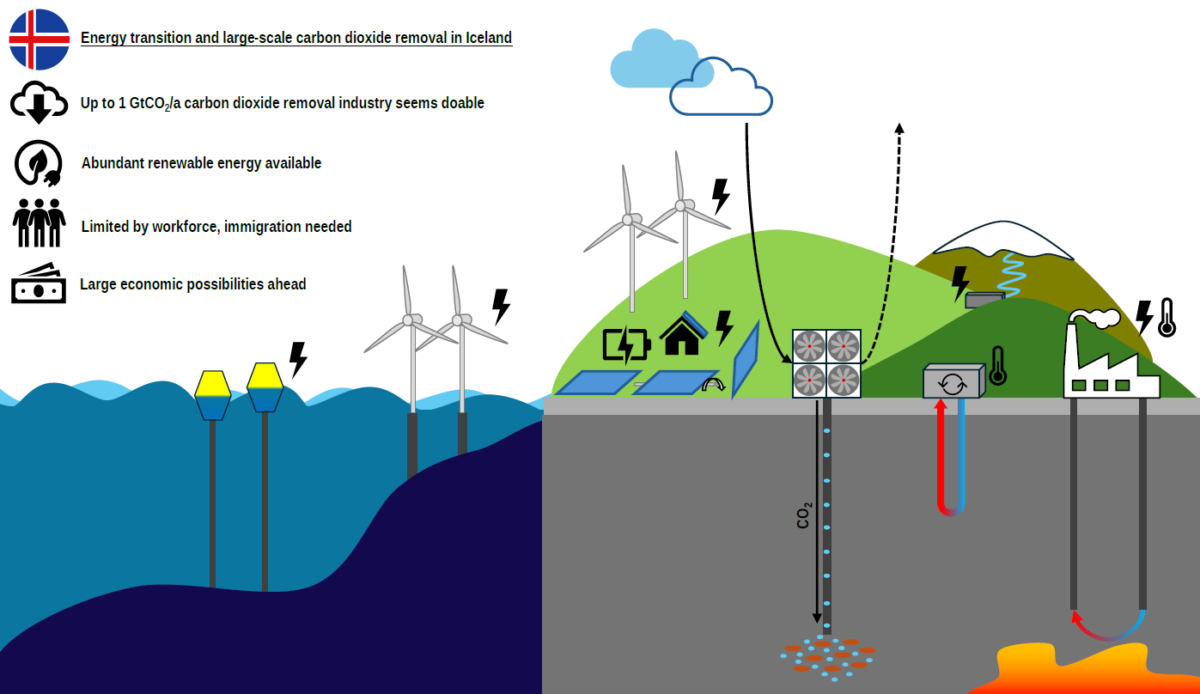
Iceland has an exceptional abundance of geothermal energy, with a maximum potential of 325 GWewhich decreases to 1.1 GWe when sustainability criteria are applied. The potential for geothermal heat extraction is over 720 PWh/y, while the sustainable potential drops to 2.4 PWh/y. Building on this resource base, recent research from LUT University examined 28 scenarios with varying geothermal availability to assess the impact on Iceland’s electricity and heat generation systems, as well as on carbon dioxide removal (CDR) deployment under different climate targets.
Geothermal heat is the dominant factor for direct air capture, enabling cost-competitive CDR services at approximately €50/tCO2while geothermal energy in combination with heat and power plants provide dispatchable base load heat and electricity, ensuring a cost-optimal and reliable energy supply.
However, geothermal energy alone cannot support CDR implementation on a very large scale. Scenarios with a higher share of geothermal electricity slightly increase electricity prices, leading to marginally higher levelized CDR costs, especially in the 2050 transition scenarios. To ensure a stable supply of the high electricity demand, solar energy plays a crucial role in countering the seasonality of wind energy in Iceland.
While the availability of geothermal resources is not a limiting factor, the analysis identifies workforce constraints rather than energy supply as the main bottleneck, limiting feasible CDR deployment to approximately 1 GtCO.2/A. Large-scale CDR expansion will require complementary renewable energy sources, including onshore wind, solar and wave energy, positioning geothermal as a crucial but non-exclusive pillar of Iceland’s long-term CDR strategy.
The analysis of multi-generation solar PV-geothermal systems should be explored for other countries and regions where high-quality solar and geothermal resources coincide, to optimize both heat and electricity supplies.
Authors: Ayobami Solomon Oyewo, Dominik Keiner and Christian Breyer
This article is part of a monthly column from LUT University.
Research at LUT University includes various analyzes related to energy, heat, transportation, industry, desalination and carbon dioxide removal options. Power-to-X research is a core subject at the university, integrated into the focus areas Planetary Resources, Business and Society, Digital Revolution and Energy Transition. Solar energy plays a key role in all aspects of research.
The views and opinions expressed in this article are those of the author and do not necessarily reflect those of the author pv magazine.
This content is copyrighted and may not be reused. If you would like to collaborate with us and reuse some of our content, please contact: editors@pv-magazine.com.
Popular content

