

SUPSI researchers found that six Swiss PV systems installed in the late 1980s and early 1990s exhibit exceptionally low degradation rates of just 0.16% to 0.24% per year after more than 30 years of use. The research shows that thermal load, ventilation and material design play a greater role in the long-term reliability of modules than height or irradiation alone.
A research group led by the Swiss University of Applied Sciences (SUPSI) has conducted a long-term analysis of six south-facing, grid-connected PV systems installed in Switzerland in the late 1980s and early 1990s. The researchers found that the annual power loss from the systems averaged 0.16% to 0.24%, significantly lower than the 0.75% to 1% per year commonly reported in the literature.
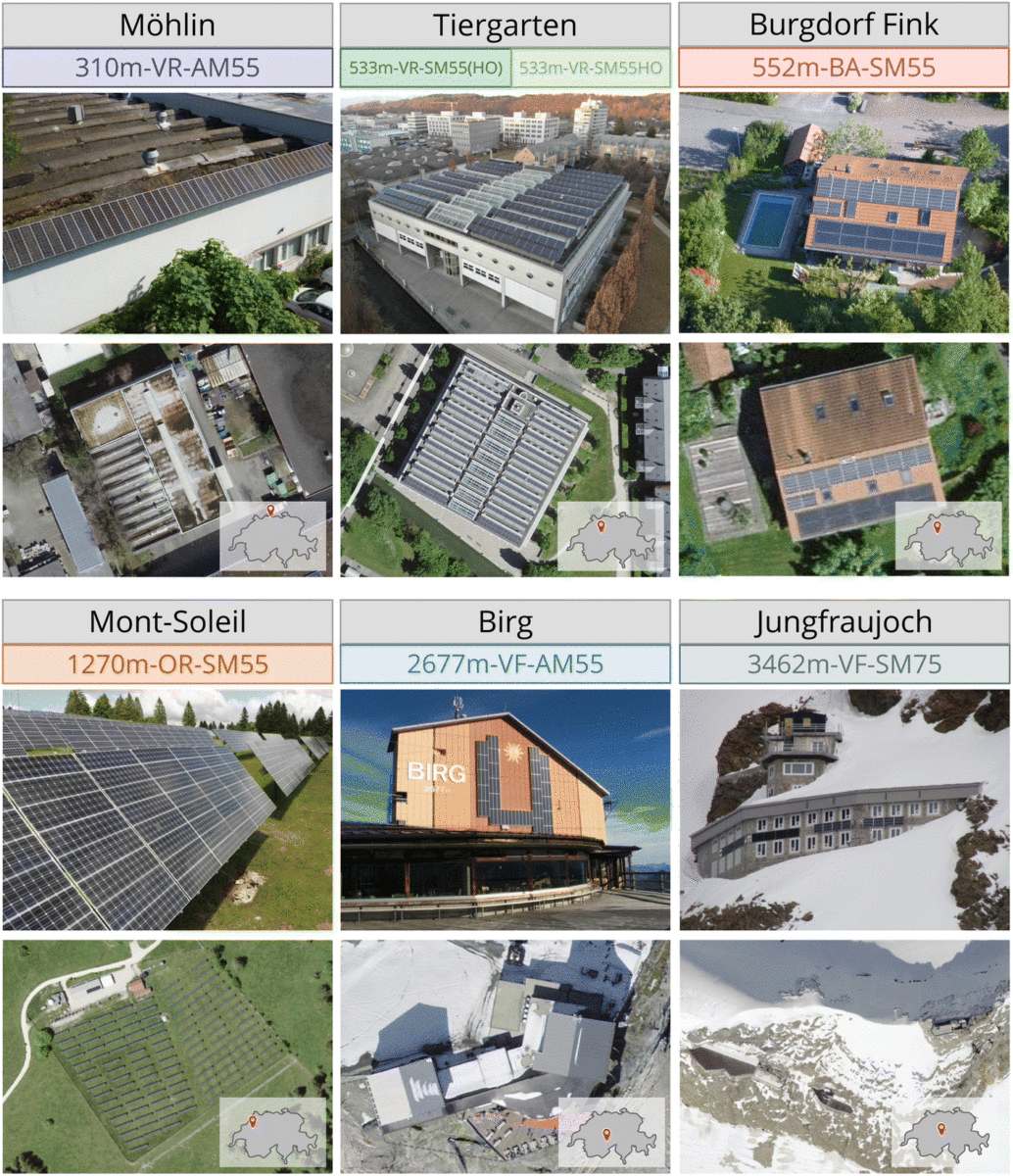
The study examined four low-height roof systems in Möhlin (310m-VR-AM55), Tiergarten East and West in Burgdorf (533m-VR-SM55(HO)) and Burgdorf Fink (552m-BA-SM55). These installations use ventilated or built-in roof configurations. The analysis also included a mid-height utility-scale plant at Mont-Soleil (1270m-OR-SM55) and two high-height facade-mounted systems at Birg (2677m-VF-AM55) and Jungfraujoch (3462m-VF-SM75).
All systems are equipped with ARCO AM55 modules manufactured by the American Arco Solar, the world’s largest PV manufacturer with only 1 MW capacity at the time, or Siemens SM55, SM55-HO and SM75 modules. Siemens became the largest shareholder of Arco Solar in 1990. The modules are rated at between 48W and 55W and consist of a glass faceplate, ethylene-vinyl acetate (EVA) encapsulation layers, monocrystalline silicon cells and a polymer backsheet laminate.
The test setup included on-site monitoring of AC and DC power, ambient and module temperatures, and plane-of-array irradiance measured using pyranometers. Based on site conditions, the researchers classified the installations into low-, mid- and high-altitude climate zones.
“For benchmarking purposes, two Siemens SM55 modules have been stored in a controlled indoor environment in the photovoltaic laboratory of the Bern University of Applied Sciences since the start of the monitoring campaign,” the researchers said. They also applied the multi-year year-over-year (multi-YoY) method to determine system-level performance loss rates (PLR).
The results show that the OURs for all systems range from -0.12% to -0.55% per year, with an average of -0.24% to -0.16% per year, well below the typical degradation rates reported for both older and modern PV systems. The researchers also found that higher-altitude systems generally exhibit higher average performance ratios and lower degradation rates than comparable low-altitude installations, despite exposure to higher irradiation and ultraviolet radiation.
The study further showed that modules of the same nominal type but with a different internal design exhibit clearly different degradation behavior. Standard SM55 modules had recurring solder joint errors, leading to increased series resistance and lower fill factor. SM55-HO modules, on the other hand, benefited from a modified backsheet design that provides higher internal reflection and improved long-term stability.
Overall, the findings indicate that the long-term degradation of first-generation PV modules is mainly caused by thermal stress, ventilation conditions and material design, and not only by altitude or irradiation. Modules installed in cooler, better ventilated environments showed particularly stable performance over decades.
The test results were presented in the article “Three decades, three climates: environmental and material implications for the long-term reliability of photovoltaic modules”, published in EES solar energy.
“The study found that the Bill of Materials (BOM) is the most critical factor affecting the service life of PV modules,” they concluded. “Despite all modules belonging to the same product family, variations in the quality of the encapsulants, filler materials and manufacturing processes resulted in significant differences in degradation rates. First generation encapsulants without UV stabilization showed accelerated aging, while later module designs with optimized backplates and improved manufacturing quality showed excellent long-term stability.”
This content is copyrighted and may not be reused. If you would like to collaborate with us and reuse some of our content, please contact: editors@pv-magazine.com.
