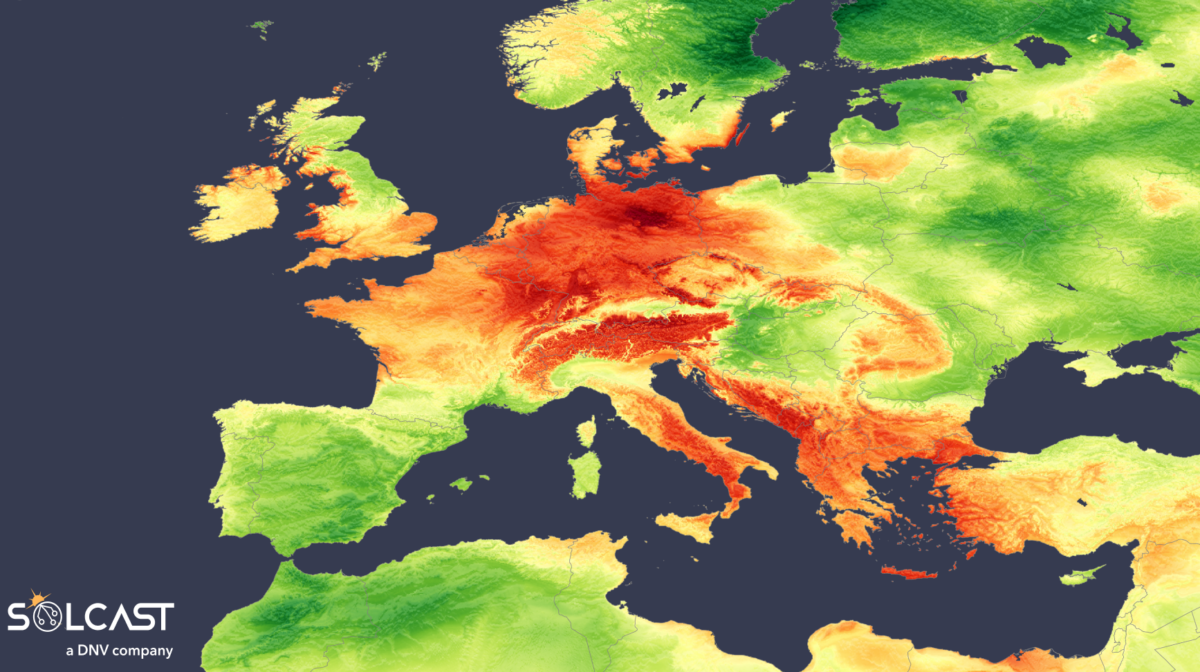
In a new weekly update for pv magazineSolcast, a DNV company, reports that Central Europe, led by Germany, saw strong solar generation in December due to clear skies from a blocking weather pattern, while Iberia, Scandinavia and Eastern Europe saw reduced insolation due to storms and cloud cover. Arctic cold and snowfall in the late months further suppressed PV production in Eastern Europe due to snow pollution, exacerbating already weak solar conditions.
Central parts of Europe provided relatively strong solar power generation conditions through December 2025, as high pressure held back Atlantic moisture and kept skies clearer than normal. By contrast, storm systems elsewhere reduced insolation, and a cold outbreak at the end of the month caused snow pollution in the east of the continent. According to analysis using the Solcast APIGermany and neighboring regions recorded the strongest irradiance anomalies, while the Iberian Peninsula, Scandinavia and Eastern Europe showed widespread underperformance.
Germany, the Low Countries and around the Eastern Mediterranean recorded the best conditions for PV generation in December. Throughout Germany, the estimated irradiation was 20-30% above the monthly average, with deviations of 15% in the Netherlands, Belgium and the Swiss Alps. Southern Italy, Greece and parts of the Balkans also had insolation levels 10 to 20% above normal. A negative North Atlantic Oscillation phase created a blocking pattern that diverted Atlantic moisture away from central and southeastern Europe, allowing increased solar radiation.
Meanwhile, much of the rest of Europe experienced continued cloud and storm activity. Spain and Portugal experienced reductions in radiation intensity that were 15-20% below average, alongside similar deficits in Scandinavia and parts of Eastern Europe. The British Isles fared
slightly better, but still recorded radiation values about 10% below the standard.

The pattern was caused by persistent low-pressure systems over the Atlantic coast, which brought successive storms. Storm Bram hit Britain early this month, followed by Storm Emilia, which brought flooding and strong winds to the Iberian Peninsula in mid-month. Towards the end of December, Storm Joannes swept across Scandinavia, further depressing insolation and disrupting the regional energy infrastructure.
Despite monthly average temperatures 1 to 3 C above average across much of Europe, the arrival of Arctic air behind Storm Joannes during the last week of the month resulted in an abrupt cold outbreak in the east. This late blast of Arctic air caused widespread snowfall in Eastern Europe, exacerbating the impact of low irradiation with significant losses from snow pollution.
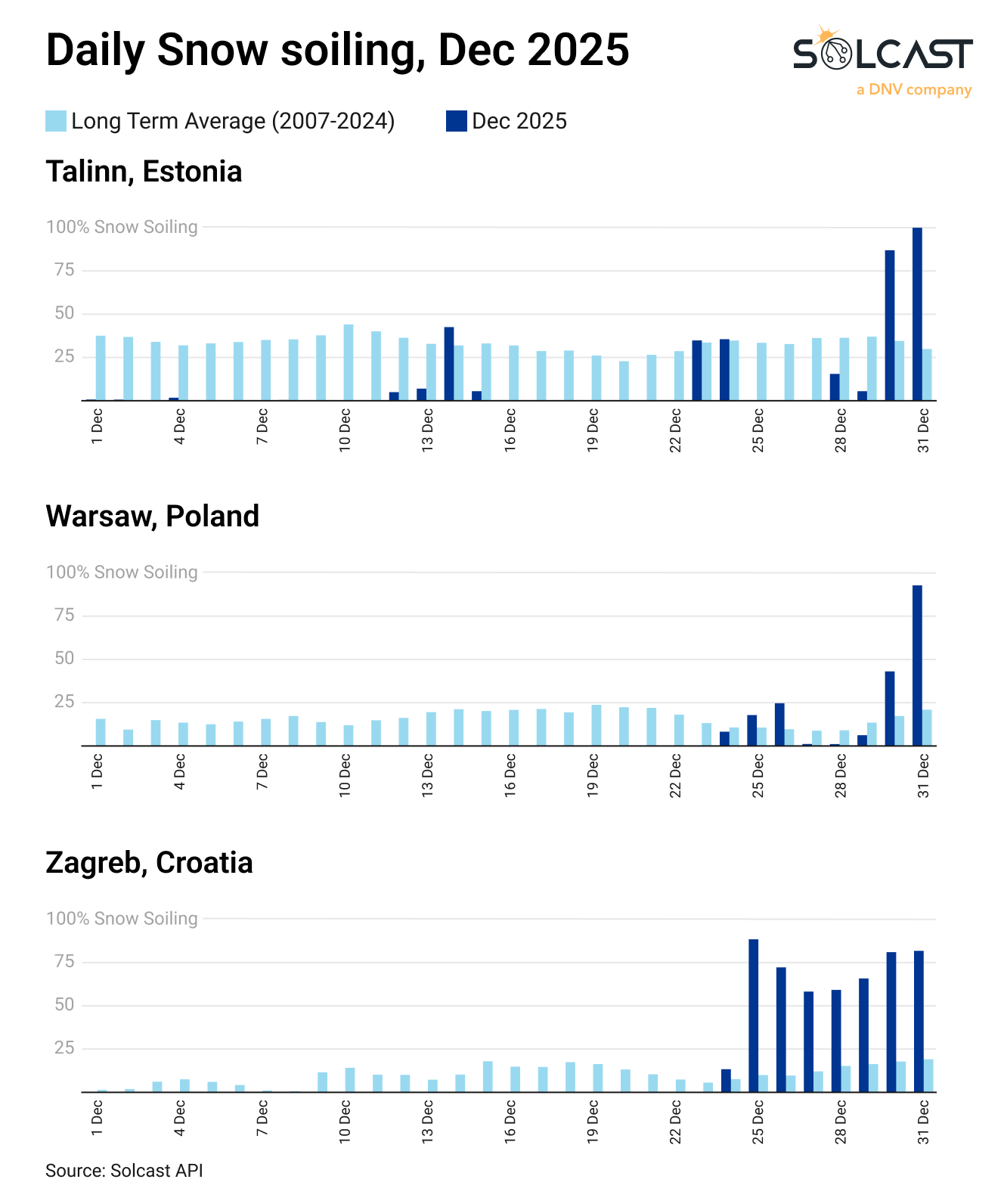
Snowfall can significantly impact PV generation due to snow pollution, where snow builds up on panels and blocks incoming sunlight. This impact can be reduced by cleaning the panels. Thus, the snow pollution estimates in the graph represent a worst-case scenario, assuming snow remains on the panels. Cities such as Tallinn, Warsaw and Zagreb had the potential for very high pollution losses during this period, with snow accumulation severely reducing irradiation at the PV panels. In contrast, Zurich experienced a relatively snow-free month, with pollution losses well below average.
Solcast produces these figures by tracking clouds and aerosols worldwide at a resolution of 1-2 km, using proprietary satellite data AI/ML algorithms. This data is used to drive irradiance models, allowing Solcast to calculate high-resolution irradiance, with a typical deviation of less than 2%, as well as cloud tracking predictions. This data is used by more than 350 companies that manage more than 300 GW of solar energy worldwide.
The views and opinions expressed in this article are those of the author and do not necessarily reflect those of the author pv magazine.
This content is copyrighted and may not be reused. If you would like to collaborate with us and reuse some of our content, please contact: editors@pv-magazine.com.
Popular content