

Chinese researchers developed an all-perovskite tandem solar cell using a non-contact laser polishing strategy that reduces surface defects and improves charge extraction in lead-tin perovskite films. The device achieved tandem efficiency up to 29.80%, with the bottom cell improving from 19.64% to 24.07% and showing strong operational stability under continuous illumination.
Researchers from Huazhong University of Science and Technology in China have developed an all-perovskite tandem solar cell using a non-contact laser polishing strategy that reportedly improves the surface morphology of perovskite films and improves device performance.
The scientists explained that although all-perovskite tandem photovoltaic devices have achieved significant efficiency levels, they still suffer from voltage losses and low fill factors. In the bottom narrow band gap (NBG) mixed tin lead (Sn-Pb) cell, these losses mainly arise from interfacial defects at the junction between the perovskite absorber and the buckminsterfullerene (C₆₀) electron transport layer (ETL).
Furthermore, asynchronous crystallization of tin (Sn) and lead (Pb) based precursors introduces structural and compositional defects, while current manufacturing methods further exacerbate these problems due to slow solvent removal. High quality perovskite films also tend to exhibit large grains with rough surfaces, leading to poor interfacial contact, increased shunting risks, and reduced carrier extraction.
Existing approaches, including solvent engineering, additive strategies, and chemical or mechanical polishing, have improved film quality but remain limited in selectivity, controllability, or scalability. To address these challenges, the research team developed a non-contact laser polishing strategy that precisely removes defective surface layers without damaging the underlying perovskite.
The academics prepared the Pb-Sn bottom cell perovskite films using vacuum-driven percrystallization (VDP) and found that they exhibited rough, defective surfaces that hinder the extraction of interfacial charge at the perovskite/C₆₀ interface, leading to shunting hazards and non-radiative recombination. To solve this problem, they used a non-contact picosecond ultraviolet laser polishing technique to improve the surface quality of films. The laser selectively removes defective and rough surface layers without damaging the underlying perovskite, reducing compositional inhomogeneity and Sn-related defects.
The newly exposed surface is then reconstructed to recover a high-quality perovskite phase with improved interfacial properties. The films were spin coated, vacuum quenched for rapid crystallization, annealed, and then surface treated with ethane 1,2-diammonium iodide (EDAI2). They were then deposited onto the glass-ITO substrate via a controlled spin-coating and gas-assisted crystallization process. Post-treatment included p-phenylenediamine iodide (PDAI₂) surface passivation, followed by C₆₀, SnO₂ (ALD) and ultrathin Au interlayers.
Tested under standard lighting conditions, the bottom cell, treated with the new polishing technique, achieved an efficiency of 21.65%, compared to 19.64% for a reference device. It also reached 24.07% after surface reconstruction.
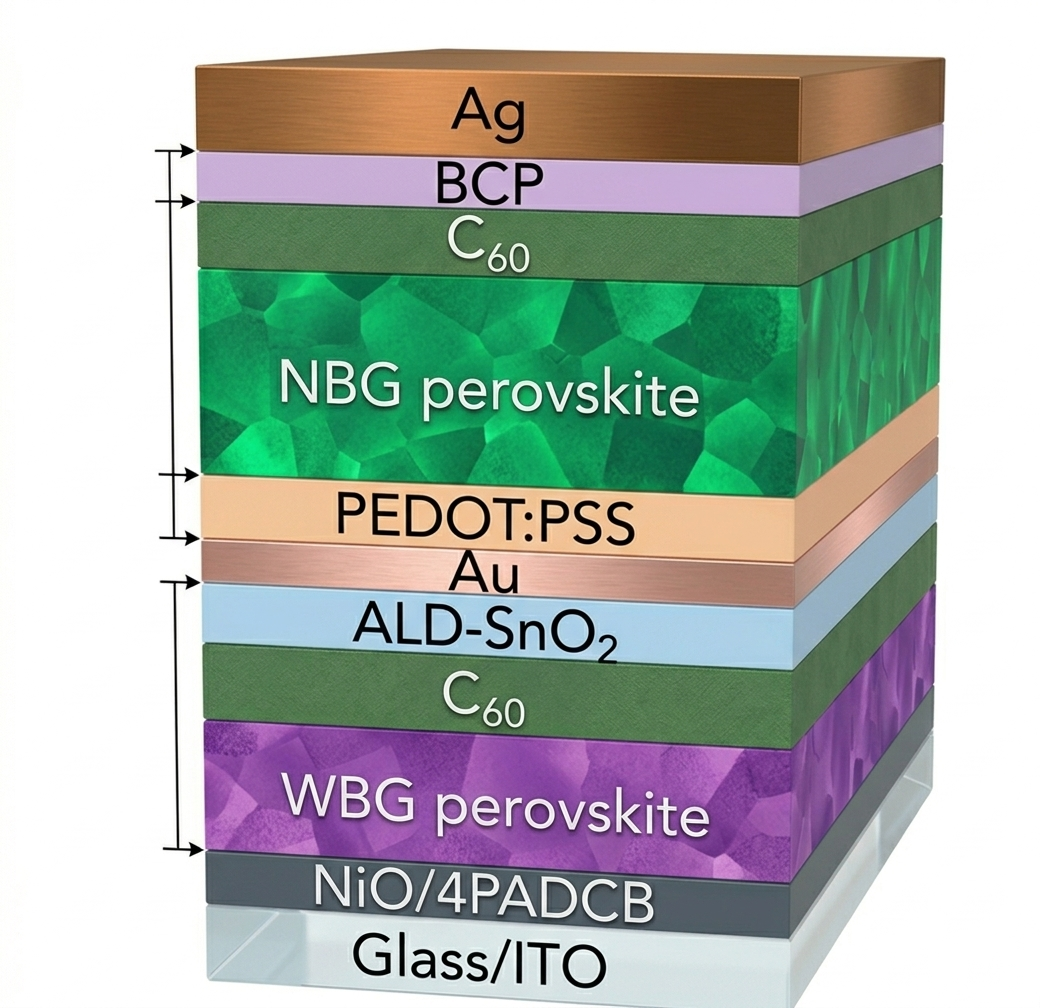
The tandem solar cell was fabricated on a glass substrate coated with indium tin oxide (ITO), a NiO-based tunnel recombination compound, a self-assembled monolayer known as 4PADCB as a hole transport layer (HTL), a wide bandgap perovskite absorber (WBG), a C₆₀/SnO₂ electron transport layer (ETL) deposited via atomic layer deposition (ALD), a gold (Au) contact, a PEDOT:PSS HTL, a narrow band gap perovskite absorber (NBG), a second C₆₀ ETL, a bathocuproin (BCP) buffer layer and a silver (Ag) metal contact.
Based on this architecture, the all-perovskite tandem solar cell achieved an unprecedented energy conversion efficiency of 29.80%, with an open-circuit voltage of 2.16 V, a short-circuit current density of 16.60 mA cm⁻² and a fill factor of 83.12%. It also delivered a steady-state efficiency of 29.18% and retained approximately 80% of its initial performance after 650 hours of continuous use under 1 sunlight.
“The proposed surface conversion strategy effectively eliminates the key bottleneck in the surface effects of different perovskite compositions, paving the way for universal performance improvement,” the scientists said.
The new cell design was presented in “Contactless laser polishing and reconstruction to highly efficient all-perovskite tandem solar cells”, published in communication about nature.
This content is copyrighted and may not be reused. If you would like to collaborate with us and reuse some of our content, please contact: editors@pv-magazine.com.
