Scientists in Morocco have devised an experimental-numerical model to quantify how fly ash pollution affects photovoltaic (PV) modules, capturing both optical losses and thermal effects. Their findings show that while dust layers can reduce panel temperatures, fly ash significantly degrades efficiency in a non-linear manner, highlighting the need for predictive models for real solar performance.
A research team from Morocco has quantified the impact of fly ash accumulation on PV modules using a combined experimental and numerical approach. By coupling experimental validation with numerical modeling, the group could provide a framework for assessing and predicting pollution-induced thermal and optical effects.
“Our paper synthesizes experimental validation, realistic simulation and coupled optothermal-electrical modeling while demonstrating practical operational applicability,” corresponding author Kamal Fadil shared. pv magazine. “This work not only advances our scientific understanding of the fouling mechanisms of photovoltaic cells, but also contributes to the development of sustainable, intelligent and energy-efficient maintenance strategies for future solar energy systems.”
Fadil highlighted that their model specifically characterized fly ash, a very fine dust mainly produced by combustion processes, such as road traffic emissions and industrial discharges. “Our framework performs a comprehensive evaluation of the influence of different types of pollution, taking into account their optical attenuation and specific thermal effects on photovoltaic performance. This facilitates a more representative interpretation of real operating conditions found in urban, industrial and highway environments, among others,” he added.
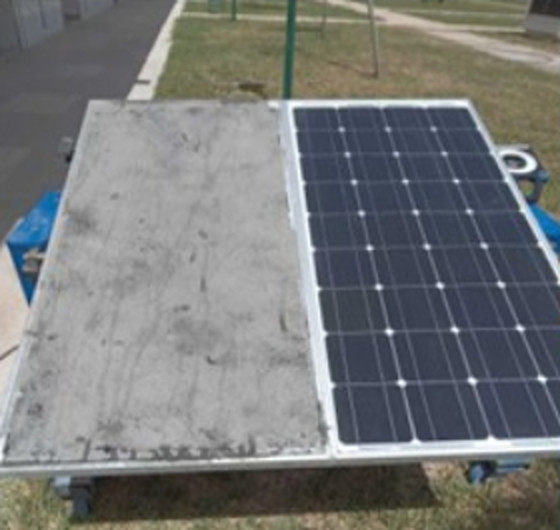
The research started with a test bench containing two identical monocrystalline silicon PV panels of 0.54 m², with a tilt angle of 35° and an azimuth angle of 0°. In three experiments, coal fly ash was applied to one of the panels, each with a different particle size: up to 20 μm, 20–45 μm and 45–63 μm. Both panels were exposed to sunlight outside during sunny periods, from 9 a.m. to 5 p.m.
Image: Scientific Engineer Laboratory for Energy (LabSIPE), Next Energy, CC BY 4.0
At the same time, the researchers built a two-dimensional thermal model of the PV modules. It included solar radiation on the front glass, natural convection on the front and back surfaces, and heat conduction through the internal layers caused by photon thermalization. The predicted temperatures were compared to bench thermocouple measurements and showed excellent agreement, with a Pearson correlation of 0.997, a coefficient of determination (R²) of 0.994, a root mean square error (RMSE) of 0.79 C and a mean absolute error (MAE) of 0.62 C.
“The numerical framework is strengthened by the integration of experimentally measured environmental and operational parameters, including climatic conditions, geometric configuration, thermophysical properties of photovoltaic modules, optical characteristics of the deposited particles and varying fouling densities,” said Fadil. “This improvement in the physical representativeness of the model leads to an improvement in its applicability to photovoltaic engineering tasks, including predicting energy yield, assessing degradation, estimating losses and sizing mini-photovoltaic power plants operating in polluted environments and future installation areas.”
According to the experimental results, the clean panel reached higher temperatures of 70–72 C, while the fly ash panel stabilized at 60–62 C due to the insulating effect of the deposited particles. However, despite being cooler, the dirty panel performed worse: efficiency started at 14% compared to 16.5% for the clean panel at 25 C, and both dropped to around 8% at high operating temperatures.
“A striking finding of this study was the strong thermal amplification effect associated with fly ash accumulation. Although prevailing wisdom attributes losses in electrical efficiency solely to optical losses, the results showed that thermal accumulation can significantly intensify the degradation of this efficiency,” the researcher concluded. “Another striking observation reported in this study is that the relationship between pollution density and photovoltaic losses is not strictly linear under certain operating conditions, especially when thermal effects become dominant.”
The research work was presented in “Quantitative Assessment of Fly Ash Pollution in Solar Photovoltaics: Experimental Validation and Predictive Modeling”, published in Next energy. Scientists from the Moroccan Science Engineer Laboratory for Energy (LabSIPE), the National School of Applied Sciences and Chouaib Doukkali University contributed to the research.
This content is copyrighted and may not be reused. If you would like to collaborate with us and reuse some of our content, please contact: editors@pv-magazine.com.
Popular content