

In a new weekly update for pv magazineOPIS, a Dow Jones company, provides a brief overview of the major price trends in the global PV industry.
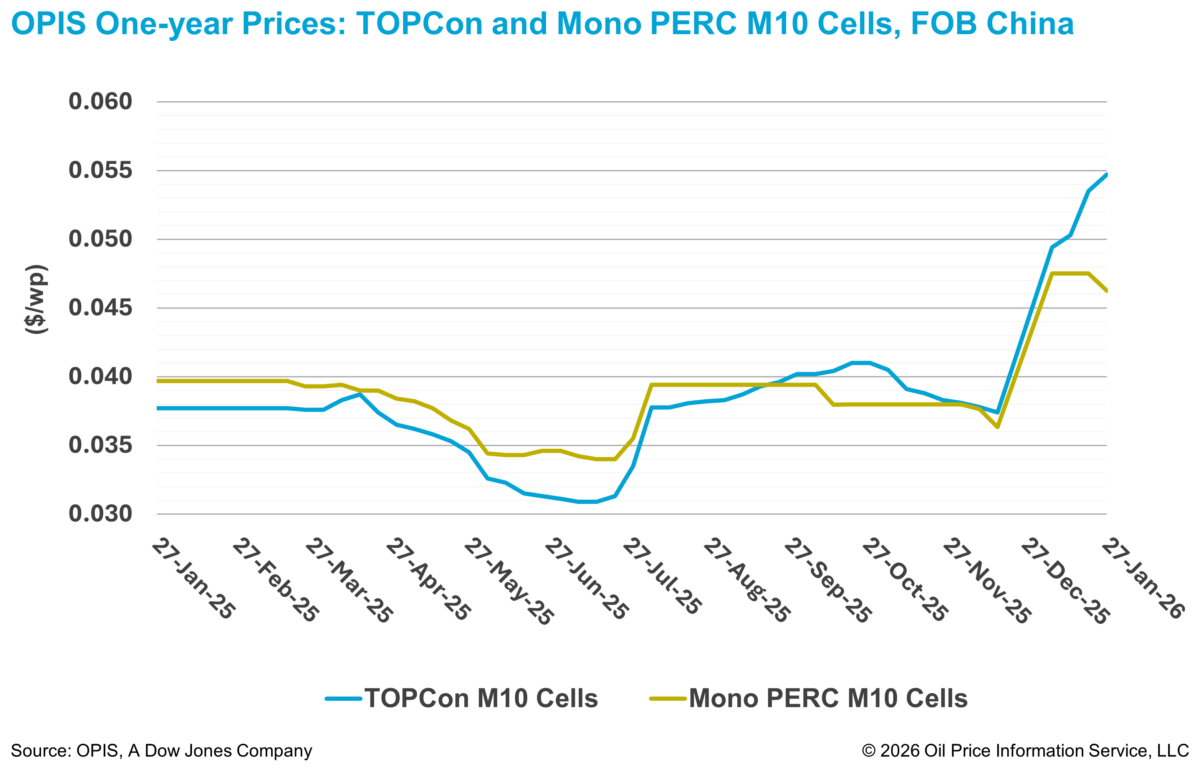
Chinese TOPCon cell prices rose for the fourth week in a row, led by higher production costs due to rising silver prices and ongoing discussions about eliminating export tax credits. In contrast, PERC cell prices fell due to declining demand, driven by the industry’s ongoing technology shift to TOPCon cells, trading sources said.
According to the OPIS Global Solar Markets Report published on January 20, Chinese TOPCon M10 cell prices were assessed 2.24% higher this week at $0.0547/W Free-On-Board (FOB) China. Meanwhile, FOB China Mono PERC M10 cells fell 2.53% to $0.0463/W over the same period.
Join us on January 28 for pv magazine Webinar+ | The Solar Module Market Playbook: Managing Prices, Risks, and Other Procurement Challenges.
We analyzed real-time market data and provided insights to help EPCs, developers, investors and distributors secure high-quality PV modules at competitive prices, ensuring project financeability.
Silver prices have soared to record highs and are up more than 40% this year, driven by rising industrial demand and increased investment flows. Chinese policy developments have also further tightened the market, with authorities introducing silver export restrictions until 2027.
Under the new framework, only 44 approved companies are allowed to export silver under a quota-based licensing system, which requires exporters to obtain approval for overseas shipments.
Market sources said silver prices have become a key variable for cell prices as silver now represents one of the largest cost components in the production of TOPCon cells. Several sources noted that even if upstream prices soften from the second quarter of 2026, cell and module prices are unlikely to retreat to 2025 price levels if silver prices remain elevated.
Since the beginning of this year, prices for downstream OPIS TOPCon cells have increased by 46%, while prices for TOPCon modules have increased by almost 35%. Upstream cost increases were more modest, with OPIS China Mono Premium – OPIS’ rating for mono-grade polysilicon used in the production of N-type ingots – rising 0.15% and N-type wafer prices rising around 13% over the same period.
This week, the upstream polysilicon and wafer segments showed early signs of weakness, with OPIS China Mono Premium and N-type M10 wafers down 2.34% and 2.20% respectively. In contrast, FOB China TOPCon modules continued to increase by 3.48% over the same period.
According to the China Nonferrous Metals Industry Association (CNMIA), sentiment in the wafer segment remained cautious this week, with upstream and downstream players in a stalemate. Despite continued price increases in cells and modules, driven by changes in export tax rebate policies and rising silver prices, price increases have yet to be effectively implemented upstream.
CNMIA noted that domestic end demand remains sluggish and that cost pressure has made cell manufacturers increasingly reluctant to accept expensive wafers, leading to few orders for wafer purchases.
Because downstream demand is unlikely to meaningfully recover before the Lunar New Year and polysilicon prices show signs of weakening, the wafer market is expected to remain weak in the near term, the association said.
Downstream sources added that higher production costs, combined with weak end-user module demand, could limit cell production levels in the longer term.
Market analysts previously predicted that Chinese installation demand will fall by more than 20% by 2026, due to the transition from feed-in tariffs to a market-based pricing mechanism for electricity. Moreover, the planned removal of export tax credits could weigh on foreign demand, reinforcing the bearish demand outlook for cells later this year, sources said.
OPIS, a Dow Jones company, provides energy prices, news, data and analysis on gasoline, diesel, jet fuel, LPG/NGL, coal, metals and chemicals, as well as renewable fuels and environmentally friendly feedstocks. It acquired assets with pricing data from Singapore Solar Exchange in 2022 and now publishes the OPIS APAC Solar Weekly Report.
The views and opinions expressed in this article are those of the author and do not necessarily reflect those of the author pv magazine.
This content is copyrighted and may not be reused. If you would like to collaborate with us and reuse some of our content, please contact: editors@pv-magazine.com.
Popular content
